
Most of us assume that intelligence requires a brain. Cognition is something that happens in nervous tissue. Memory, decision-making, and pattern recognition are the exclusive property of animals complex enough to have evolved a centralised neural architecture.
However, a study out of Tohoku University in Japan is making that assumption harder to hold.
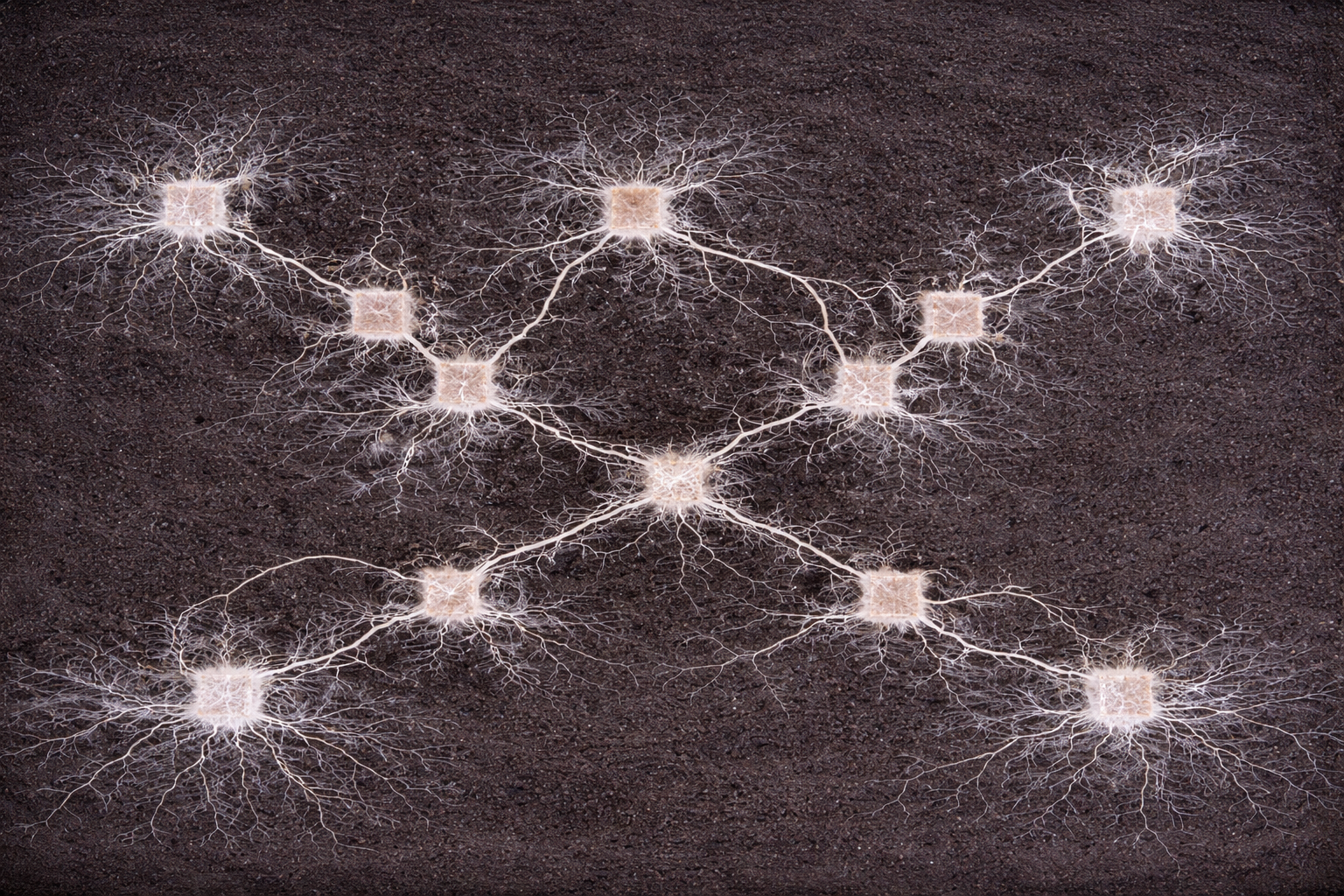
Researchers there set up a deceptively simple experiment. They took a wood-decaying fungus called Phanerochaete velutina, grew it on small wooden blocks, and arranged those blocks in two configurations: a circle and a cross. Then they left it alone and watched what happened over 116 days.
What they found was not what you’d expect from something with no brain, no nervous system, and no sensory organs.
The Experiment
In the circle arrangement, the degree of connection between blocks was uniform, with no significant differences observed across positions. In the cross arrangement, the outer blocks exhibited a greater degree of connection than the inner blocks. The mass loss of the wood blocks was positively associated with the degree of connection, and was significantly smaller in the cross than in the circle arrangement.
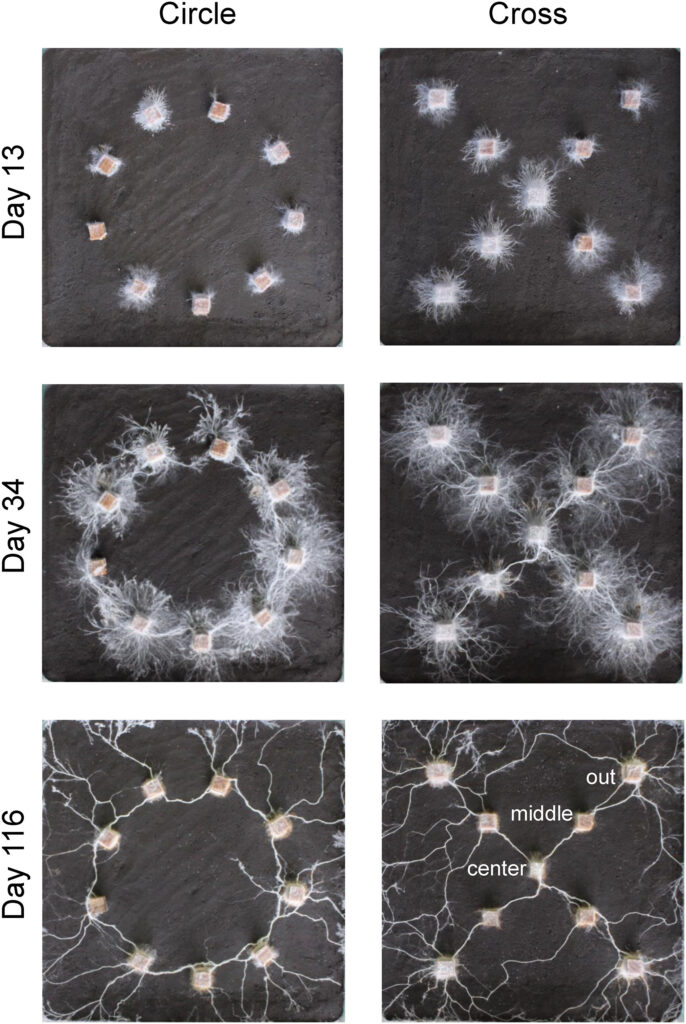
To understand why that matters, you need to know what the fungus was actually doing. The mycelium spread out from a central point until it encountered other tendrils from neighbouring blocks. Those tendrils linked up, forming and strengthening connections. Then the excess tendrils were retracted, and the mycelium started behaving as one unit, sending out strands in directions most likely to result in successful foraging.
It pruned, reorganised, and redirected resources toward the most productive areas and pulled back from the ones that weren’t worth colonising.
In the circle setting, the fungus barely grew into the ring’s interior. The theory is that the mycelial network communicated and determined that growing into an already-occupied area was of little advantage. In the cross configuration, the four exterior blocks’ growth areas served as outposts for foraging missions.
The researchers had set a clear benchmark at the start: if the fungus had no capacity to perceive and respond to its environment, it should spread indiscriminately. It didn’t. It spread strategically.
What This Means
The study, published in Fungal Ecology in September 2024, reveals that these seemingly simple organisms possess a level of basal cognition that challenges our understanding of intelligence.
The lead researcher, Yu Fukasawa, put it plainly: “You’d be surprised at just how much fungi are capable of. They have memories, they learn, and they can make decisions. Quite frankly, the differences in how they solve problems compared to humans is mind-blowing.”
That’s not a fringe position. Fungal biologist Nicholas P. Money at Miami University, who wasn’t involved in the study, described the findings as novel evidence of fungi’s spatial memory, and said the field has only in the last two to three years begun to seriously reckon with fungal sensitivity to environment, a phenomenon he believes has been critically overlooked.
What’s particularly striking is the mechanism. There is no command centre here. No region of the mycelial network acting as a brain, integrating information and issuing instructions. The cognition, if we can call it that, is distributed. The whole network processes, adjusts, and responds collectively. Information about the shape and arrangement of resources appears to propagate through the mycelium until the entire organism has, in some functional sense, a model of its environment.
We’ve covered the science behind why this is possible in detail before. A landmark study in Network Neuroscience Theory found that human intelligence doesn’t reside in a single region like the prefrontal cortex. Rather, general intelligence emerges from the topology of the whole brain – meaning how it’s wired, how weakly connected nodes talk to each other across long distances, and how certain hub regions orchestrate the symphony. Mycelial networks have all of that. If you want to understand the architecture behind what this fungus is doing, that piece is worth reading first.
Fukasawa and his team are now investigating the mechanisms behind this, specifically studying the electrical signal transfer across mycelium as a potential explanation for how the network communicates spatial information.
The Big Question
Fukasawa’s team didn’t set out to make a philosophical argument. They set out to study wood decay. But the implications of what they found reach well beyond forest ecology.
Fukasawa noted that one of the major takeaways is the challenge it poses to the prevailing view that consciousness is necessary for cognitive abilities like decision-making and memory. “Our result on fungal intelligence may help people to notice that many parts of intelligent behaviour of organisms can be achieved without brain and consciousness.”
This goes against the dominant neurocentric model of cognition that says intelligence lives in brains, in neurons, and in the electrochemical chatter of nervous tissue. Everything else is mechanism, reflex, chemistry. Under that model, a fungus routing its growth around an empty space isn’t thinking, it’s just doing what fungal chemistry compels it to do.
But that distinction starts to collapse when you look closely enough. Because what is the brain doing, exactly, if not routing signals through a network, strengthening connections that prove useful and pruning ones that don’t? The architecture is different. The substrate is different. And the scale is different. But the underlying logic, remarkably, isn’t.
Money put it directly: “When we look at the level of the individual cells, it’s not like human cells are any more complicated than the cells of any other organism on earth. Studying the sensitivity of individual cells may give us clues to how the human brain works in the future.”
A Different Model of Mind
There’s a broader conversation happening at the edges of neuroscience and philosophy of mind right now, one that fungi keep showing up in. The question of whether cognition requires centralisation, whether a mind needs a brain or whether it just needs an information-processing network capable of adapting to its environment, is no longer purely theoretical.
Slime moulds solve mazes. Octopuses think partly through their arms. And now a wood-rotting fungus in a Japanese lab is recognising shapes and allocating foraging resources accordingly.
None of this means fungi are conscious in the way you and I are conscious. What it does mean is that the threshold for something we’d call cognitive behaviour keeps getting lower, simpler, and older than we thought.
Fungi have been doing this for hundreds of millions of years. They were building distributed information-processing networks in forest soil long before animals with brains appeared. It’s only now we’re starting to realise just how smart they are.
Want to Apply This?
The same principles at work in fungal networks (distributed processing, no central command, intelligence emerging from the right conditions) apply directly to your brain.
Most cognitive decline isn’t inevitable. Brain fog, poor focus, low motivation, and mental fatigue are signs that the systems powering your brain (mitochondria, metabolism, sleep, minerals, light exposure) are out of alignment with how your biology is designed to work.
The Decentralised Brain Protocol is a 7-day reset built around that idea. Fix the inputs, and clarity returns naturally.
Get the Decentralised Brain Protocol



3 thoughts on “Fungi Think. We Just Proved It.”