There are drugs in the food supply.
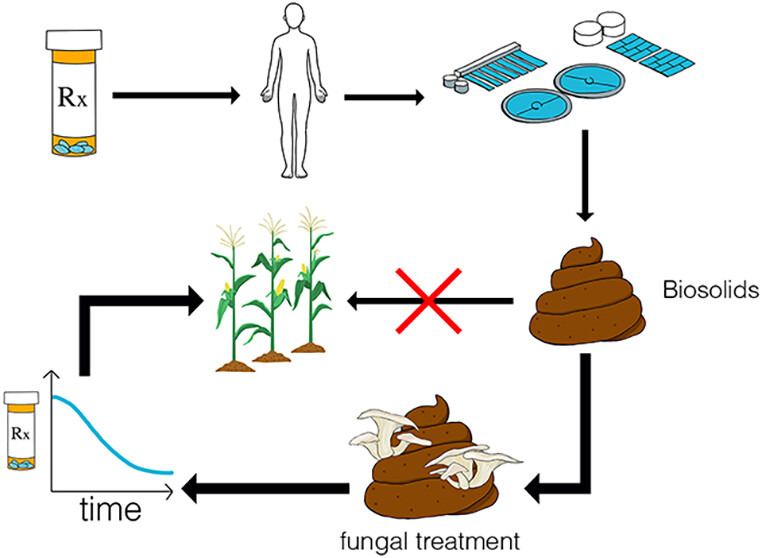
It’s a contamination problem that rarely makes headlines, and it goes something like this. You take a course of antidepressants or some other drug. Your body metabolises some of it, but not all. The rest exits through your urine, enters the sewage system, and gets processed at a wastewater treatment plant.
That plant does an excellent job of killing pathogens and filtering out heavy metals. Then it produces a nutrient-rich solid byproduct called biosolids (essentially treated sewage sludge) and that gets spread across farmland as fertiliser.
The drugs come with it.
Conventional wastewater treatment methods are effective at killing pathogens and reducing metals, but they are far less successful at neutralising complex organic chemicals. Antidepressants, antipsychotics, anticonvulsants are molecules engineered to be pharmacologically active at low concentrations, which means they don’t need to survive in high doses to have an effect. And they’re turning up in soil, in water systems, and in trace amounts in crops grown in biosolids-amended earth.
It’s a problem that nobody has had a solution to. Until now, thanks to a new study from Johns Hopkins.
What the Research Found
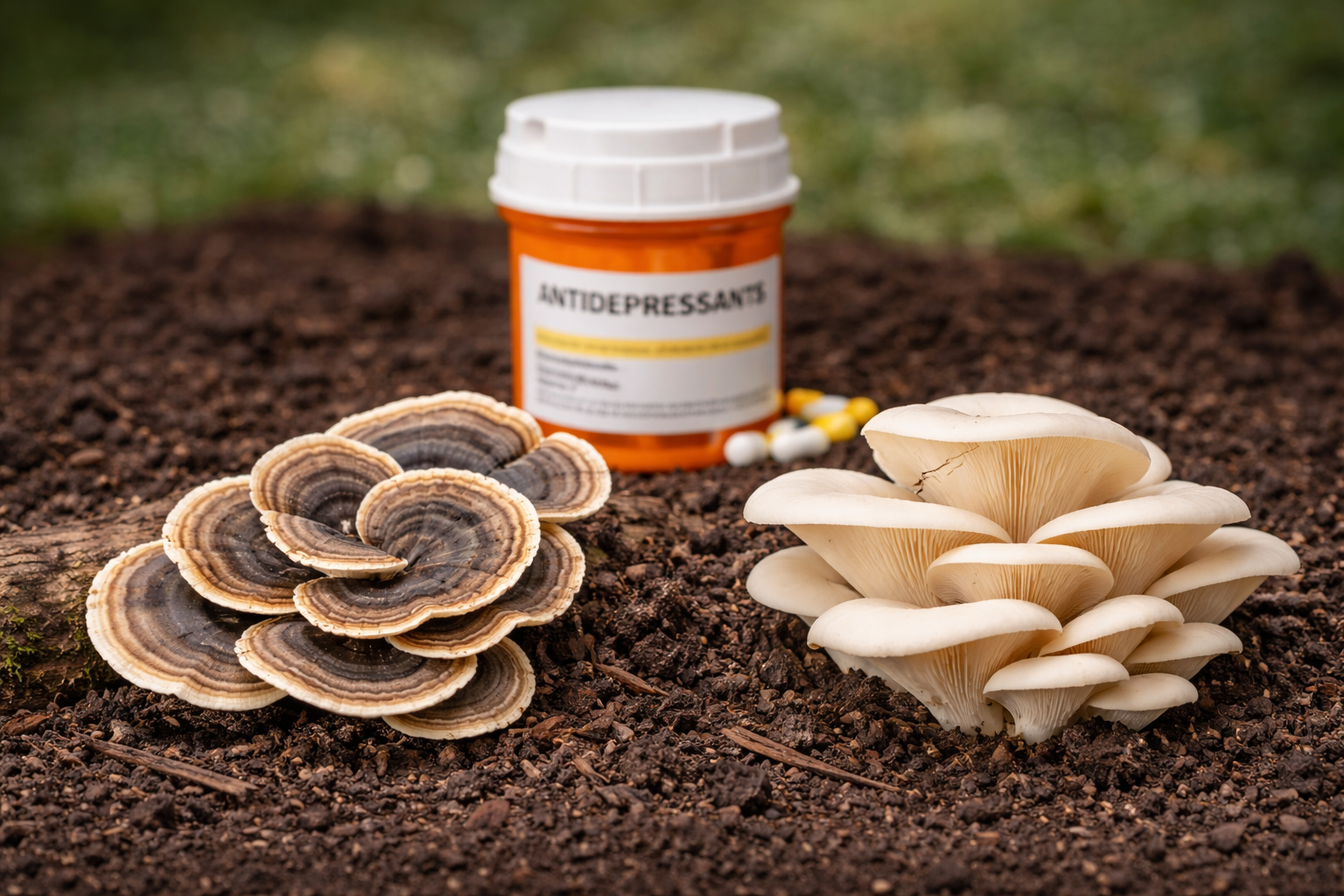
Researchers in the Johns Hopkins Department of Environmental Health and Engineering have shown that two species of white-rot fungi (oyster mushrooms and turkey tail) can degrade a wide range of psychoactive pharmaceuticals commonly found in biosolids. The study demonstrates that these fungi can break down many persistent drug compounds before biosolids are applied to farmland, potentially reducing environmental and public health risks.
The researchers took biosolids from a municipal wastewater treatment plant and spiked them with nine psychoactive drugs, including commonly used antidepressants such as citalopram and trazodone. They then introduced the two fungal species and measured what happened over 60 days.
The results showed that each species degraded eight of the nine compounds, achieving removal efficiencies between 48 and 99%. Oyster mushrooms nearly completely degraded desvenlafaxine, trazodone, and citalopram (all above 90% removal) while turkey tail achieved over 75% degradation of desvenlafaxine, trazodone, and lamotrigine.
Critically, chemical analyses showed that the fungi were not simply trapping the drugs but chemically transforming them. This is important because sequestration (where a contaminant binds to the fungal mass and stays there) is very different to degradation. The fungi were actually breaking these molecules apart, rendering them harmless.
A Fungi Superpower
Turns out this special ability to break down chemical is something unique to fungi. The reason why is found in the evolutionary history of white-rot fungi and what they’ve spent millions of years learning to digest.
White-rot fungi are known for their ability to decompose lignin, the tough polymer that gives wood its rigidity. Unlike many bacteria, fungi release powerful enzymes directly into their surroundings. These enzymes are “nonspecific,” meaning they can act on a wide range of complex molecules rather than targeting a single compound.
This is the key. Bacteria tend to evolve highly specialised metabolic pathways for breaking down specific molecules. It’s an efficient strategy for known substrates, but it makes them poorly equipped to handle novel synthetic compounds that didn’t exist until the 20th century. Fungi evolved a different approach. They release broad-spectrum enzymatic machinery into the surrounding environment and let it go to work on whatever complex organic matter happens to be there. Lignin. Dead wood. Pharmaceutical residues in sewage sludge. The enzymes don’t much care about the distinction.
It is their enzymatic flexibility that makes white-rot fungi well-suited for breaking down pharmaceuticals, which are tightly bound to organic matter in biosolids.
This enzymatic promiscuity is the same property that makes mycoremediation (using fungi to clean up contaminated environments) such a persistent area of scientific interest. It’s also why the two species chosen here are particularly well-suited. Oyster mushrooms and turkey tail are among the most studied and most widely available mushroom species. These aren’t exotic strains requiring specialist cultivation. They’re easy to grow at home and you can find them fruiting on dead wood in almost any temperate woodland.
Mycoaugmentation
The study’s authors frame their findings around the term mycoaugmentation. It refers to the intentional use of fungi as a strategy for treating biosolids prior to land application. Because white-rot fungi are widespread in nature and can grow on solid materials, they could potentially be integrated into existing biosolids management practices with relatively low energy and infrastructure requirements.
No need for an elaborate high-tech solution. The researchers suggest this simple, efficient, and well-understood solution could be integrated into the existing treatment pipeline before biosolids leave the facility. No new chemical inputs. No high-energy processes. Just fungi doing what fungi do.
The study was published in ACS Environmental Au and funded by the US Environmental Protection Agency. It’s early-stage research (a proof of concept rather than a deployable technology) but the direction is clear. The question now is how quickly the wastewater treatment industry is willing to take fungi seriously as infrastructure.
Given the track record of institutional adoption, don’t hold your breath. But the science is there.
If you’re interested in the science, culture, and evolving story of nature’s intelligence, our weekly newsletter The Spore Report is worth your time.
Read The Spore Report →