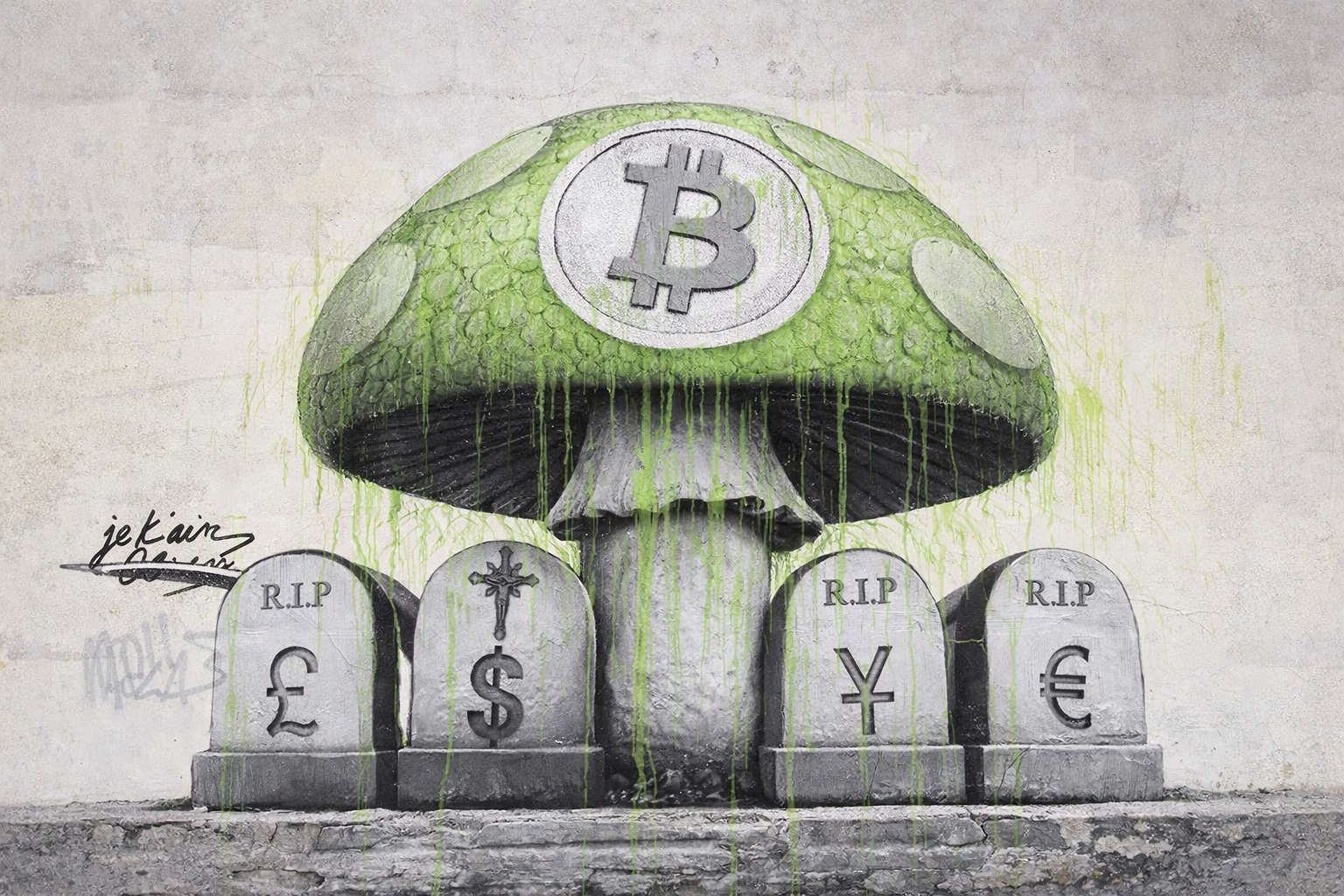
Brandon Quittem published one of the most interesting essays in the history of both mycology writing and cryptocurrency theory. We read it so you don’t have to.
There is a particular kind of essay that gets written when someone falls down two rabbit holes internet simultaneously and sees a connection. Brandon Quittem’s The Mycelium of Money is one of those essays. Originally published as a four-part series, it draws an extended parallel between Bitcoin and fungi. And while it has all the hallmarks of a crypto-enthusiast making their pet subject sound cosmic and inevitable, it also contains some sharp mycological thinking that deserves a closer look.
We’re not a Bitcoin publication. But we are a mycology publication, and when someone uses fungi as the central analogy for explaining the most disruptive monetary technology of the last century, we have something to say about it.
I’ll be honest about where I’m coming from. I’ve read a lot about Bitcoin. I don’t fully understand the technical architecture, but I understand game theory. And if Bitcoin is what it claims to be (genuinely decentralised, provably scarce, and cryptographically secure) then the logic of why it becomes humanity’s base layer of value makes sense. Neutral, apolitical, hard-capped money that no single actor controls tends to win, eventually, over money that can be inflated by whoever happens to hold power. It’s a pattern that’s played out acrooss history.
I think Quittem’s essay is, at its core, an attempt to explain why that pattern is biological as much as it is economic.
What Quittem Argues
The thesis, stripped down is this: Bitcoin and mycelial networks share a structural logic. Both are decentralised. Both have no single point of failure. Both adapt to their environment through distributed signal processing rather than top-down command. Both are, in Nassim Taleb’s language, antifragile. They get stronger under attack rather than weaker.
Quittem organises his argument across four chapters.
Chapter 1 establishes the structural parallel. Mycelium is a distributed intelligence network with no central brain, capable of routing information across vast distances, forming consensus about resource allocation, and adapting to environmental pressure in real time. Bitcoin’s node network, Quittem argues, works the same way. Miners, nodes, exchanges, and wallets each act like mycelial tips: semi-autonomous, locally responsive, collectively forming a consensus that no single actor controls.
Chapter 2 explores Bitcoin as a social phenomenon, using the mushroom’s reproductive cycle as a metaphor for hype cycles. When conditions are right, fungi throw up mushrooms – brief, spectacular, spore-releasing organs – before retreating underground again. Bitcoin’s bull markets function identically. The price spike is the mushroom. The underlying network development is the mycelium, growing whether anyone’s watching or not.
Chapter 3 frames Bitcoin as a kind of financial immune system, analogous to the role fungi play as planetary decomposers and ecosystem defenders. He draws on Paul Stamets’ research into fungi as antivirals (specifically the work on bees, Varroa mites, and fungal extracts) to argue that Bitcoin is the “antivirus” to the parasitic logic of central banking.
Chapter 4 goes furthest, positioning Bitcoin as a catalyst for human evolution through symbiosis, drawing a direct line from the ancient plant-fungi partnership that colonised dry land 500 million years ago to the current moment of monetary transformation.
It’s a lot. And it’s written with the kind of evangelical certainty that crypto attracts and that sceptics find easy to dismiss. The dismissal would be a mistake, though, because the underlying mycological framework is rigorous, and several of the parallels are genuinely illuminating.
Where the Analogy Holds
The decentralised intelligence argument is solid. Mycelial networks genuinely do exhibit something that looks like distributed decision-making. The slime mold experiment Quittem cites is real, peer-reviewed, and quite remarkable.
Published in Science in 2010 by Toshiyuki Nakagaki and colleagues, the study demonstrated that biological networks can solve optimisation problems with no central planner, no blueprint, and no conscious intent. The mechanism is elegant. The organism allocates more resources to pathways that are used more, and withdraws from those that aren’t. Efficiency emerges from feedback, not from design.
That is, structurally, how a proof-of-work blockchain works. No single entity decides which transactions are valid or which blocks get added. The consensus emerges from distributed computation across thousands of independent nodes. Whether you find Bitcoin compelling or not, the structural parallel to mycelial network logic is there.
The antifragility argument is well-grounded. Fungi have survived all five mass extinction events. They don’t rely on photosynthesis, which means they’re not dependent on the conditions that wipe out most of the biosphere. They decompose dead matter, meaning catastrophe, for fungi, is food. Quittem draws a parallel to Bitcoin’s behaviour during financial crises, and it’s a reasonable one.
The 2008 financial crisis was, in part, the catastrophe that birthed Bitcoin. Whether Bitcoin fulfils its long-term promise or not, its architecture was explicitly designed to survive the kind of centralised failures that brought down E-gold and other predecessors.
The horizontal gene transfer comparison is clever. Fungi don’t only pass genetic information vertically, from parent to offspring. They perform horizontal gene transfer, which means they can absorb genetic material from competing organisms in their ecosystem, integrating useful information from rivals. Quittem compares this to Bitcoin’s absorption of useful features from competing cryptocurrencies. It’s a stretch in some ways, but as a metaphor for how open-source protocols evolve, it’s more precise than it might first appear.
What Is Intelligence?
The most common objection is that Bitcoin involves human beings with ideologies, financial interests, political commitments, and tribal loyalties. Meanwhile, mycelial networks aren’t really intelligent. They don’t have goals, strategies, or beliefs. When a fungal network responds to a predator by synthesising a new enzyme, it isn’t “deciding” anything. It’s the aggregate output of chemical gradients, feedback loops, and evolutionary pressures.
How can you compare a religion-like social movement to a network of cells?
I understand the objection. I don’t buy it.
The assumption underneath it is that human cognition is categorically different from fungal behaviour, that our deliberate choices occupy a different ontological register entirely. But the more you look at how human beings actually behave in networks, the less confident you can be about that distinction.
Our ideologies, tribal loyalties, and financial interests are not free-floating rational choices. They are outputs of electrochemical gradients, reward feedback loops, and evolutionary pressures operating below the threshold of conscious awareness. We experience them as beliefs and intentions.
A sufficiently detached observer – something looking at human civilisation the way we look at a Petri dish – would likely see something much more like fungal network dynamics: distributed signal processing, resource routing, territorial defence, and reproductive cycles, running on a more complex substrate but obeying the same underlying logic.
Intelligence is a spectrum. Fungi occupy a legitimate position on it. They solve problems, encode information, and adapt to novel conditions without neurons, without a brain, without anything we’d recognise as thought. The architecture that allows intelligence to reflect on itself is something we have and they don’t. But that doesn’t make our collective behaviour categorically different from theirs. It makes it more elaborate.
Quittem is right in saying that there’s a side of Bitcoin that looks like religion – The cult of Satoshi, the BCH schism, the martyrs and the heretics. But religion itself looks, from a sufficient distance, like a particularly sophisticated version of what fungi do when they form symbiotic alliances (coordinating behaviour across a distributed network, enforcing shared rules, excluding defectors, and expanding territory). The social layer of Bitcoin extends the mycelium analogy upward rather than breaking it. It’s the same deep pattern, running on more complex hardware.
The Lightning Layer
The comparison Quittem makes most convincingly is between mycelial network topology and distributed ledger topology. There’s a deeper parallel he doesn’t explore, though: the chemical communication layer.
Mycelial networks don’t only route physical resources. They route molecular signals, secondary metabolites, stress hormones, and chemical warnings across species lines. The Wood Wide Web functions, in part, as a chemical internet. Trees under attack from insects can broadcast warning signals through the fungal network that trigger defensive responses in neighbouring trees before the insects arrive.
Bitcoin’s base layer doesn’t have an equivalent of this. But the Lightning Network (Bitcoin’s second-layer payment protocol) functions more like it than proof-of-work mining does. Small, fast, low-cost transactions routing value across a network of channels, settling periodically to the base chain. The topology is granular, adaptive, and constant in a way the blockchain itself isn’t. If the blockchain is the mycelial structure, Lightning is something closer to the chemical signalling layer on top of it.
The reproductive cycle analogy in Chapter 2 is where Quittem’s mycological thinking is most precise. The mushroom, as he correctly notes, is not the organism. It is the reproductive structure, thrown up when conditions allow, visible briefly, then gone. The organism is the mycelium. This is one of the most persistently misunderstood things about fungi, and it maps onto one of the most persistently misunderstood things about Bitcoin: the price is not the asset. The price is the fruiting body. The network is the mycelium.
Hold that image clearly and Quittem’s entire thesis becomes more tractable. The bull runs are mushrooms. They release spores in the form of new participants, new developers, new capital, and new ideas. Most of which don’t survive, but some of which establish new colonies. The bear market is the organism going underground, doing the slow work that doesn’t make headlines.
The Bigger Claim
Quittem’s fourth chapter is his most ambitious and most speculative. He argues, essentially, that Bitcoin is the next step in a long chain of evolutionary symbioses. Fungi and algae colonised dry land together; fungi and plants built the first terrestrial ecosystems; humans and fungi developed fermentation and medicine; now humans and Bitcoin are forming a new symbiosis that will advance the species.
It’s stated with more confidence than the evidence supports. But the underlying logic that transformative change in complex systems tends to happen through symbiosis rather than conquest, through network effects rather than centralised planning, is consistent with what we know about how life actually works.
The fungi kingdom did not dominate by being the biggest or the fastest. It dominated by being the most connected, the most adaptive, and the most willing to enter into productive relationships with organisms that seemed completely unlike itself.
Whether Bitcoin fulfils that role in human economic history, no one knows. But I like to think about it. What I would say is that if the technical properties are real (the decentralisation, the scarcity, the security) then game theory should play out. Neutral money tends to beat politicised money over long enough timeframes. That’s less of a prediction and more of a description of how monetary history has tended to go.
Quittem ends with a line worth sitting with: “The mycelial archetype is an emergent property of biology, which means Bitcoin was inevitable.”
The distributed network archetype is one of the deepest patterns in nature. We see it in neurons, in mycelium, in the internet, and in immune systems. Whether Bitcoin is the latest expression of that pattern or a historical footnote, the pattern itself is real. It has been real for 1.3 billion years.
That’s the part worth paying attention to, no matter what the price is.
Read the original: Brandon Quittem, “Bitcoin is the Mycelium of Money” — brandonquittem.com