
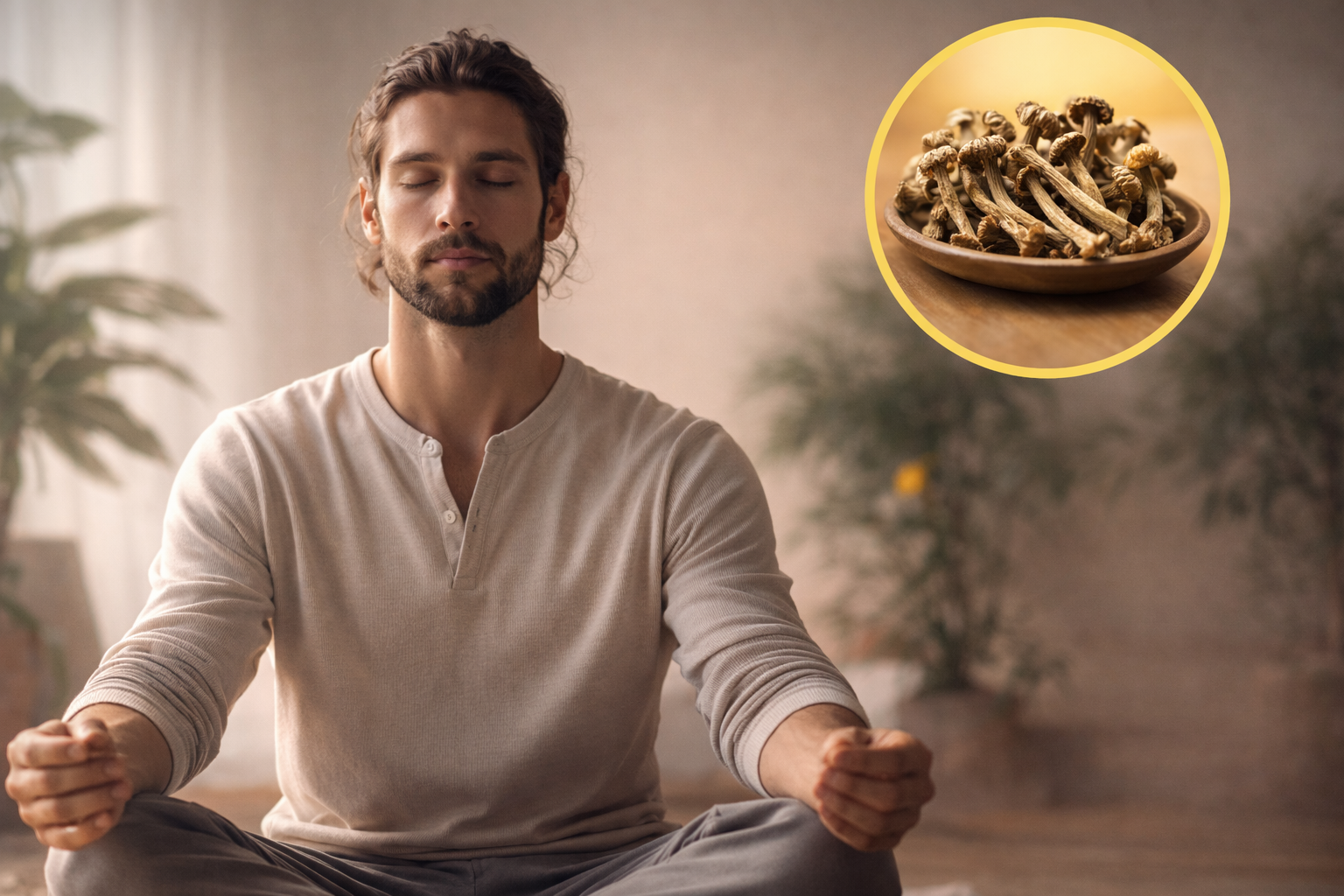
There’s a version of the psychedelics conversation that frames them as silver bullets. Take the substance, have the experience, change your life. Clean and simple. A pill for an ill, just a more interesting pill.
New research suggests that story might be missing something important.
A study published in 2025 in the journal Consciousness and Cognition, led by Andreas Krabbe and colleagues at Åbo Akademi University in Finland, set out to do something surprisingly rare in psychedelic research by investigating what else people who benefit from psychedelics are doing with their lives. Specifically, whether they meditate.
The findings highlight an important nuance about psychedelics and long term wellbeing.
The Study
The researchers ran two complementary analyses. In the first, they surveyed 679 people with prior psychedelic experience and looked at how often they used psychedelics and how often they meditated, then measured their psychological wellbeing, flexibility, anxiety, depression, and peace of mind.
In the second, they compared 137 people across three groups: those who’d had a meaningful experience through psychedelics alone, meditation alone, or both together. They then asked how their wellbeing had changed as a result.
The key methodological move was that they looked at both practices at the same time, in the same model, rather than in isolation.
The Findings
When psychedelic use was analysed on its own, it looked decent. It was associated with better psychological flexibility, peace of mind, and higher wellbeing.
But when they added meditation to the model, the psychedelic effect largely disappeared.
Meditation, it turned out, was doing most of the heavy lifting. More frequent meditators had consistently better outcomes across almost every measure. When you accounted for how often people meditated, psychedelic use alone became a weak or non-significant predictor of wellbeing.
What I find most interesting was that combining the two was better still. In Study 2, people who meditated during a psychedelic experience reported significantly greater improvements in positive affect, peace of mind, and reduced negative affect compared to those using psychedelics alone. Meditation alone also outperformed psychedelics alone on these measures.
The researchers also found preliminary evidence of a cumulative synergy. So people who regularly did both over time showed greater wellbeing than either practice alone would predict.
What This Means
The researchers offer a useful metaphor for understanding the findings. Psychedelics, they suggest, are like taking a direct flight to a foreign country with no preparation. You arrive somewhere radically different, potentially beautiful, but potentially overwhelming. Meditation is like having a knowledgeable local guide waiting when you land. Someone who helps you navigate, integrate, make sense of what you’re seeing, and not get lost.
This reframes something important. We’ve inherited a tendency to think in terms of active ingredients and passive recipients. Take drug and receive benefit. The psychedelic renaissance has sometimes fallen into the same trap.
But this study suggests healing is more participatory than that. The people getting the most out of psychedelic experiences are bringing something to the encounter. In this case, a meditative practice that gives them capacity for inner attention.
The Metabolic Parallel
This resonates with where the most interesting psychedelic science is heading more broadly.
Recent psilocybin research points toward a new way understanding health. These compounds don’t work like traditional pharmaceuticals that target single pathways to prevent or reduce isolated symptoms. They work more like fertiliser, creating conditions for growth (like fungi) that then depend on what you do with them.
The body and brain are plastic. Psychedelics may amplify that plasticity. But plasticity in the direction of what is the question. And that’s where lifestyle, practice, and intention come in.
If psilocybin is emerging as a potential metabolic therapy, interacting with serotonin receptors in ways that affect not just mood but inflammation, gut signalling, and cellular renewal, then the idea that meditation might meaningfully shape those outcomes becomes less surprising. Meditation has its own measurable physiological effects on cortisol, on heart rate variability, on inflammatory markers, and more. So these aren’t separate conversations.
Peace of Mind
One finding that deserves more attention than it’ll probably get is what they discovered about peace of mind.
The study used a validated measure of internal peace and harmony (a construct that’s historically been more at home in Eastern psychology than in clinical trial spreadsheets). And it showed up consistently, linked to both practices, and especially enhanced when they were combined.
Peace of mind isn’t reducible to the absence of anxiety or depression. It’s a distinct quality, something closer to equanimity, settledness, a felt sense of being okay in yourself. It’s what a lot of people are actually looking for when they reach for either a meditation cushion or a psychedelic, even if the clinical language doesn’t quite capture it.
The fact that it’s measurable and responsive to practice is significant. It suggests we might be able to unite what’s often treated as separate: the scientific language of outcomes and mechanisms, and the experiential language of inner peace and integration.
Thee unity between the biological and the spiritual is probably where the most important conversations in this space are heading.
The Takeaway
This study isn’t saying psychedelics don’t work. It’s saying they work best when you bring something to them. And that regular meditation might be one of the most important variables.
If you’re interested in psychedelics as part of a serious approach to your own health and consciousness, the implication is that the preparation and integration matter as much as the experience itself. The practice you build around the moments of intensity could be what makes those moments mean something.
If you want to go deeper on the science of psychedelics, mushrooms and what it actually means to take your wellbeing seriously, the Spore Report is worth your time. It’s a newsletter that connects research to real life.
→ Subscribe at thesporereport.co.uk
Source: The interplay of psychedelic use and meditation in shaping psychological well-being Andreas Krabbe , Pilleriin Sikka , Jussi Jylkkä. Consciousness and Cognition. Volume 137, January 2026,
“Hello, I’m Mongolian and I’m very interested in psychedelics and meditation. I want to develop this interest further and expand my knowledge. Where could I go to learn more about this, and who would be the best person to contact for guidance?”