Researchers just ate mushrooms that spent a month floating in space. And apparently they were delicious.
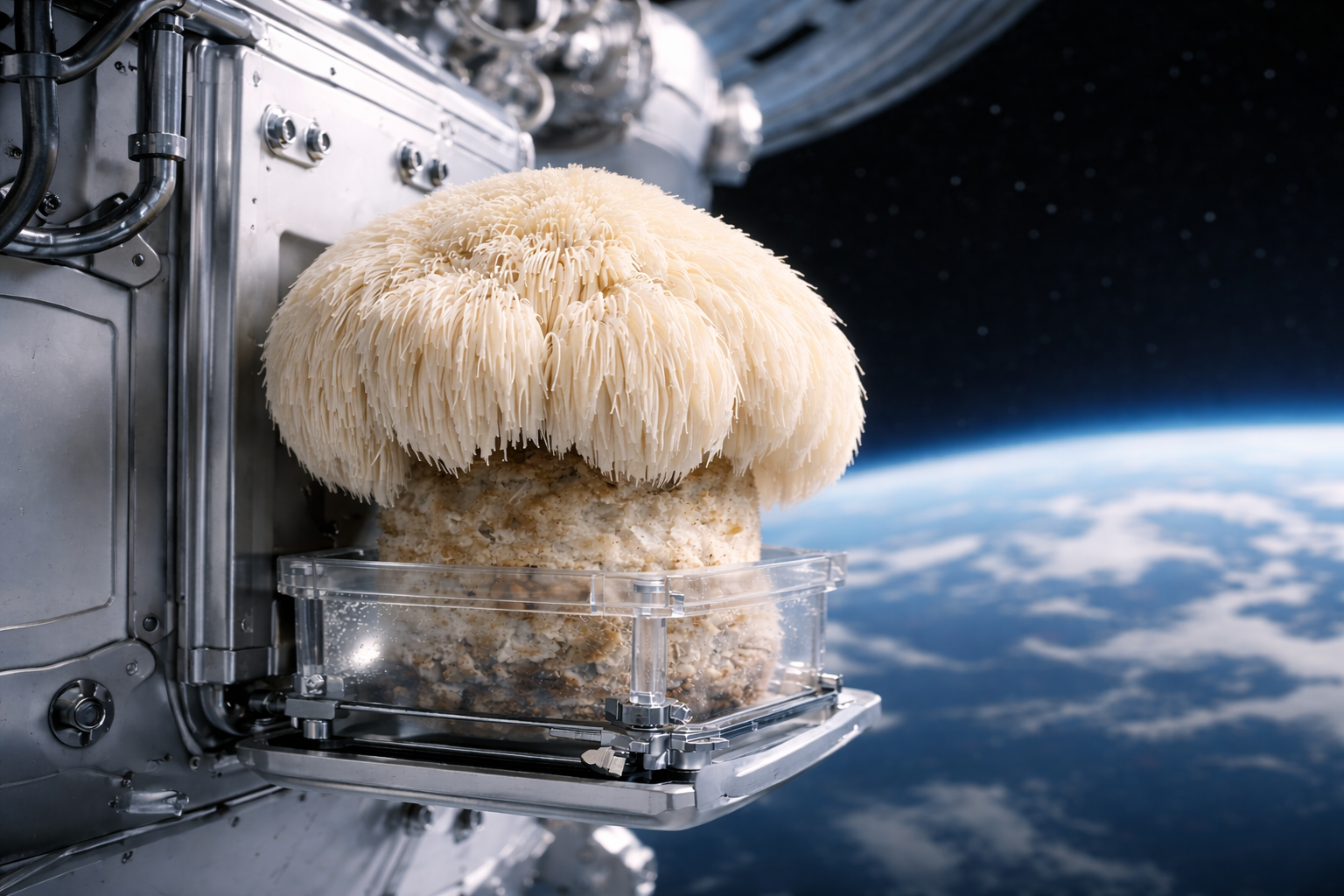
Dr. Sara Webb and Dr. Rebecca Allen from Swinburne University of Technology sent lion’s mane, turkey tail, and cordyceps to the International Space Station in August 2024. The fungi came back to Earth, grew into full mushrooms, and ended up in a pasta sauce. The scientists said: “The rich lion’s mane flavour immediately shone through.”
This fun experiment tells us something profound about resilience, adaptation, and why mushrooms are more incredible than you think.
The Unexpected Finding
In August 2024, 36 vials of edible mushroom mycelium was sent to the ISS aboard a SpaceX Falcon 9.
Led by Swinburne University’s microgravity program and designed with help from 12 Melbourne students, the fungi were sealed in temperature-stable packaging for nearly a month in orbit before returning with a crew change.
Here’s what shocked the researchers. After experiencing extreme radiation, microgravity, temperature fluctuations, and the violence of rocket launches, the mycelium (mushroom root networks) survived.
Within days of returning to Earth, they started producing mushrooms. Beautiful, healthy mushrooms that kept producing multiple rounds of fruiting bodies. A week later, the fresh lion’s mane was ready to cook and enjoy (which the scientists did).
The reduced gravity environment didn’t negatively impact them. If anything, these mushrooms seemed very healthy.
The Mushrooms
These weren’t random mushrooms. Lion’s mane, turkey tail, and cordyceps were specifically chosen because they support brain function, gut health, and immune health.
Lion’s mane is already known for supporting neuroplasticity, which is your brain’s ability to form new neural connections and adapt. It contains compounds called hericenones and erinacines that can cross the blood-brain barrier and stimulate nerve growth factor (NGF) production. This is foundational for cognitive clarity, memory formation, and protecting against age-related cognitive decline.
Cordyceps supports mitochondrial function. Mitochondria the cellular powerhouses that generate energy in every cell. When mitochondria decline, you get brain fog, fatigue, and that feeling of mental sludge. Cordyceps helps restore ATP production, giving you the energy you need to move, think and all the other fun stuff we humans do.
Turkey tail modulates inflammation and supports gut health. Chronic inflammation literally impairs energy metabolism and interferes with a host of bodily processes.
The Resilience Principle
Remarkable, these mushrooms demonstrated adaptive resilience under extreme stress. For anyone whose interested in the health benefits of mushrooms, this is very interesting.
You face a version of this daily. Chronic stress, inflammatory foods, poor sleep, environmental toxins. Although not as dramatic as space radiation, they’re still creating a hostile environment in your body. And just like those mushrooms needed robust biological systems to survive space, your brain and body need robust support systems to maintain function under modern life’s constant stressors.
Mushrooms aren’t pharmaceutical drugs that force a specific outcome. They’re known as adaptogens, meaning they help your body respond intelligently to whatever stress it’s facing. The fact that these specific species could maintain their biological integrity through space travel suggests their adaptive mechanisms are extraordinarily sophisticated.
This is what I call first-principles health. Instead of trying to override your brain’s struggling systems, you’re providing the raw materials and biological intelligence to help those systems restore themselves.
The Long-Duration Mission Problem
The researchers note that understanding nutrition for long-duration space missions is critical. Astronauts on months-long missions to the Moon need foods that won’t degrade, that will actually support their biology under stress, and that provide more than just calories.
Sound familiar?
You might not be going to the Moon, but you’re on your own long-duration mission. It’s called your life.
And it’s why we, if we want to stay healthy as we age, we should ask ourselves “What will continue supporting my resilience over decades of cumulative stress?”
The Bigger Picture
As NASA looks toward Artemis II and longer missions beyond Earth, they’re asking: “How do we nutritionally support humans in extreme environments for extended periods?”
You should be asking the same question about your own life.
Because the demands of modern life (constant digital stimulation, decision fatigue, chronic stress, inflammatory environments) are extreme conditions for an animal that evolved in very different circumstances.
Mushrooms that can survive space are examples of biological resilience that we’re only beginning to understand. And that same resilience, honed over millions of years of evolution, is available to you right now.
Those researchers ate their space mushrooms and reported they were delicious. But more importantly, they proved that the right biological support systems don’t just survive stress. They adapt, regenerate, and continue producing value.
You can do the same. You just needs the right support.
Check out our quality mushroom extracts Mushies
Reference: Webb, S. & Allen, R. (2026). “We ate space mushrooms and survived to tell the tale.” The Conversation, February 3, 2026.