October 3rd, 1799. A poor man identified only as J.S rises before dawn, pulls on his coat, and walks to the park.
There is nothing remarkable about J.S. on the morning of October 3rd, 1799. He is a working man in a working city, and he is doing what he has done many times before: gathering field mushrooms from the damp grass of London’s Green Park before the day properly begins. He knows this patch. He has eaten from it before. The small brown fungi are unremarkable. A free breakfast, nothing more.
He takes them home. He cooks them into a broth with flour, water, and salt, and serves it to his wife and their four children. It is an ordinary autumn morning in Georgian London.
Then, about an hour later, the world comes apart.
J.S. notices black spots swimming across his vision. Odd flashes of colour. A rising vertigo that makes the floorboards feel uncertain beneath him. His wife and the older children are clutching their stomachs, their hands gone cold and numb. Their pulses oscillate. They are convinced they have been poisoned and were dying.
All except eight-year-old Edward. Edward cannot stop laughing.
An apothecary named Everard Brande is summoned to the household, and what he finds there will eventually become the first documented account of psilocybin intoxication in European medical history. He writes it up in a letter to the London Medical and Physical Journal, dated November 16th, 1799. His tone is precise, professional, and mildly baffled.
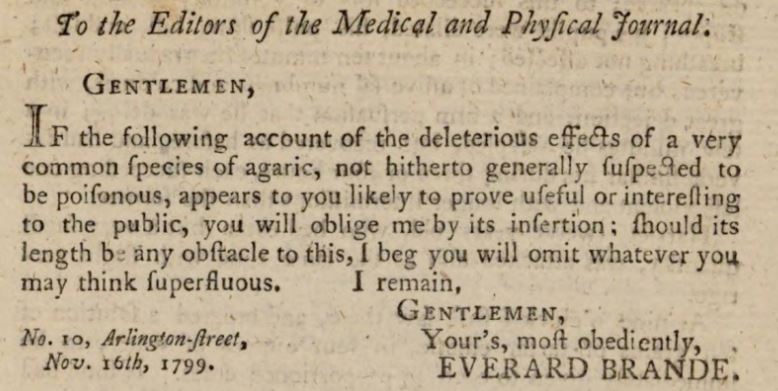
Everard Brande records, “Edward, one of the children, (eight years old,) who had eaten a large proportion of the mushrooms, was attacked with fits of immoderate laughter, nor could the threats of his father or mother refrain him. To this succeeded vertigo, and a great deal of stupor, from which he was roused by being called or shaken, but immediately relapsed.”
Brande administers emetics. He gives what he calls “fortifying tonics.” He has the mushrooms identified. He does everything a competent physician of his era would do, and he documents it with a care and rigour that, two centuries later, we are still drawing on.
The family recovers. Brande files his report. And then, almost entirely, the incident is forgotten.
What makes this story worth telling is not just what happened, but what it reveals about the strange blindspot at the heart of British culture.
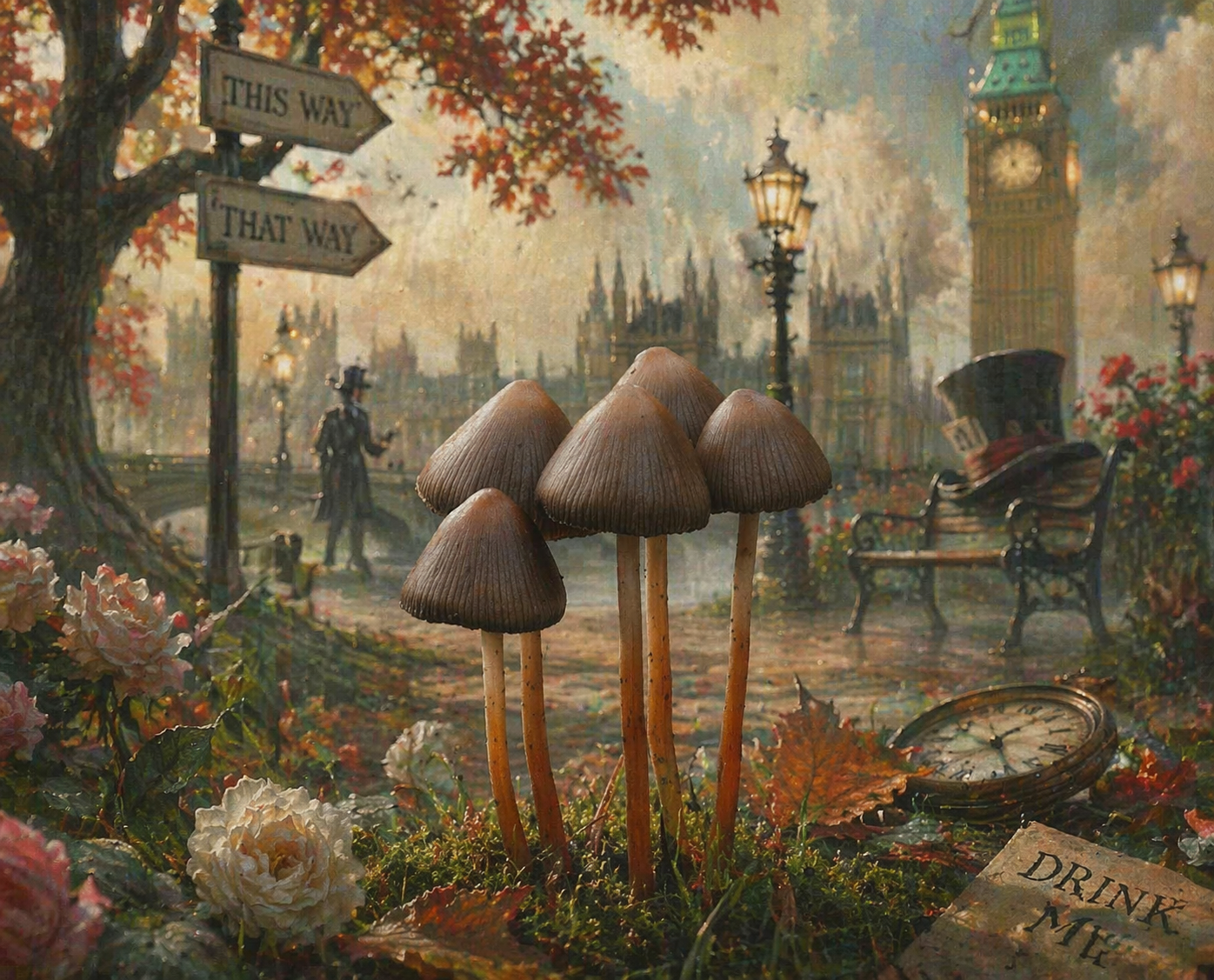
The mushrooms J.S. gathered that morning were Psilocybe semilanceata – now commonly know as the liberty cap. They are common across the British Isles. They grow in the damp grassland of parks, commons, moorlands, and hillsides every autumn. They had been growing there for thousands of years before J.S. crouched down in the early morning half-dark of Green Park.
And yet nobody, it seems, had ever really noticed what they did.
This is almost impossible to square with what was happening on the other side of the world. In Mesoamerica, mushrooms of the same genus – teonanacatl, the Aztecs called them, the divine mushroom – had been woven into ritual and spiritual practice for at least two millennia. They were served at the coronation of Moctezuma II in 1502. They were a doorway, deliberately sought out, used with intention and reverence.
In Britain, they were apparently unknown – at least to science.
The contrast is not just historical curiosity. It speaks to something deeper about the relationship between a culture and the natural world it inhabits. The Aztecs understood that certain mushrooms could dissolve the boundary between the ordinary and the sacred. The British, meanwhile, just got their first clue.
It is not that Britain lacked mystery or mysticism. The same era produced Blake, who saw angels in Peckham. It produced the Romantics, with their intoxicating fixation on nature, sublimity, and altered perception. It produced De Quincey, who was documenting his opium visions in extraordinary detail. The raw material for a psychedelic tradition was all there. But the fungi, it seems, had not yet registered.
Or had they?
Over the nineteenth century, something curious happened in British cultural life. As the industrial revolution dragged populations from countryside to city, a new generation of folklorists began frantically preserving the oral traditions of rural England. And woven through them was a persistent, peculiar connection between mushrooms and other worlds. Fairy rings. Toadstool-dwelling elves. The unwitting transport of ordinary people into a realm of shifting dimensions and elemental spirits.
Mushrooms and toadstools became emblematic of fairyland itself. The Victorian fairy tradition was a literature obsessed with exactly what psilocybin does: the dissolution of ordinary scale and perspective, the sudden sense of access to some deeper, stranger layer of reality.
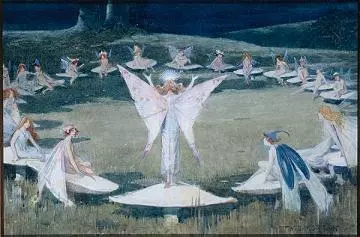
Folklorist Thomas Keightley, whose The Fairy Mythology (1850) was enormously influential, noted traditional Welsh and Gaelic names for certain fungi that invoked Puck and elemental spirits, and wondered whether they referred to those “pretty small delicate fungi, with their conical heads” – a description that fits the liberty cap. The slang for mushrooms in Ireland, he noted, was pookies, derived from the nature spirit Pooka. That slang persists in Irish drug culture to this day.
And then there is the most famous mushroom story in the English language. When Lewis Carroll sent Alice tumbling down a rabbit hole into a world where size and proportion become fluid, where logic collapses and the ordinary rules of reality simply stop applying, he was drawing on a tradition already thick with exactly this imagery. Carroll was a known enthusiast of the Victorian fairy literature saturated with mushroom lore; the caterpillar sitting atop a giant fungus, calmly dispensing wisdom about altered states of perception, has the quality of something Carroll understood intuitively, even if he never articulated it directly.
None of this constitutes proof of an intentional psychedelic tradition. The more likely reading is that the liberty cap’s effects were encountered sporadically slowly folded into the category of fairyland rather than chemistry. given mythological shape rather than medical documentation. The experience was being encoded, just in a mythological language compared to Brande’s scientific language.
Brande’s letter sat in the medical literature, occasionally cited. But it was not until Albert Hofmann (the Swiss chemist who had already given the world LSD) turned his attention to psilocybin mushrooms in the late 1950s that the active compound in liberty caps was finally isolated and named. Only then could anyone look back at Brande’s 1799 account and say with certainty that yes, that was psilocybin. That was what caused Edward’s laughing fit.
The species itself was not formally confirmed as the culprit until mycologist James Sowerby published Coloured Figures of English Fungi or Mushrooms in 1803, four years after the incident. German mycologist Jochen Gartz later reviewed the description and concluded it was fully compatible with modern knowledge of Psilocybe semilanceata. The identification took decades. The pharmacology took a century and a half.
The lag is understandable. Brande had no framework for what he was observing. He called it poisoning, because what else would you call it? If you ate an unidentified mushroom and your children started hallucinating, the word poisoning would feel very accurate.
But in another sense, the lag is the whole point. The experience was there. What was missing was the context to understand it, the tradition to hold it, the cultural vocabulary to give it meaning beyond alarm.
Every autumn, the liberty caps still come up in Green Park. In the damp hollows and long grass along the paths. Small, brown, and apparently unremarkable.
But to people who’ve eaten them, like J.S and his son Edward, they can be seen as a gateway to a different world filled with wonder, the dissolution of normal rules, and maybe even otherworldy entities.
If you’re interested in the evolving story of fungi, psychedelics, and nature’s intelligence, our weekly newsletter The Spore Report is worth your time.
Read The Spore Report →