Recently I’ve been talking a lot about how psilocybin mushrooms’ longevity effects. But the science is also stacking up that common non-psychoactive mushrooms found in your local supermarket also contain compounds that profoundly influence how we age.
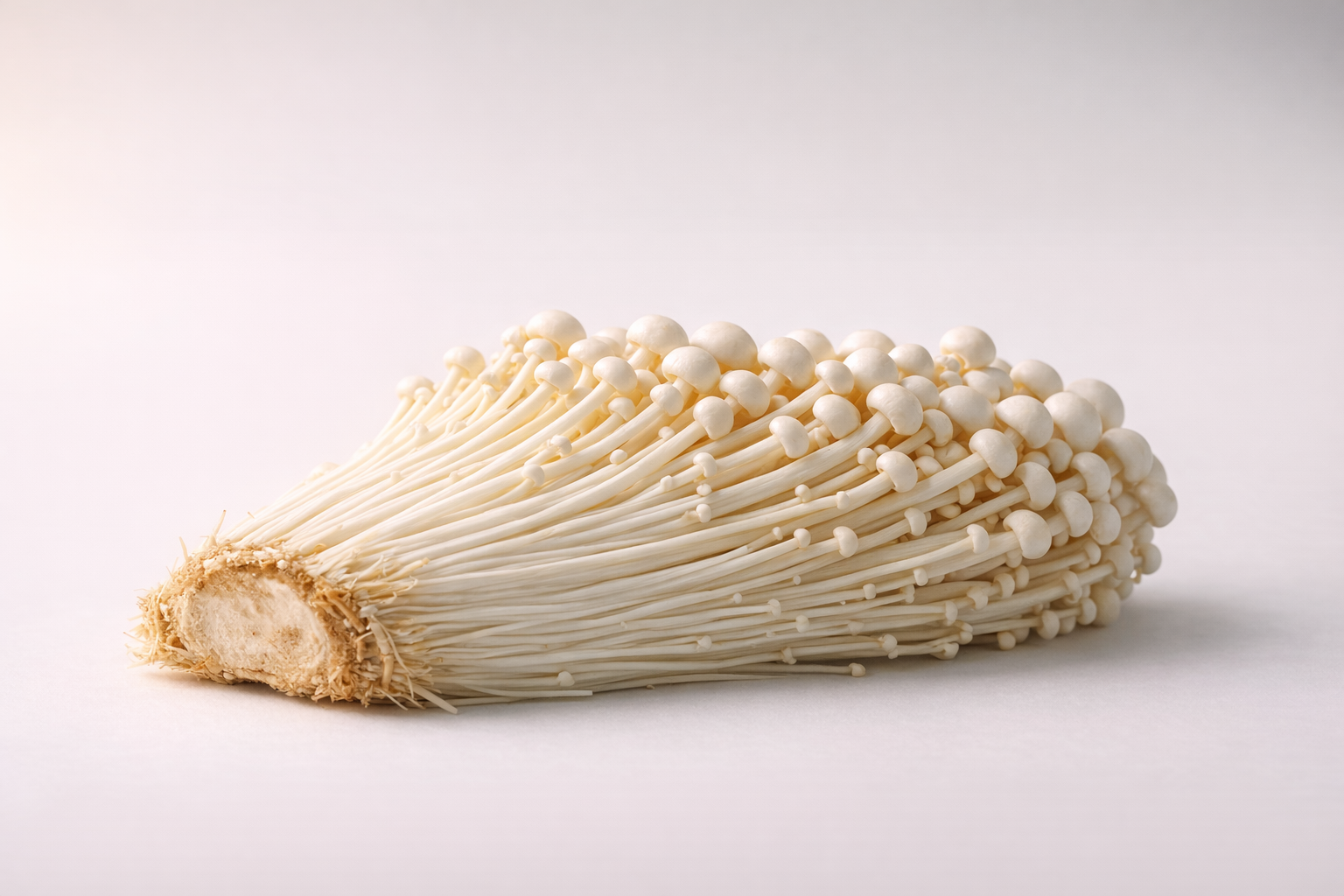
A recent study published in Nutrients offers a fascinating example by investigating enoki mushroom. The researchers gave middle-aged and older Japanese men enoki mushroom extract daily for 12 weeks and tracked their experience of male menopause symptoms.
What they found suggests enoki might have profound effects on the underlying cellular machinery that governs energy, hormones and overall vitality.
Increased Testosterone
The study was on 55 men aged 40 and up, all experiencing mild to moderate symptoms of what’s technically called late-onset hypogonadism (LOH) – the gradual decline in testosterone and other androgens that comes with age. Think fatigue, brain fog, muscle weakness, poor sleep, and declining libido. The stuff most middle age men dread.
Half received powdered enoki extract (containing 0.56mg of adenosine per capsule, 10 capsules daily). Half got placebo. Nobody knew who got what. After 12 weeks, the researchers measured changes in symptoms and testosterone levels.
The headline finding was men taking enoki showed significant improvement in sexual function symptoms. But more interestingly, when they looked at men whose testosterone increased by at least 0.5 ng/mL during the study, significantly more were in the enoki group. It wasn’t a massive hormonal shift, but still enough to potentially move someone from “borderline low” to “normal range.”
The Adenosine Connection
What caught my eye was that the active compound they identified was adenosine – a molecule that I’m familiar with because it’s also found in Cordyceps mushrooms and is fundamental to cellular energy production.
Adenosine is literally what the “A” stands for in ATP (adenosine triphosphate), the energy currency every cell in your body runs on. When your mitochondria break down glucose and fatty acids to generate energy, they’re essentially charging up adenosine molecules. It’s the battery that powers everything, including neuron firing, muscle contraction, hormone synthesis, and cellular repair.
The researchers cite earlier work showing enoki extract enhanced Leydig cell function. Leydig cells are the testosterone-producing cells in the testes. Put simply, it’s supporting the metabolic machinery in specialized cells, giving them what they need to do their job properly.
Energy at the Root
The study points to something bigger than simply increasing male hormones. Testosterone production is energy-intensive. It requires multiple enzymatic steps, adequate cholesterol (the precursor molecule), functional mitochondria, and cellular resources to synthesize and secrete the hormone. When cells are metabolically compromised (inflamed, stressed, depleted), this process falters.
This ties in to brain health and cognition when you consider that neurons are even more metabolically demanding than hormone-producing cells. Your brain uses roughly 20% of your body’s energy despite being only 2% of your body weight. This is why cognition suffers alongside loss sexual function and libido.
The symptoms these men reported (fatigue, depression, cognitive decline, and sleep disruption) aren’t separate issues from declining testosterone. They’re all downstream effects of the same metabolic dysfunction. Everything in biology is connected through energy production.
Mushrooms as Metabolic Tools
This is what makes mushrooms fascinating from a first-principles perspective. They’re not delivering hormones directly. They’re not pharmaceutically blocking or stimulating receptors. Instead, compounds like adenosine (and the polysaccharides, beta-glucans, ergothioneine, and other bioactives in mushrooms) seem to support the fundamental metabolic processes cells need to function optimally.
It’s regenerative rather than compensatory. You’re helping the system produce what it should naturally make.
Think about inflammation and metabolism. Chronic low-grade inflammation disrupts mitochondrial function, which reduces ATP production, which compromises every energy-dependent process in your body. Including testosterone synthesis, neurotransmitter production, cellular repair, and immune function. Mushrooms, including enoki, have documented anti-inflammatory and antioxidant properties. They may be helping by reducing the metabolic drag that makes cells less efficient.
The men in this study who showed the greatest improvement in symptoms are those who scored 4 or 5 (most severe). These are people whose systems were most compromised. The fact that enoki extract showed clearest benefits in this group suggests it might be most helpful when metabolic function has genuinely declined, not as a performance enhancer for the already optimal.
Previous Research
Before this human study, enoki mushrooms had already accumulated an interesting research profile, though most of it came from laboratory and animal studies.
The foundational work saw enoki extract tested on mice whose testosterone production had been impaired by cisplatin (a chemotherapy drug known to damage testicular function). The extract restored testosterone production. When they gave it to “fatigue model” mice, it enhanced Leydig cell function and increased testicular testosterone output.
Critically, they identified adenosine as the primary active compound responsible for these effects. They showed dose-dependent activity: more adenosine meant more testosterone production.
Beyond hormonal effects, earlier studies have documented enoki’s broader biological effects:
Anticancer properties: Various studies found compounds in enoki that showed tumor-inhibiting effects in laboratory settings, likely through immune modulation and direct cytotoxic effects on cancer cells.
Antimicrobial activity: Enoki extracts demonstrated ability to inhibit certain bacterial and fungal pathogens, suggesting immune-supportive properties.
Antioxidant capacity: Multiple studies confirmed that enoki contains compounds that neutralize free radicals and reduce oxidative stress – the cellular damage that accumulates with age and inflammation.
Immunomodulation: Enoki polysaccharides were shown to influence immune cell activity, helping the immune system respond more effectively without overreacting.
The animal research was consistent enough that the 2025 human study done to test whether effects seen in controlled laboratory conditions would translate to actual middle-aged humans experiencing natural age-related decline.
The fact that they did translate, even modestly, suggests the mechanisms are real and relevant to human physiology. Not every promising compound makes that jump from petri dish to human biology. Enoki apparently does.
What This Doesn’t Mean
Let’s be clear, this was one study, 55 men, 12 weeks. The effect sizes were modest. This isn’t suggesting enoki extract is a miracle cure for male menopause or cognitive decline.
But it’s another data point in an accumulating body of evidence suggesting mushrooms contain compounds that meaningfully influence human metabolism and hormonal function through biochemical pathways that co-evolved over millions of years.
Final Thoughts
This study is interesting. It found that enoki extract increased testosterone in some men by 0.5 ng/mL, suggesting it helped cells function better and metabolic processes work more efficiently.
It adds to the evidence that when your cells have what they need to produce energy effectively, everything downstream improves. Hormones, cognition, mood, physical performance, and resilience.
It’s a regenerative approach based first principles – something I’m especially passionate about. And that’s why I believe mushrooms have so much potential as ancient metabolic tools we’ve only recently begun to understand.
Want to explore the intersection of metabolic health, mushrooms, and cognitive function? I write about these connections every week in The Spore Report. Join me at thesporereport.co.uk
Study: Beneficial Effects of Enoki Mushroom Extract on Male Menopausal Symptoms in Japanese Subjects: A Randomized, Double-Blind, Placebo-Controlled Study. Shizuo Yamada et al.