
In today’s fast-paced world, who wouldn’t say no to better sleep, more energy, and less stress?
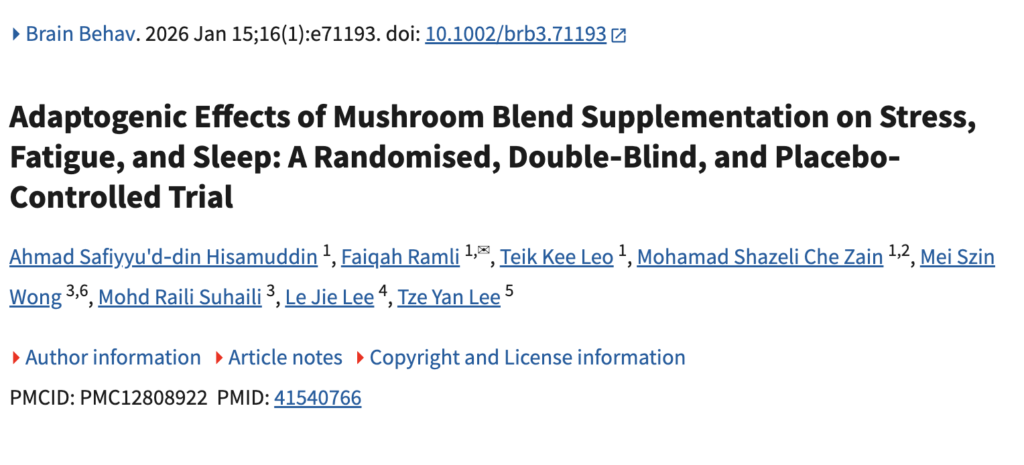
I’m a huge proponent of medicinal mushrooms for exactly this reason. There’s already lots of research suggesting they’re effective individually. But a new study published in Brain and Behavior (January 2026) by Hisamuddin and colleagues is the first to test a combination of five medicinal mushrooms in humans. And the results are compelling.
The Setup
The researchers recruited 50 people (ages 22-55) who were struggling with moderate to severe stress, chronic fatigue, and poor sleep. Their symptoms included headaches, palpitations at rest, and frequent sleep disturbances. Half took two capsules (1000mg total) of a mushroom blend called Restake, the other half took a placebo. Nobody knew which they were taking – this is called a double-blind experiment.
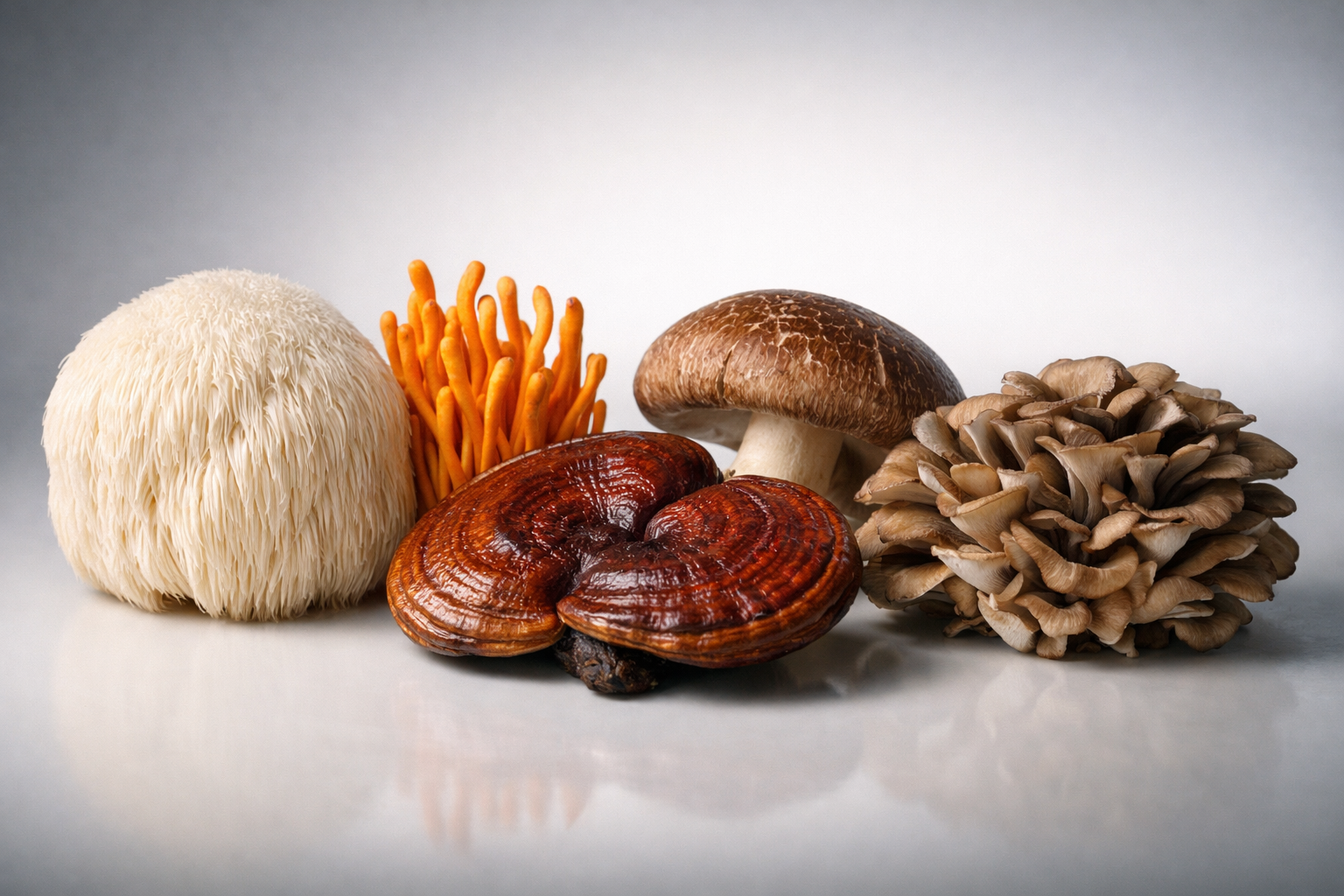
The blend contained extracts of five medicinal mushrooms you’ve probably heard of: Lion’s Mane (Hericium erinaceus), Cordyceps militaris, Reishi (Ganoderma lucidum), Shiitake (Lentinula edodes), and Maitake (Grifola frondosa). Importantly, the supplement was standardised with over 30% beta-glucans. Beta-glucans are thought to be responsible for much of the immune-modulating and anti-inflammatory effects of mushrooms.
Restake is manufactured by Nexus Wise Sdn Bhd, which also funded the study, which is worth keeping in mind.
What Happened
After 12 weeks, the mushroom group had the following measurable changes:
Anxiety dropped significantly. Hamilton Anxiety scores fell by 33.5% in the mushroom group vs. 13.1% in placebo. State anxiety (those moment-to-moment stress spikes) decreased by 8.7% vs. 4.9%. These differences showed up by week 6 and held.
Depression scores improved. While the placebo group’s depression scores actually increased by 4.1%, the mushroom group saw a 16.8% reduction. That’s a meaningful shift in mood regulation.
Physical fatigue took the biggest hit, dropping 9.2% compared to just 2.1% in placebo by week 12. Mental and general fatigue improved too, though the effects were more modest.
Sleep quality improved by 11% overall (measured by the Pittsburgh Sleep Quality Index). People fell asleep easier, woke up less, and reported better daytime function.
Biomarkers
Cortisol dropped 5.5% (vs. basically no change in placebo). ACTH dropped 8.1%. These are your stress hormones that signal your HPA axis in action. When you’re chronically stressed, this axis stays activated, pumping out cortisol, disrupting sleep, and draining energy. The mushroom blend appears to help regulate this system back toward homeostasis.
C-reactive protein (CRP) decreased 6.3% while it increased 4.9% in placebo. CRP is an inflammation marker. Chronic inflammation drives fatigue, mood issues, and metabolic dysfunction. Beta-glucans interact with immune cell receptors (specifically dectin-1), modulating inflammatory signaling pathways like NF-kB.
Norepinephrine increased 10.4% in the mushroom group. At first glance, that might seem counterintuitive for a “calming” supplement. But context matters, as norepinephrine supports focus, motivation, and healthy sympathetic tone. The study suggests this reflects improved autonomic balance rather than stress-induced sympathetic overdrive.
Morning melatonin showed an upward trend (though not statistically significant). Melatonin regulates your circadian rhythm, and even modest increases can enhance sleep quality and timing.
The Mushroom Mechanisms
Each mushroom in the blend brings something different:
Lion’s Mane stimulates nerve growth factor (NGF), supporting neuroplasticity and potentially explaining the 33.5% anxiety reduction. It also influences serotonergic pathways involved in mood regulation.
Reishi has triterpenes that modulate GABA receptors and may support sleep architecture. Animal studies show it influences gut microbiota composition, which affects sleep behaviour through the gut-brain axis.
Cordyceps enhances mitochondrial ATP production and oxygen utilisation – literal cellular energy optimisation. This likely explains the improvements in physical fatigue.
Shiitake and Maitake contribute immune-modulating polysaccharides and support glucose metabolism, helping stabilise energy levels and reduce stress-related metabolic disruption.
All of these mushrooms also contain beta-glucans that have been shown to support healthy gut microbiomes, which play a major role in many other bodily processes.
This is polypharmacology – multiple compounds hitting multiple targets. Unlike most pharmaceutical drugs that target one pathway, this is a systems-level intervention. It mirrors how whole foods work compared to isolated nutrients.
Instead of one drug for anxiety, another for sleep, another for inflammation, could mushrooms help your whole system by supporting the body’s own regulatory networks? I think so.
Takeaways
Let’s be clear about limitations:
- 50 people isn’t huge. The effects are statistically significant, but we’d want replication in larger, more diverse populations.
- 12 weeks is a good start, but what happens at 6 months? A year? Do effects plateau or compound?
- Morning melatonin measurement is suboptimal (melatonin peaks at night). The trend is interesting but not definitive.
- Mechanism clarity: While we can point to beta-glucans, triterpenes, and NGF stimulation, the exact molecular pathways remain partially unclear.
However, if you’re dealing with chronic stress, fatigue, or poor sleep, this study suggests a standardised mushroom blend (high in beta-glucans) might meaningfully help within 6-12 weeks. It’s not a replacement for fundamentals (sleep hygiene, stress management, nutrition, and movement) but potentially a useful addition.
The safety profile was also clean. There were no adverse effects and all blood markers stayed in normal ranges. This is important when prescription options often come with trade-offs.
Final Thoughts
This study adds to the evidence for mushrooms as holistic, systems-based interventions. That doesn’t mean we dismiss reductionist science (the biomarker data here is essential), but it does show how integrating both can validate complexity-friendly approaches.
That’s the future I’m invested in: interventions that support resilience, regeneration, and adaptation rather than just suppressing symptoms. Science-backed, mechanistically grounded, but working with biological complexity rather than against it.
If you’re in the UK, check out my brand Mushies, where we’ll soon be launching our own mushroom blend in gummy form.
Study Reference: Hisamuddin, A.S., Ramli, F., Leo, T.K., et al. (2026). Adaptogenic Effects of Mushroom Blend Supplementation on Stress, Fatigue, and Sleep: A Randomised, Double-Blind, and Placebo-Controlled Trial. Brain and Behavior, 16(1), e71193.


One thought on “Double-Blind Study Shows Blend Of Five Medicinal Mushrooms Can Improve Sleep, Energy, And Stress Resilience”