
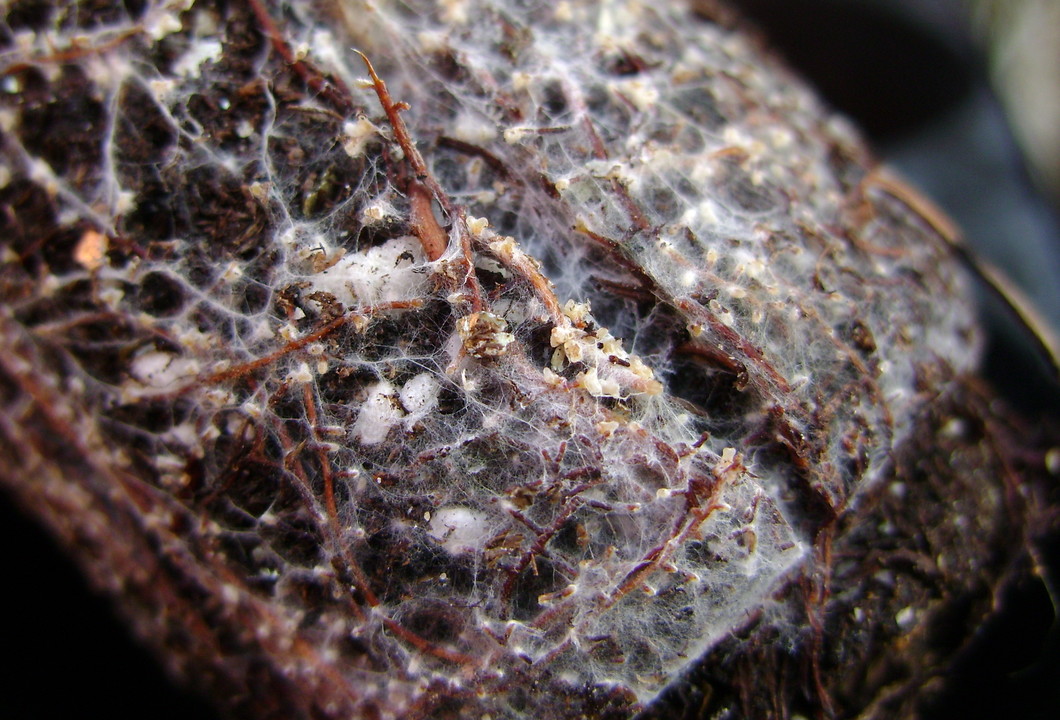
There’s a greenhouse at the University of Kansas where two scientists are fighting to save hundreds of millions of years of evolution. But they’re not keeping exotic animals or rare plants. They’re tending plastic pots of grass and mud – and, most importantly, the invisible networks living in their roots.
This is a story that should alarm anyone who cares about the environment because these fungal networks are vital for ecosystem restoration, regenerative agriculture, and the future of humanity’s food system – no big deal.
The International Collection of Vesicular Arbuscular Mycorrhizal Fungi (INVAM) – the world’s largest living library of soil fungi – might close within a year due to federal budget cuts.
Let me explain why this could have disastrous consequences.
The Foundation Of Life
These aren’t the mushrooms you see at farmers markets. Arbuscular mycorrhizal (AM) fungi live entirely underground, forming symbiotic partnerships with 70% of all land plants. They are the Earth’s original decentralised network and the foundation of all plant and animal life on the planet.
The way they partner with plants is elegant. Plants provide sugars and fats (energy), and fungi deliver phosphorus, nitrogen, and trace minerals the plants can’t access alone. But it goes deeper. These fungi also buffer plants against drought and disease, while storing massive amounts of carbon underground. They are vital to healthy ecosystems in ways we are only beginning to fully appreciate.
Healthy animals need healthy plants. If you want healthy plants, you need healthy soil. To have healthy soil, you need living fungal networks. Capiche?
A Living Library
What makes this crisis particularly brutal is that INVAM houses over 900 distinct fungal strains from six continents, and unlike seeds in a vault or frozen cells, these organisms require constant care. Each strain must be meticulously cultured, isolated under microscopes, hand-painted onto grass roots, grown for 12 weeks, harvested, and stored. Every single year.
This is living knowledge that took 40 years to assemble. And if it dies, it’s gone.
Professor Jim Bever, who runs the collection, warns that without new funding, they can survive maybe another year. The Trump administration’s proposed budget would slash National Science Foundation funding by 57%. Right now, the collection is just about surviving on temporary grants and volunteer labor.
Fungal Snake Oil
Meanwhile, there’s a $1.29 billion global market for fungal biofertilisers – even though most of it is useless, according to Bever.
Bever and his colleagues tested 23 commercial products marketed as AM fungi (stands for arbuscular mycorrhizal and describes a type of mycorrhiza that forms a symbiotic relationship with plant roots). They are supposed to boost plant growth naturally, but the results were damning: 87% failed to colonise plant roots. Many contained only dead spores or no spores at all. Some even had plant pathogens mixed in.
This is what happens when you have an unregulated market and a dying public research infrastructure. Farmers and land managers desperately want these solutions and are buying them by the millions, but they’re getting scammed because nobody’s maintaining the expertise or standards needed to do this properly.
What Actually Works
The irony is that when you use real AM fungi, the results are spectacular.
Nine years ago, Liz Koziol (INVAM’s curator) seeded a tired Kansas hay field with native prairie plants and AM spores from old-growth prairie fragments. Control plots got seeds but no fungi. Today, the difference is stark. The AM-treated plots transformed into a riot of 12-foot prairie docks, head-tall grasses, butterflies, and grasshoppers. It’s a reincarnation of the tallgrass prairie ecosystem that once dominated the central US.
Meanwhile, the control plots are still struggling.
This highlights how modern agriculture has decimated AM fungi. We know fungicides kill them, excessive fertiliser makes plants abandon the symbiosis, and ploughing destroys their networks entirely. In some intensively farmed soils, researchers can barely detect AM fungal DNA anymore.
What’s At Stake?
Mycologist Toby Kiers frames the stakes perfectly: “INVAM represents a library of hundreds of millions of years of evolution. Ending INVAM for scientists is like closing the Louvre for artists.”
Additionally, Bever sees massive potential for AM fungi in the Conservation Reserve Program – a federal initiative that’s already converted 20 million acres of marginal farmland back to native grassland and woodland. Imagine if those restoration efforts systematically included native mycorrhizal fungi. The returns on soil health, water retention, and carbon storage would multiply dramatically.
Beyond restoration, there are practical agricultural applications. Koziol founded MycoBloom in 2016 to produce high-quality preparations of old-growth prairie fungus spores. Customers report promising results in vineyards, orange orchards, peppers, and tomatoes. The effects are especially strong in perennial crops, where roots stay in place long enough for stable symbiosis.
The Bigger Picture
This is bigger than fungi. At some point, humans are going to have to get serious about regenerative agriculture, ecosystem restoration, and building resilient food systems. It’s kind of imperative if we want to survive. It’s about whether we invest in the foundational research needed to understand and work with living systems, or whether we keep chasing shortcuts and buying snake oil.
Merlin Sheldrake, author of Entangled Life, calls these organisms “vital ecosystem engineers that hold the key to so many problems we face.” To lose INVAM, he says, would be “an unimaginable tragedy.”
He’s right. We’re talking about maintaining living tools that could help us restore degraded land, reduce fertiliser dependence, sequester carbon, and grow healthier food. These are organisms that have been holding ecosystems together for hundreds of millions of years.
The current administration is shifting funding away from basic science, and while private donors might help, there’s no real substitute for sustained federal investment in public research infrastructure. Some things are too important to leave entirely to market forces, especially when the market is currently dominated by products that don’t work.
What We Can Do?
This story is still unfolding. INVAM is preparing a new funding proposal, and public awareness matters. If you care about regenerative agriculture, soil health, or maintaining the scientific infrastructure we’ll need to address climate change and food security, this is worth paying attention to.
Because once this library closes, essential fungal strains will be gone for good. And we’re going to need them.


Please keep me up to date
Have you reached out to RFK JR. or any of his people yet? That should be your start with the current admin. That guy was an environmental warrior for decades and seems to understand the importance of good soil. Good luck and God bless you in your work for Pacha Mama.