For three decades, New Zealand’s top fungal researchers couldn’t legally study their own native mushroom species. Not because they were dangerous. But because a 1975 drug law made it illegal.
Sam Lasham and Rhys Ponton recently published a fascinating paper in the Independent Scientific Committee on Drugs journal that reveals how prohibition creates absurd barriers for scientists trying to understand the natural world.
Criminal Scientists
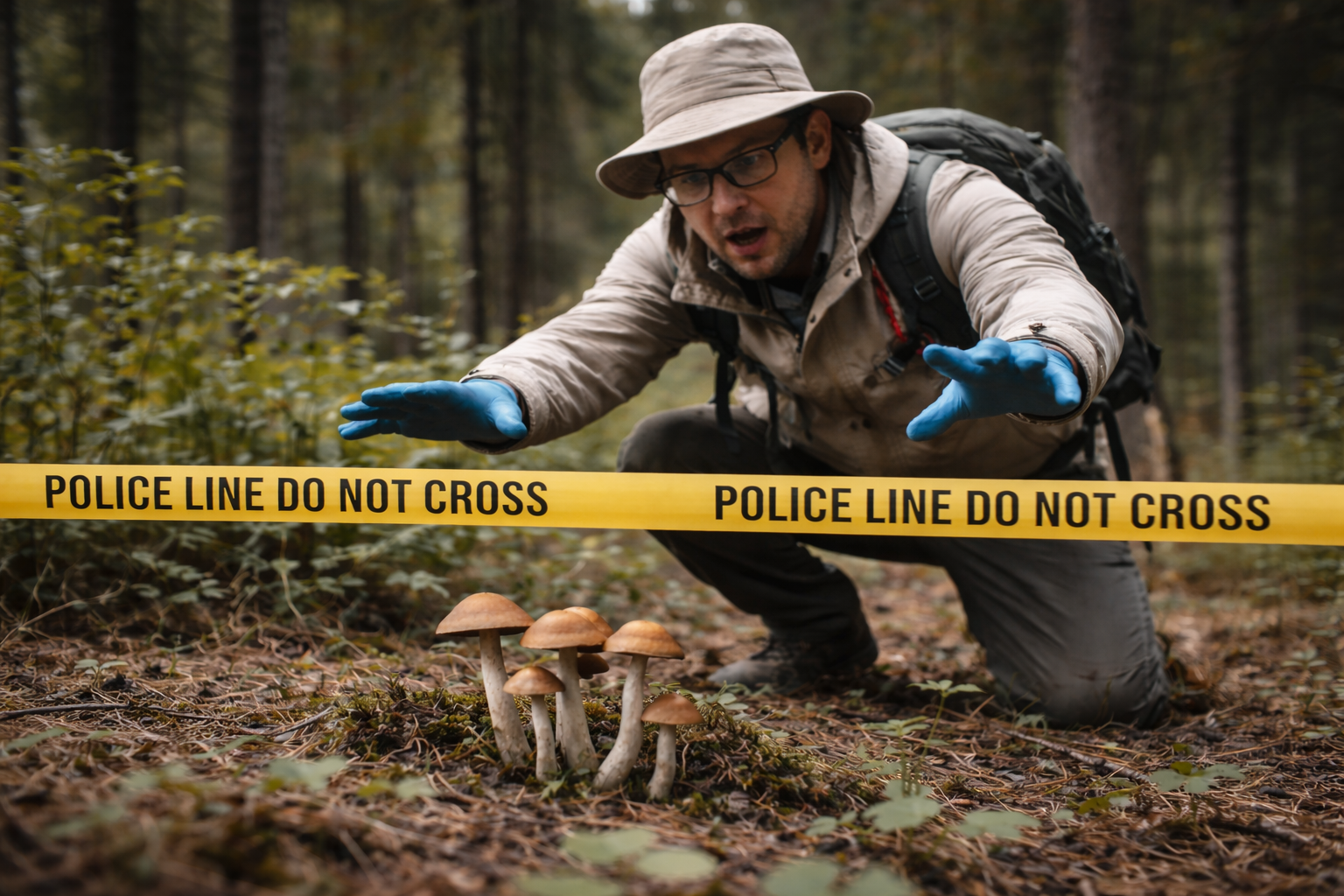
In 2023, researchers at New Zealand’s government-owned fungal collection realised they’d been technically breaking the law for decades. Their crime was storing a dried mushroom specimen – the kind mycologists have been collecting since the 1800s for basic taxonomic research.
They were pressed, catalogued specimens sitting in drawers, many of them endemic species found nowhere else on Earth. But because they contained psilocybin, New Zealand’s Misuse of Drugs Act classified them as Class A substances, the same category as heroin.
It took until 2024 for the government to finally grant permission for researchers to legally possess their own collections.
Harmful or Healing?
Psilocybin consistently ranks as one of the least harmful drugs in harm-reduction studies. Yet it faces the strictest legal controls while we allow damaging substances like alcohol, tobacco and ultra-processed foods to be widely available.
Not only are psilocybin mushrooms non-toxic and relatively safe, new research is now showing they also offer profound mental and physical health benefits. They are proving highly effective at treating mental health disorders including depression, PTSD and addiction, as well as promoting metabolic health through lowering inflammation, improving mitochondrial function, and balancing blood sugar.
The authors also point out that psilocybin-containing mushrooms are the only substance shown to increase “nature-relatedness” – that felt connection to the living world that makes people adopt more eco-friendly behaviours. So we’re legally blocking research into organisms that might help us heal our relationship with nature, at precisely the moment when biodiversity collapse and climate change demand that reconnection.
Nature vs. Man
The legal framework reveals a fundamental tension between how nature works and how bureaucracies think. Mushrooms don’t respect Schedule classifications. Psilocybe species fruit prolifically in council gardens, on roadsides, along footpaths. It’s completely decentralised and unstoppable.
Meanwhile, the centralised control system creates Kafkaesque barriers: researchers wait months for permits to import reference compounds needed for basic chemical analysis. A simple lab procedure becomes a multi-month bureaucratic odyssey. The system is designed to control a black market that exists anyway, while accidentally preventing the science that might lead to genuine understanding and harm reduction.
Not only that, the evidence suggest there has ben no clear benefit to drug harm reduction from decades of prohibition. These restrictions have not reduced drug availability in society and have directly harmed scientific research.
The Unknown Unknowns Problem
Most fungal species on Earth haven’t been discovered yet. In New Zealand, any biological material containing a controlled substance is itself a controlled substance, including undescribed species. This means researchers risk criminal prosecution for collecting mushrooms they’ve never seen before, studying species not yet known to science.
You could be a mycologist documenting biodiversity in a forest, stumble across a new species, and unknowingly commit a felony if that species happens to contain psilocybin or a structurally similar compound. Section 29 of the Act explicitly states that ignorance is not a defense.
The law has essentially criminalised exploration of the unknown.
A Global Problem
Before you think this is just New Zealand being overly cautious, consider that the same barriers exist across most of the world. The United Nations’ drug conventions technically don’t schedule psilocybin-containing mushrooms themselves, but they’ve recommended that countries prohibit them anyway, and most have complied. The UK’s Misuse of Drugs Act (1971), the US Controlled Substance Analogue Enforcement Act (1986), and similar legislation worldwide have created a global research blackout.
The result is decades of stalled scientific progress on organisms that grow wild on every continent except Antarctica. We’re talking about hundreds, possibly thousands of species that remain unstudied – their ecology unknown, their chemical diversity unexplored, and their potential contributions to medicine undiscovered.
This isn’t a hurdle to learning more about psilocybin. It’s a wall. And it’s standing between humanity and knowledge about some of the most fascinating (and beneficial) organisms on the planet.
Need For Research
For anyone thinking about regenerative approaches to human and planetary health, this paper highlights a crucial bottleneck. You can’t regenerate what you don’t understand. You can’t steward biodiversity if scientists face legal barriers to simply documenting what exists.
The authors note that between 1995 and 2024, not a single scientific paper was published on New Zealand’s Psilocybe species. Three decades of undiscovered endemic species, unknown ecological relationships, and unstudied chemical diversity.
All while these mushrooms fruited abundantly in public spaces, completely indifferent to their legal status.
The Path Forward
The paper’s conclusion is that policy reforms should reduce barriers to collection, possession, and study of fungal specimens in non-clinical research. Essentially, just stop criminalising basic natural science.
And things are slowly starting to shift. The FDA has designated psilocybin as a “breakthrough therapy” for treatment-resistant depression. In New Zealand, a single psychiatrist now has approval to prescribe psilocybin-assisted therapy. The UK has begun allowing clinical studies, with Imperial College London’s Centre for Psychedelic Research leading groundbreaking work on how these compounds affect the brain. Johns Hopkins University has established an entire Center for Psychedelic and Consciousness Research, legitimising what was considered fringe science just a decade ago.
That’s great, but these developments focus almost entirely on clinical applications, using isolated psilocybin as medicine. The natural science remains stuck. The mycologists still can’t freely study the organisms themselves, the ecologists can’t map their distributions, the biochemists can’t explore their full metabolic pathways without months of paperwork.
We’re learning how to use the compounds while remaining largely ignorant about the living systems that produce them.
This research highlights how prohibition creates perverse outcomes. It blocks knowledge creation while failing to achieve its stated goals. It treats living organisms as if they were manufactured products that can be controlled through bureaucratic categorisation.
Nature is more complex, more decentralised, and more generous than that. Maybe it’s time our laws caught up.
Source: Lasham S, Ponton R. The impact of drug control on wider research: Psychedelic mushroom exploration. Drug Science, Policy and Law. 2026;12. doi:10.1177/20503245251412697