
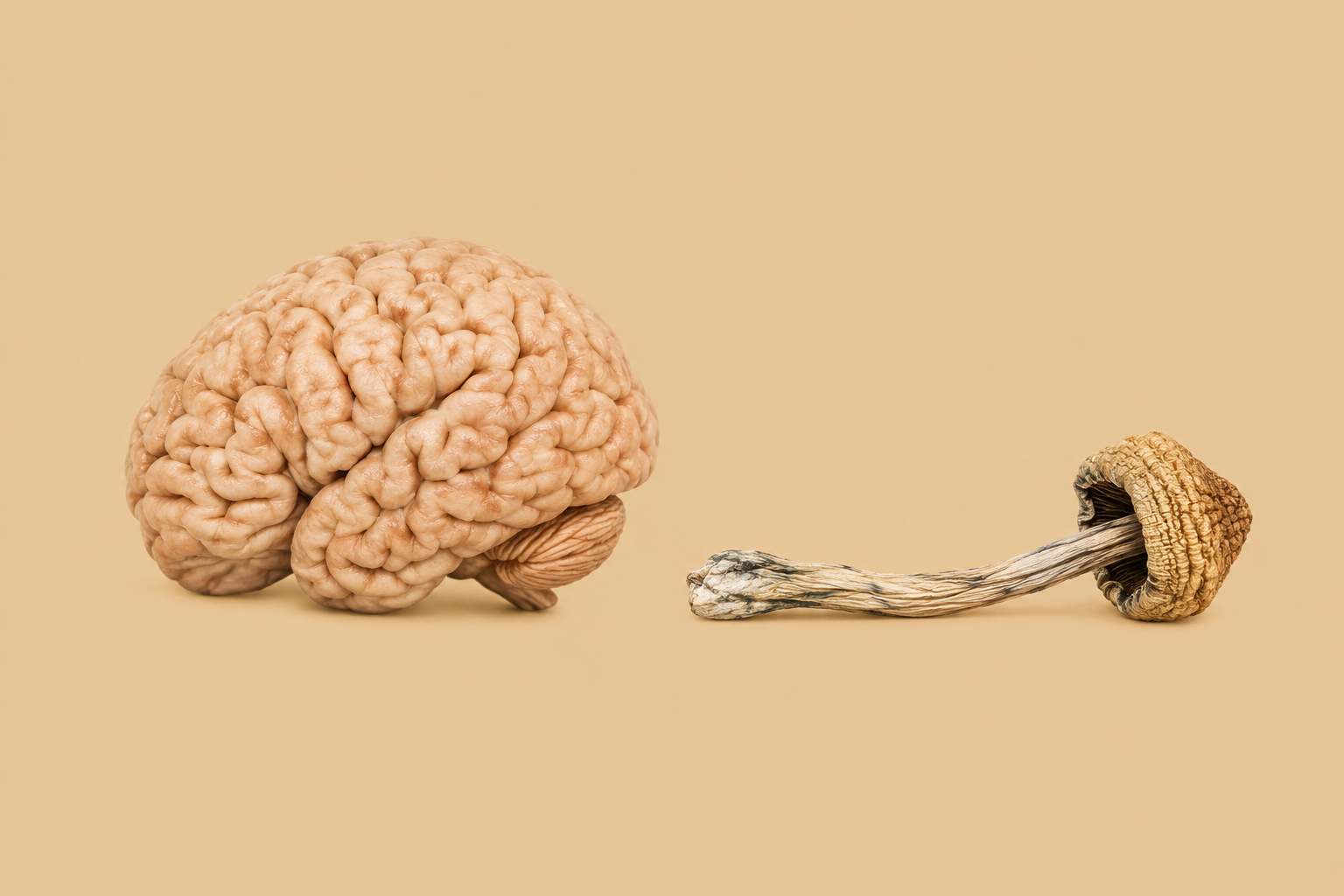
Scientists think psilocybin could be a radical anti-ageing treatment.
A preprint published in April 2026 by researchers at the Medical University of Lodz makes the case that psilocybin may be one of the most effective interventions we have for the specific biology of an ageing brain.
And yet older adults are massively underrepresented in the trials testing it, with only 1.4% of psychedelic trial participants since 1965 aged 65 or over.
The review, titled Psilocybin in Older Adults: Therapeutic Opportunities in Inflammation-Driven Disorders of Aging, doesn’t present new clinical data. But it does is synthesise the evidence into a clear argument. It is a narrative review rather than a meta-analysis, and it is not yet peer-reviewed. But the argument it assembles is fascinating.
Ageing Is an Inflammatory Condition
Here’s the central idea the paper builds on is that getting older isn’t just about time passing. It’s about inflammation accumulating. Researchers call this “inflammaging”. It’s describes a state of chronic, low-grade inflammation that runs in the background of the ageing body, even when there’s no infection or injury. Levels of key inflammatory signals (IL-6, TNF-α, CRP) stay persistently elevated, and over time this smouldering immune activity does real damage.
It shows up in the brain as Alzheimer’s and Parkinson’s. It shows up in mood as late-life depression that doesn’t respond to antidepressants. And these conditions aren’t as separate as they look. Depression in later life significantly increases the risk of subsequent dementia, suggesting they share the same underlying inflammatory biology.
The drugs we currently use for older people with these conditions are poorly suited to them. Standard antidepressants (SSRIs) rely on having enough serotonin circulating to work, which declines with age. Benzodiazepines cause sedation and falls. Antipsychotics carry serious metabolic and movement-related risks. The standard toolkit is, frankly, the not up to the challenge.
Why Psilocybin Fits the Biology
Psilocybin works differently from any existing psychiatric drug, and several of those differences are specifically relevant to ageing.
SSRIs boost serotonin indirectly, by preventing its reabsorption. That only works if there’s enough serotonin being produced in the first place – which there isn’t in an ageing brain. Psilocybin skips this entirely. It acts directly on serotonin receptors, so the age-related decline in serotonin production doesn’t get in the way. There’s also evidence that older brains clear serotonin more slowly, which could actually amplify psilocybin’s effects.
There’s a second mechanism that’s arguably more significant. Recent research (Moliner et al., Nature Neuroscience, 2023) found that psilocin (the active form psilocybin converts into) directly activates TrkB, the receptor for BDNF, a protein the brain uses to grow and rewire itself. BDNF is sometimes called the brain’s fertilizer. It declines with age, and low BDNF is linked to depression, cognitive decline, and neurodegeneration. No existing drug activates TrkB directly. Psilocybin appears to.
Psilocybin also dials down inflammation in the brain. It reduces the activity of NF-κB, a master switch for inflammatory gene expression. It shifts the brain’s tryptophan metabolism toward a neuroprotective compound (kynurenic acid) and away from a neurotoxic one (quinolinic acid). In human volunteers, a single dose lowered circulating inflammatory markers for up to a week. These effects may be stronger in people who are already inflamed. Which is, again, precisely the profile of older adults with depression or neurodegeneration.
One more practical point: psilocybin is broken down by a liver process (glucuronidation) that stays intact with age, unlike the CYP450 enzyme pathways that handle most psychiatric drugs and slow down as we get older. This makes it much less likely to interact badly with other medications, which is a major consideration for older adults who are typically managing multiple prescriptions simultaneously.
Life Extension
The review mentions a 2025 paper from Emory University that shook the world of longevity when it was published. Kato et al. (npj Aging, 2025) ran the first study ever to test psilocybin as an anti-ageing agent at the level of the cell itself.
They treated human cells with psilocin and watched how long those cells lived. The result was that cellular lifespan extended by up to 57%, depending on the dose. The cells showed preserved telomere length (telomeres are the protective caps on chromosomes that shorten as we age), lower oxidative stress, and increased activity of SIRT1 – a protein strongly associated with longevity.
They then gave psilocybin to aged mice (the equivalent of 60-year-old humans) and found that treated animals survived significantly longer than controls. The mice also looked healthier, showing better fur quality, which is a reliable proxy for biological age in rodents. Lead author Kato psaid: “Even when intervention is initiated late in life, it can have dramatic impacts.”
Now, these are cells and mice, not humans. Continuous cell dosing is different from the intermittent doses used in clinical settings. But the study is still significant. It asks a question almost nobody else has: what is psilocybin doing to the body as a whole, not just the brain? The answer appears to be something quite different from what anyone expected.
What We Still Don’t Know
The honest limitation of all this is that the actual evidence base in older humans is almost nonexistent. One systematic review could only find detailed safety data for ten people aged 60 or over who had received psilocybin in a clinical context.
The most substantive data comes from a 2024 study that followed 62 adults aged 60 and above through group psilocybin ceremonies. Wellbeing improved significantly, particularly in those with a history of mental health struggles. Older participants reported less intense psychedelic experiences than younger people (fewer episodes of ego dissolution or mystical states) but their outcomes were just as good.
The NIH-funded INSPIRE Network is now building a research consortium specifically to study psychedelics in older adults.
For a long time, psilocybin was written off as a mind-altering drug and nothing more. Then we learned what it does for mental health. Now the science is suggesting it may be a potent anti-ageing agent. So think again if you believe you’re too old to take a trip.
Jóźwiak-Bębenista M et al. Psilocybin in Older Adults: Therapeutic Opportunities in Inflammation-Driven Disorders of Aging. Preprints.org 2026. doi:10.20944/preprints202604.1125.v1.
The Spore Report covers the science of fungi, neuroplasticity, and regenerative health every week. If this kind of research is what you want more of in your inbox, subscribe here.
I am 85 and have toyed with light mushi and found them enlightening and enjoyable