Here’s a thought experiment. Take a person who grew up in a city, spends their days under LED office lights, and wears UV-blocking sunglasses whenever they step outside. Are they well protected from the sun? Or are they, in some important biological sense, running on the wrong kind of light?
Dr. Alexander Wunsch, a German physician and photobiologist who has spent decades studying how light interacts with the human body, would say the second. His argument, developed in a recent interview with Ra Optics where he serves as Chief Science Officer, starts with a simple observation: for most of human evolutionary history, the light reaching our eyes and skin arrived pre-filtered through a forest canopy.
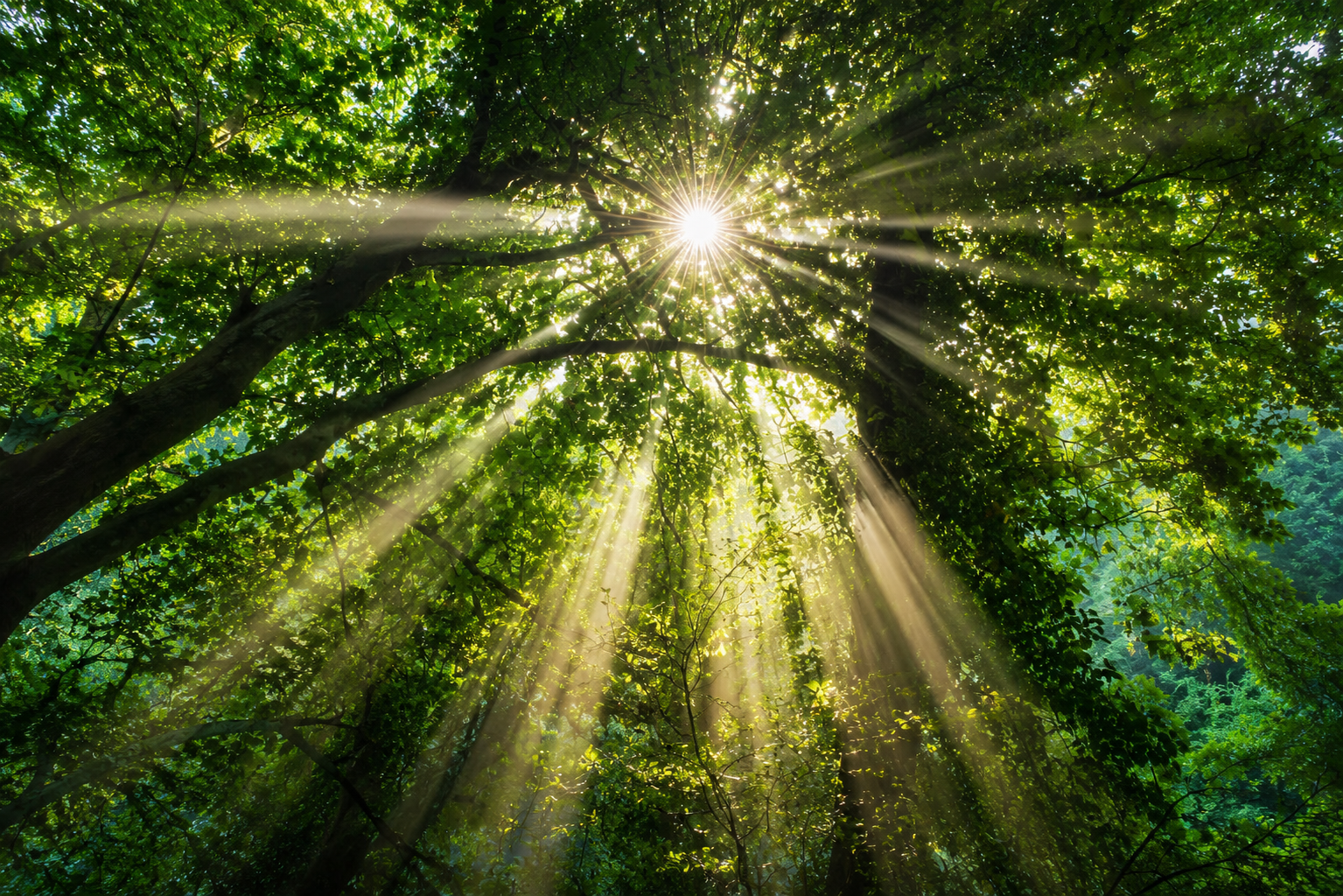
Leaves absorb blue and red wavelengths and let green and near-infrared through. They dramatically reduce UV load. The result, for our ancestors, was a particular flavour of light: green-rich, warm, gentle on UV. That forest spectrum, Wunsch argues, is what our biology was calibrated for. It’s the light our eyes evolved to expect every morning.
Today, most of us never get it.
The wrong kind of light environment
Instead of forest light, we get concrete, glass, and LEDs. These give us a fundamentally different spectral mix: heavy in blue, stripped of near-infrared, bouncing UV off reflective surfaces in ways that bypass any natural filtering.
The consequences show up in the body in ways you might not expect. The retina isn’t just a camera. It contains a class of cells that aren’t involved in vision at all. Their job is to read the light environment and set the body’s clocks, regulating hormones, alertness, and sleep cycles via the brain’s autonomic centres. Blue light, delivered in isolation without the broader spectral context of natural light, gives these cells a signal that evolution never prepared them for.
Wunsch is also interested in what happens at the skin level. When we evolved in forest environments, our bodies were surrounded by that chlorophyll-rich spectral background. We then lost our body hair, probably as a thermoregulatory adaptation for life on open savannahs, which stripped away a natural UV barrier. The body compensated with melanin, hormonal UV-signalling systems, and a protective thickening of the skin’s outer layer called the solar callus.
The solar callus is your body’s built-up UV tolerance, developed gradually through repeated, moderate sun exposure. It’s a biological asset. And according to Wunsch, many people are unknowingly stripping it away with frequent washing using products that abrade the skin’s surface layer, leaving themselves more vulnerable to burning despite thinking they’re being careful.
The forest bathing connection
Shinrin-yoku, or forest bathing, the practice of spending unhurried time walking in woodland, has been studied seriously for several decades. The findings are consistently remarkable. A comprehensive review of shinrin-yoku studies compiled data from 24 forests across Japan and found that cortisol levels dropped by an average of 12.4 percent after forest walks compared to urban walks, with blood pressure falling significantly in participants with elevated baseline levels.
The immune effects are particularly interesting. Research by immunologist Dr. Qing Li at Nippon Medical School in Tokyo found that a three-day forest trip produced a 50 percent increase in natural killer (NK) cell activity, the immune cells responsible for fighting infections and tumours. That boost lasted for seven days after just a single day trip to a forest park.
Researchers initially assumed the benefits came from stress reduction and fresh air. Then they found phytoncides: antimicrobial compounds released by trees, particularly cedar and cypress, that appear to directly stimulate immune activity when inhaled. The forest air is chemically active in ways city air simply isn’t.
But Wunsch’s work adds a dimension that the shinrin-yoku researchers haven’t fully explored: the spectral quality of the light itself. The forest isn’t just delivering better air. It’s delivering better light, the precise mix of wavelengths that our eyes and skin evolved to process. When you step into a forest, you’re not just lowering your stress hormones. You’re giving your retina the morning signal it’s been waiting for.
What this means in practice
The combined picture from photobiology and forest medicine suggests something worth sitting with: that the modern environment is subtly misaligned with what our biology expects, not catastrophically, but persistently, across multiple channels at once.
Getting outside is clearly good. But the forest specifically seems to do something that a city park doesn’t quite replicate, and the light, filtered through canopy rather than reflected off buildings, may be a significant part of why.
Wunsch’s practical advice is less exotic than you might expect. Build sun exposure gradually rather than oscillating between total avoidance and burning. Don’t reach for sunglasses for every outdoor moment, especially in the morning when the light signal matters most to your circadian system. And treat time among trees as a biological need rather than a leisure activity.
The forest, it turns out, was doing more than providing shelter. It was providing an instruction set. One that our cells still know how to read. We just stopped giving them the chance.
The Spore Report covers the science of fungi, neuroplasticity, and regenerative health every week. If this kind of research is what you want more of in your inbox, subscribe here.