
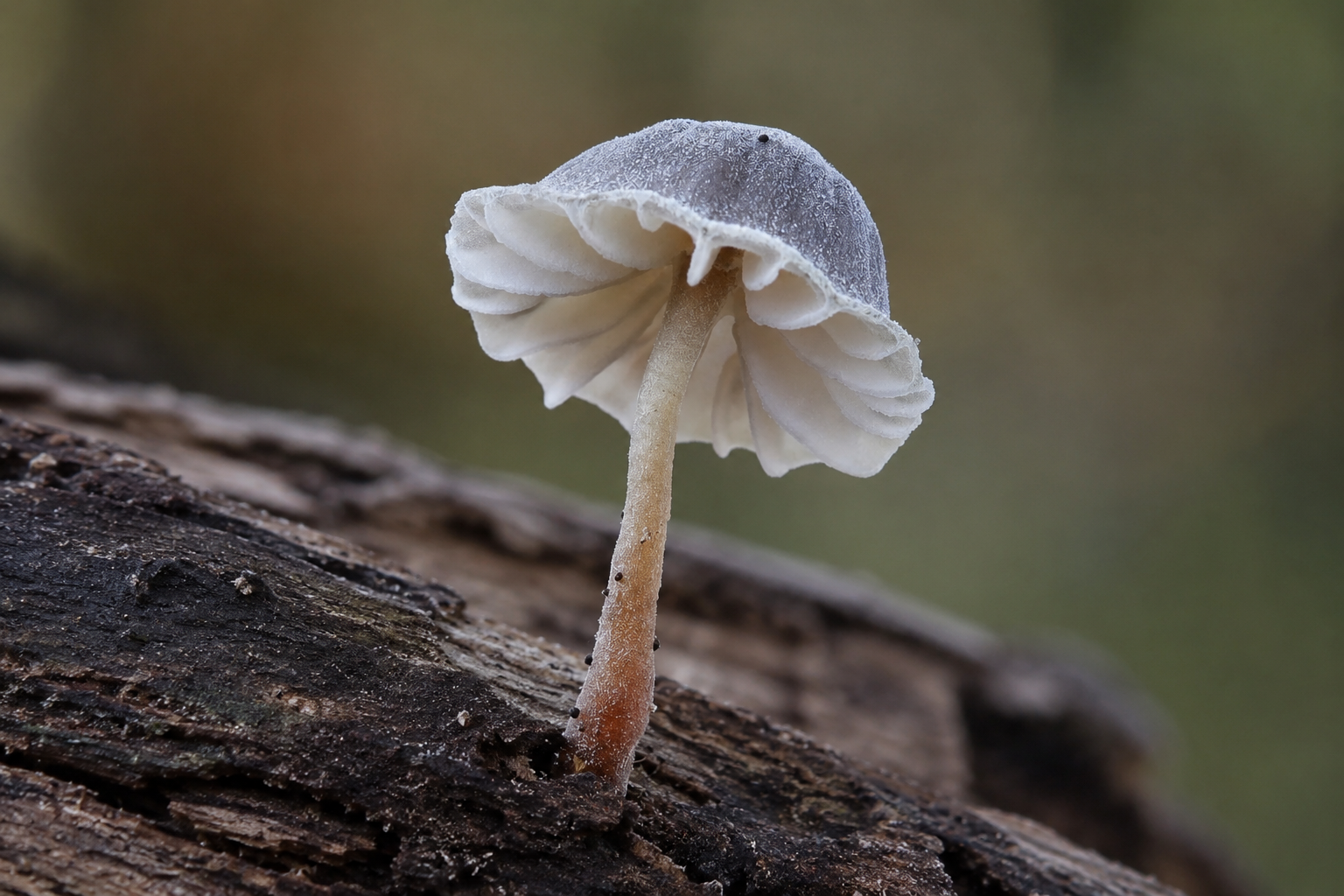
A new study from the world’s most remote atoll highlights how you cannot restore life without restoring fungi first. And the principle goes deep.
Palmyra Atoll is an island so remote and so pristine that visiting scientists have to freeze their clothes to stop non-native organisms hitching a ride on their gear. Palmyra Atoll sits in the middle of the Pacific, equidistant between Hawaii and Samoa, and for decades it has served as a living laboratory for what ecological recovery looks like when humans get out of the way.
Recently, conservationists have been removing Palmyra’s biggest invasive species, non-native coconut palm plantations, so that Pisonia grandis, an important indigenous rainforest tree, can grow back.
Now, research published in Current Biology (April 2026) by a team from Lund University, the University of Oxford, and the Society for the Protection of Underground Networks (SPUN) has revealed that removing the invasive tree is not enough to regenerate the rainforest – native fungi are needed.
An Ecosystem Hidden Underground
Palmyra’s native forest has been historically dominated by Pisonia grandis, a large broadleaf tree that forms dense canopies across the atoll’s islands. These trees are the backbone of the entire ecosystem. Seabirds nest in their canopies in vast numbers. Their guano flows into the surrounding ocean, fertilising plankton, which in turn sustains coral reefs. The reef grows faster, supplies sediment to the island’s shoreline, and helps it stay above the waterline as sea levels rise.
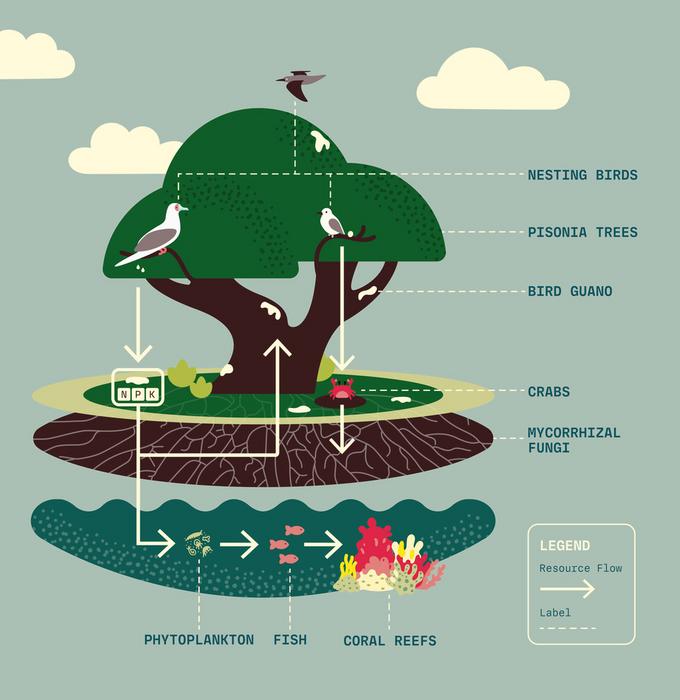
The cycle sounds like it starts with the tree. The study reveals it starts underground.
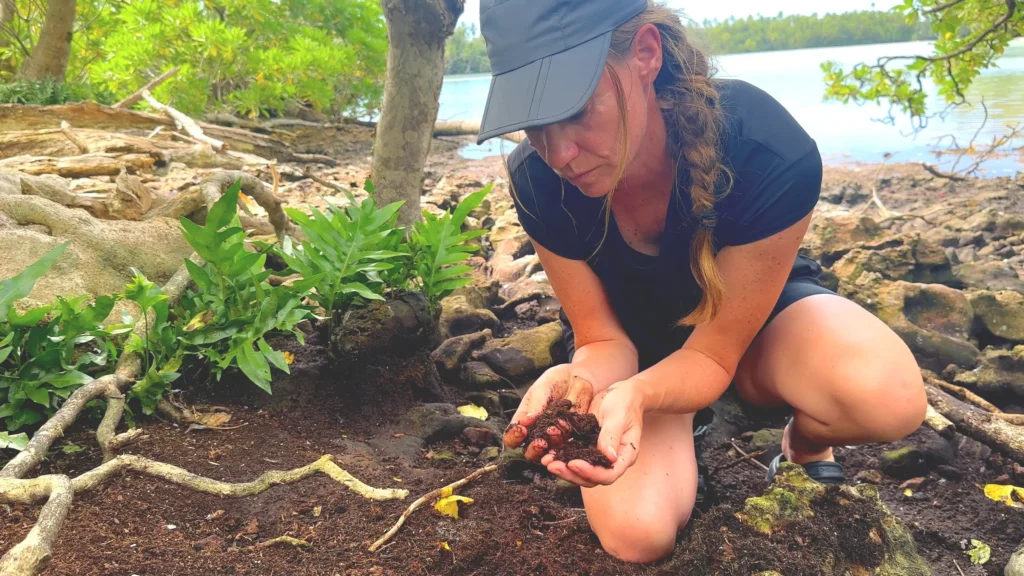
When researchers sampled the soil beneath Pisonia, they found rare mycorrhizal fungi, including several species found nowhere else on Earth. These organisms form an intricate symbiosis with the trees’ root systems, trading phosphorus, nitrogen, and water for carbon, and appear to be essential to the trees’ capacity to establish and thrive in the atoll’s demanding conditions.
The problem is that this fungal layer was almost entirely absent beneath the invasive coconut palms that had replaced the native forest across much of Palmyra. Not only have the palms displaced the trees, they have erased the underground network those trees depended on.
As lead author Charlie Cornwallis of Lund University put it: “The health of Palmyra’s coral reefs ultimately depends on seabirds, which depend on Pisonia trees for nesting, which depend on fungi. Remove any link in that chain and the whole system could unravel.”
The Missing Piece Of Conservation
The study highlights a broader argument. For generations, conservation and restoration efforts have focused almost exclusively on what is visible. Plant trees, reintroduce animals, and remove invasive species. What this research makes clear is that restoration without the fungal layer is like rebuilding a house without foundations. It might last for a while, but it will soon collapse.
Coauthor Toby Kiers of Vrije University Amsterdam, one of the foremost researchers in mycorrhizal networks, described it plainly: “Until now, restoration has almost exclusively focused on native plants. That is changing. Research is showing how successful restoration involves introducing native plants together with native fungi.”
This is the hidden dependency at the heart of regeneration. And it is not unique to remote atolls.
A Principle That Scales
If you have read our recent piece on fungi and regenerative farming, the Palmyra findings will feel immediately familiar. The logic is the same, whether the ecosystem in question is a Pacific island or a field in Yorkshire.
Mycorrhizal fungi form symbiotic partnerships with around 80% of all land plants. They extend hyphal networks through soil, accessing nutrients and water in exchange for carbon. They connect neighbouring plants in common networks, allowing nutrient transfer across root systems. They are, in the most literal sense, the connective tissue of healthy soil.
Industrial agriculture has spent the last century systematically destroying this infrastructure. Tillage severs hyphal networks that take months or years to mature. Synthetic fertilisers reduce the selection pressure that makes fungal partnerships worth maintaining from the plant’s side. A plant saturated in applied nutrients has less reason to invest in a mycorrhizal relationship. Over time, the fungi diminish, the soil biology simplifies, and the whole system becomes dependent on external inputs to function at all.
The Palmyra study makes this degenerative logic visible at ecosystem scale. When the fungal layer was erased by invasive species, the trees could not regenerate even after the palms were removed. The upstream cause of ecological collapse was not the absence of trees, but rather the absence of fungi.
Fungi, Soil, and the Nutrient Chain
As we explored in our piece on regenerative farming, ergothioneine is an amino acid produced almost exclusively by fungi and certain soil microorganisms. Plants acquire it through their root systems via mycorrhizal symbiosis. When soil fungi are abundant, crops accumulate it in proportion. When soil fungi are depleted, the supply chain breaks.
Ergothioneine concentrates in the tissues under the highest oxidative load, the liver, kidneys, bone marrow, and brain. Researchers have linked chronically low levels to faster rates of cognitive decline, and some now classify it as a longevity vitamin, a compound so critical to cellular protection that humans evolved a dedicated transporter protein just to absorb it from food.
The mechanism that delivers this compound from soil to human tissue runs directly through the mycorrhizal network. Disrupt the fungi, and you disrupt the entire chain: from soil health, to plant health, to animal health, to human health.
This is not a metaphor. It is a nutrient pathway, and it depends on a living fungal layer in the soil.
The Same Logic, Inside Your Body
The Palmyra chain, fungi to trees to birds to reefs, is a nested dependency: each layer only functions because the layer beneath it is intact. Strip one out and the whole system stalls. Your gut works the same way.
The human gut microbiome is an ecosystem. Like soil, it is home to thousands of species in dynamic relationship, bacteria, archaea, and fungi, all participating in processes that the body cannot perform alone: producing short-chain fatty acids that feed the gut lining, synthesising B vitamins, regulating immune tone, producing neurotransmitter precursors, and maintaining the mucosal barrier that separates the gut’s contents from the bloodstream.
Fungi are a component of that infrastructure that has been consistently underestimated. The gut mycobiome (the fungal fraction of the microbiome) is smaller in number than the bacterial population but functionally significant. Candida, Saccharomyces, and Malassezia species are among the most commonly studied residents, and their relationship with bacterial communities shapes immune responses in ways that are still being mapped. When the balance is right, fungi appear to be part of what keeps inflammation in check. When it is disrupted, as in dysbiosis, fungal overgrowth correlates with increased intestinal permeability, systemic inflammation, and a range of conditions including IBD, metabolic disease, and neurological symptoms.
The parallel to soil is clear. Industrial food, ultra-processed and antibiotic-laden, does to the gut what intensive tillage does to farmland. It disrupts the fungal layer, simplifies the ecosystem, removes the checks and balances that a complex microbial community provides, and leaves the system reliant on external inputs (medications, supplements, interventions) to function at all.
Soil depletion and gut depletion are not separate problems. They are the same degenerative process operating at different scales. What you eat is downstream of how it was grown. If the soil has lost its fungal network, the food carries less of what your gut ecosystem needs to maintain its own. The chain from Palmyra’s forest floor runs, more directly than it might seem, all the way to the microbiome inside you.
What Regeneration Actually Requires
The Palmyra study has a practical conclusion that the research team are now acting on. Successful restoration, they argue, means reintroducing native plants alongside native fungi. Without the fungal component, even well-resourced conservation projects may fail to trigger the regenerative dynamics they are trying to restore.
This matches what the regenerative agriculture movement has been learning through field practice. Cover cropping, minimal tillage, avoidance of synthetic fungicides, and maintaining living root systems year-round all work, in significant part, because they protect and rebuild fungal communities. The visible outcomes (higher yields, more resilient crops, richer soil) are downstream effects of a fungal infrastructure being allowed to function.
Whether you are looking at a remote Pacific atoll or a farmed field, the same principle applies. Regeneration is about more than what you plant or remove. It is about whether the underground network is there to make it possible.
The Underground Layer We Keep Overlooking
From the remote atolls of the Pacific, to trials in maize and soybean fields, to epidemiological data on human cognitive health, the evidence keeps converging on the same substrate: the fungal network in the soil beneath our feet.
We have built entire systems of agriculture, conservation, and land management largely without accounting for it. The Palmyra study is a reminder of what that oversight costs.
It also points toward what is possible when we stop overlooking it.
The full study, “Symbiotic fungi underlie the regeneration potential of island rainforests,” is published in Current Biology (2026). Read our related piece on fungi as the missing piece of regenerative farming.


One thought on “Fungi Are Key to Regeneration”