
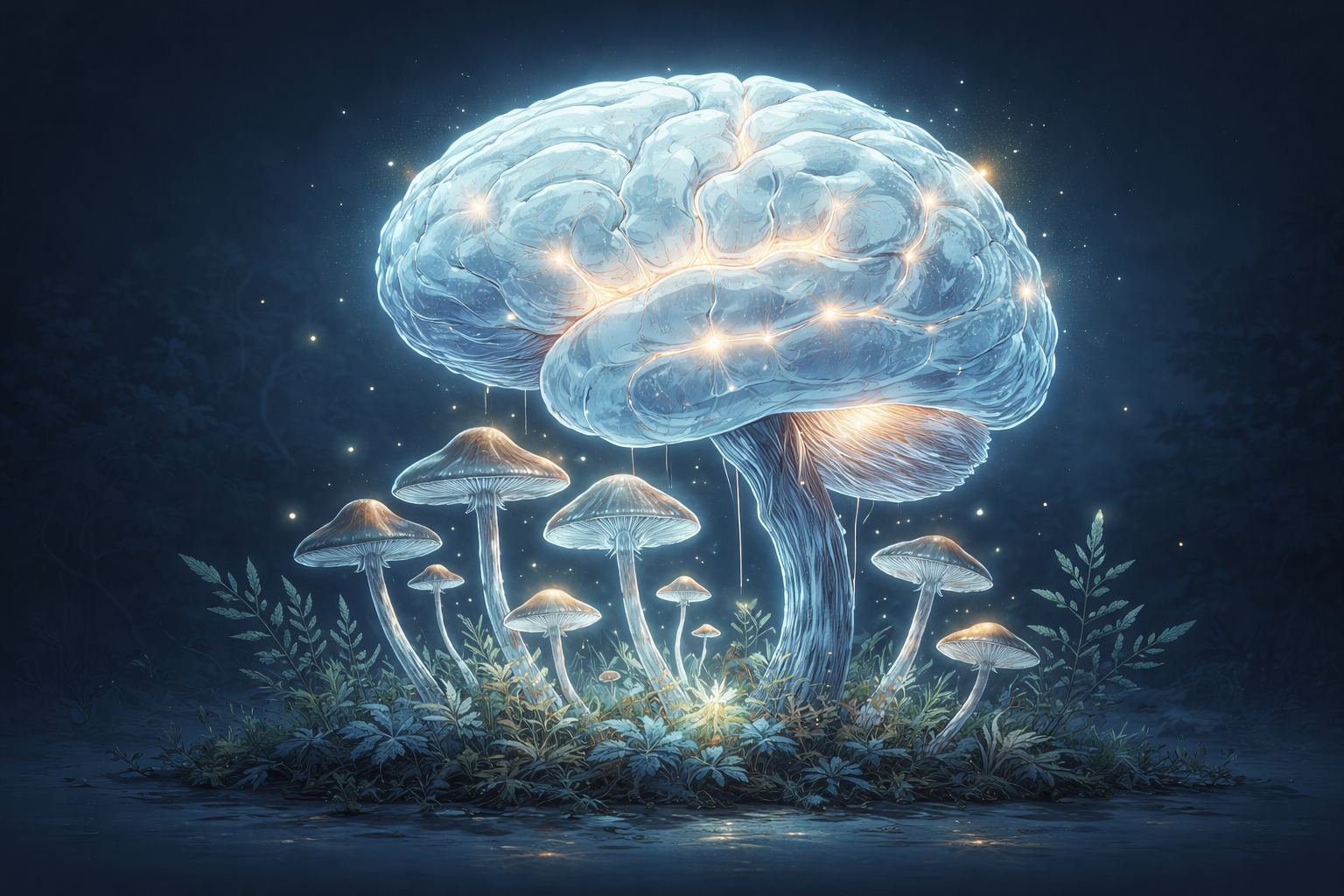
We’ve been sold the wrong story about microdosing.
The pitch has always been: take psilocybin, unlock limitless creativity, become a productive machine. The Silicon Valley dream packaged in a limitless-style capsule.
But a major new study published in Neuropharmacology by researchers at Leiden University just flipped that script.
Microdosing psilocybin doesn’t make you produce more ideas. But it does make you produce better ones.
More vs Better
Luisa Prochazkova and her team at Leiden University ran three separate double-blind, placebo-controlled trials with 171 participants over several years. They tested different doses of psilocybin truffles – from 0.65 grams up to 1.5 grams – in conditions designed to mimic how people actually microdose in real life.
They measured two types of creative thinking: convergent (finding the one right answer) and divergent (generating many possibilities). The hypothesis was that psilocybin might boost cognitive flexibility by relaxing rigid thought patterns without overwhelming control.
Here’s what happened. Microdosing didn’t improve logical problem-solving. It didn’t increase the number of ideas people generated. But it significantly improved the originality-to-fluency ratio, meaning participants produced a higher proportion of unique, uncommon ideas relative to their total output.
So they weren’t thinking faster, but they were thinking differently. And that difference was statistically real (although subtle), even when researchers controlled for placebo effects.
Brain Default
When we generate ideas, we tend to start with what’s closest.
For example, when you’re asked to list uses for a towel, you say: to dry off, as a beach blanket, gym gear. Everyone does. These responses come from pattern recognition, from what your brain has seen before.
Only after you exhaust the familiar do you start reaching for something genuinely novel. That’s when creativity actually begins.
What this study suggests is that psilocybin helps you bypass that initial phase of obvious associations. It loosens your brain’s reliance on prior knowledge, letting you access remote, abstract concepts earlier in the process. So essentially you’re generating ideas from a different place.
That’s cognitive flexibility. And it has everything to do with how your brain manages energy, forms connections, and decides what’s worth paying attention to.
Awakening
This finding lands differently when you consider the Awakened Ape Theory which we wrote about recently.
Dennis McKenna and modern neuroscientists are revisiting Terence McKenna’s controversial hypothesis that psilocybin mushrooms catalysed the rapid evolution of human consciousness. Not as the sole driver, but as a catalyst that tipped the balance.
The same mechanism this study identified (loosening rigid thought patterns, bypassing obvious associations, and accessing remote concepts) could be exactly what early humans needed to make the leap to symbolic thought and language.
Psilocybin, as this study confirms, makes your brain more flexible. It relaxes the hierarchical control that keeps you locked into familiar patterns. And in small doses, it does this without impairing function. Visual acuity can even improve.
If your ancestors stumbled onto these mushrooms growing in dung on the African grasslands two million years ago, and if they consumed them regularly in low doses while hunting and gathering, you’re looking at a naturally occurring neuroplasticity enhancer in the exact ecosystem where human brain size tripled.
I’m just sayin…
Flexibility Over Force
This isn’t just about microdosing. It’s about what happens when your brain stops clinging to rigid pathways.
Neuroplasticity (the brain’s ability to reorganise itself) largely depends on metabolic health. Your neurons need clean energy to form new connections. They need mitochondria that work. They need an environment that’s not inflamed, not stressed, and not locked into patterns that served you once but don’t serve you now.
Psilocybin works on the brain in ways that temporarily relax hierarchical control. It’s allowing it to explore and connect differently. And it’s a principle that applies beyond psychedelics: flexibility over force.
Mushrooms operate on this same principle. In nature, they break down matter to create the conditions for new growth. In humans, certain medicinal species restore the conditions under which your body and brain can do what they’re designed to do: adapt, connect, and create.
Lion’s mane, for instance, supports nerve growth factor production. Again, it’s not a stimulant and doesn’t make you think faster. But it does help maintain the infrastructure that makes flexible, adaptive thinking possible over time. It’s the difference between flooring the accelerator and maintaining the engine.
Meaning
We live in a culture obsessed with output. It’s almost impossible to avoid. More posts, more projects, more hustle. But what if the goal isn’t to generate endlessly? What if it’s to generate meaningfully?
This study suggests that the quality of your thinking matters more than the speed. That originality is more about access to parts of your mind that don’t get heard when you’re locked into default mode.
That’s how insight works and how breakthroughs happen. And while psilocybin might offer a temporary window into that state, the real work – the work of maintaining cognitive flexibility, metabolic health, neuroplasticity – that’s a daily practice.
And it starts with supporting your brain’s capacity to adapt.
If you’re interested in learning more about mushrooms, sign up to read The Spore Report newsletter every week.
For daily support of cognitive function and neuroplasticity, Mushies’ Lion’s Mane capsules works on the same first-principles approach to help your brain maintain the infrastructure for flexible, adaptive thinking over time.
And if you want to go deeper into brain health, check out The Decentralised Brain Protocol – A 7-Day system for restoring mental clarity, energy, and cognitive resilience.
Source: Microdosing psilocybin and its effect on creativity: Lessons learned from three double-blind placebo controlled longitudinal trials,” authored by Luisa Prochazkova, Josephine Marschall, Michiel van Elk, et al.


I am interested in this, but have questions. Thank you, Lindy