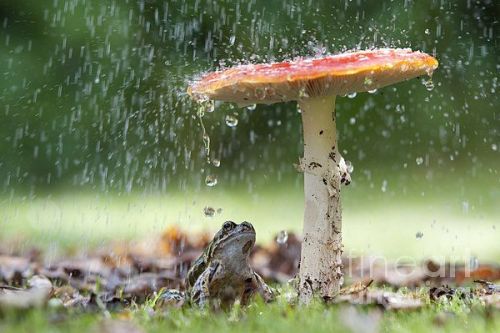
Buried in the soil, microscopic fungi are secreting proteins so effective at forcing water to freeze that, when the wind carries them into the clouds, they can trigger rainfall over entire regions.
A study published in Science Advances by researchers at the Max Planck Institute for Polymer Research, Boise State University, and Virginia Tech has identified a previously unknown class of ice-nucleating proteins in fungi belonging to the family Mortierellaceae, and the implications stretch well beyond basic mycology.
First, a quick lesson in how rain actually forms
Most rain doesn’t start as liquid water. It starts as ice. High in the atmosphere, water droplets can stay liquid at temperatures well below freezing, sometimes as low as -40°C. This is called supercooled water, and the reason it doesn’t freeze is that it has nothing to hold onto.
For ice to form, water molecules need a surface to crystallise around. These surfaces are called ice nucleators, and things like dust, soot, and sea salt can serve this role, but they’re not particularly good at it. They usually need temperatures to drop quite significantly before they kick in.
This is where biology steps in. For decades, scientists have known that certain bacteria, particularly Pseudomonas syringae, produce proteins that cause water to freeze at temperatures as warm as -2°C. These bacteria typically live on plant leaves, and they evolved this ability as a kind of parasitic tool in that they trigger frost damage, break open the plant tissue, and then consume the nutrients inside. As a side effect, when wind sweeps these bacteria into the atmosphere, their ice-nucleating proteins turn them into remarkably efficient cloud seeds.
This is what researchers call the bioprecipitation cycle, a feedback loop in which microbes trigger rainfall that in turn supports microbial growth on the ground below. That part has been known for a while. But this new research adds something no one was expecting.
Fungi that secrete ice
The Mortierellaceae fungi at the centre of this study grow in garden soil, agricultural fields, forest floors, and Arctic tundra on virtually every inhabited continent. They are not rare or exotic. What researchers didn’t know until now is that they produce proteins capable of forcing ice formation at temperatures between roughly -5.6°C and -7.5°C, temperatures that sit right in the range where most of the world’s precipitation is initiated.
The key difference between these fungal proteins and the bacterial ones is structural. Bacterial ice-nucleating proteins are anchored to the cell membrane. They’re fixed to the surface of the bacterium, which means the bacterium itself needs to reach the atmosphere to function as a cloud seed.
Fungal proteins are different. They’re secreted freely into the surrounding environment as water-soluble, membrane-independent molecules. They can wash into streams, dry into dust, and travel through the atmosphere as dissolved particles small enough to pass through filters that block whole cells. They also keep working after the fungus has long moved on.
The proteins are built from subunits that assemble into large complexes, forming extended ice-binding surfaces that align water molecules and force them to crystallise. They’re also unusually hardy, surviving extreme pH and high temperatures, which is part of why they remain active in soil and atmosphere long after secretion.
An evolutionary heist
Now, these fungi didn’t evolve ice-nucleation from scratch. By analysing their genetic code, the research team found that a fungal ancestor almost certainly acquired the gene responsible for this ability from bacteria, through a process called horizontal gene transfer.
This is essentially biological copy-and-paste. Rather than inheriting DNA only from parents, microbes can occasionally absorb functional genetic code from completely unrelated neighbouring organisms. The specific gene transferred is called InaZ, the same gene that encodes ice-nucleating proteins in bacteria.
This kind of cross-kingdom gene transfer between bacteria and fungi doesn’t happen often. But when it does, the receiving organism can end up with a capability it never would have developed on its own. In this case, the fungi did more than just borrow the gene. They improved on it. The bacterial protein stays tethered to the cell, but the fungal version became water-soluble and free-floating, making it far more mobile and atmospheric.
The feedback loop beneath your feet
What this adds up to is what some researchers now describe as a bio-precipitation feedback cycle, and fungi appear to be a central driver of it. Mortierellaceae grow in moist soil; they secrete proteins that get carried into the atmosphere by wind; those proteins seed ice formation in clouds at relatively warm temperatures; rainfall is triggered; the soil is watered; the fungi grow and secrete more proteins. The organisms below are, in part, regulating the moisture regime above them.
Unlike Pseudomonas, which uses ice nucleation destructively to parasitise plant hosts, Mortierella appear to operate as mutualists. Secreting these proteins into the soil around plant roots creates a kind of thermal buffer, controlling ice formation in a way that protects delicate fungal hyphae from the mechanical damage of uncontrolled freezing, while also benefiting the plants the fungi are partnered with. The rainfall this system helps generate keeps the whole ecosystem hydrated.
Some researchers argue this feedback has been operating for an extraordinarily long time, and that many landscapes don’t passively receive weather so much as actively participate in generating it. Vegetated land emits water vapour and biological ice nucleators into the atmosphere, which promote cloud formation and precipitation, which in turn supports the biological life that continues the cycle. The current study adds a new and underappreciated actor to that system.
Why any of this matters now
There are two immediate practical implications worth taking seriously. The first is conservation. When a forest is cleared, we’ve tended to think about the losses in terms of carbon storage, biodiversity, and soil stability. The Mortierellaceae finding adds another category. The disruption of a protein-secreting network that was actively contributing to regional precipitation. Cutting down forests may not just reduce the trees that absorb rain; it may eliminate the biological system that was helping to generate the rain in the first place.
The second implication is weather modification. Cloud-seeding programs already exist in the UAE, China, and parts of the United States, but they rely on silver iodide, a heavy metal that persists in the environment and carries its own ecological concerns. A natural, biodegradable, highly effective ice-nucleating protein produced by a fungus found in virtually every soil type on earth is an obvious candidate for a cleaner alternative.
Beyond cloud seeding, the proteins have potential applications in cryopreservation, food processing, frost protection for crops, and artificial snow production at higher temperatures and lower energy cost.
The researchers are clear that significant questions remain. The exact function these proteins serve for the fungi themselves hasn’t been fully resolved, and their precise contribution to global precipitation relative to bacteria and other particles requires more modelling. But the proteins have been structurally characterised, their evolutionary origin traced, and their ice-nucleating activity confirmed in isolated form and when expressed in model organisms.
The key to generating water is in the soil. It turns out some of it has been there for hundreds of millions of years, running quietly beneath forests that may have been, at least in part, watering themselves.
The Spore Report covers the science of fungi, psychedelics, neuroplasticity, and regenerative health. If you found this useful, you can subscribe to our newsletter here.