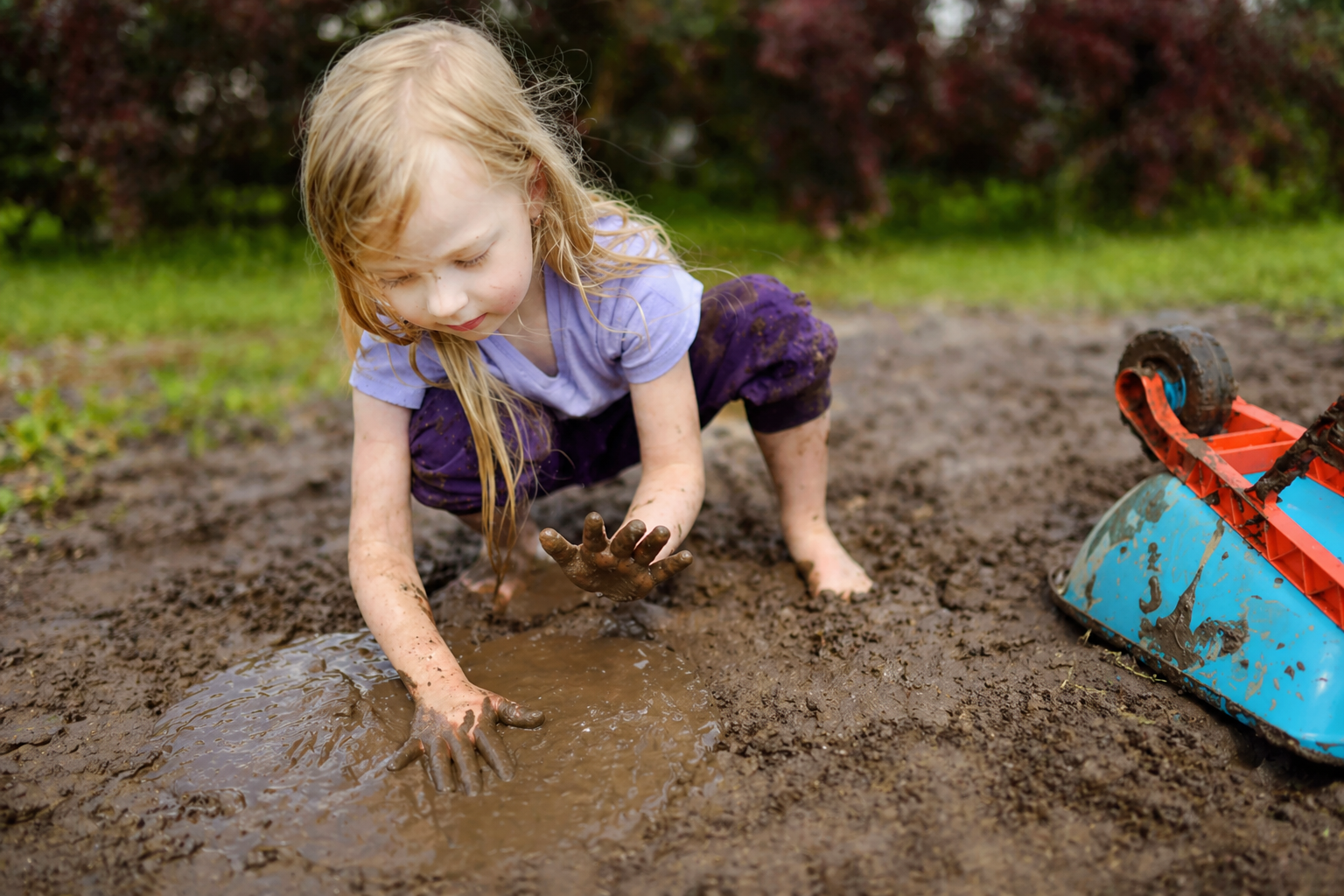
Most kids love to jump in muddy puddles and roll in the dirt. And research shows that’s a good thing, especially for their immune system and chances of developing allergies.
That’s the implication running through a two-year study out of Finland, and it helps explain why the scrubbed-clean environments we’ve built for children may be doing them harm in ways that only show up years later in the form of allergies, autoimmune conditions, and a dysregulated immune systems.
Across 43 daycare centres, researchers from Finland’s Natural Resources Institute swapped rubber mats, asphalt, and plastic flooring for soil, sand, moss, live plants, and in some cases entire sections of imported forest floor. They tracked what happened inside the bodies of 75 children aged three to five, sampling microbes from skin, saliva, and faeces, and drawing blood to look at immune markers.
The results revealed that children playing in the rewilded environments showed fewer disease-associated bacteria like Streptococcus on their skin. Their gut microbiota showed reduced levels of Clostridium species (bacteria linked to inflammatory bowel disease, colitis, and sepsis). Within 28 days, in fact, blood samples showed an increase in T regulatory cells, the immune cells that protect the body from attacking itself.
Children in standard asphalt-and-plastic playgrounds showed none of these shifts. The full Finnish research programme is ongoing, with €1m distributed across participating centres.
The researchers are careful not to claim causation. But the signal is consistent, and it lines up precisely with a growing body of evidence that has been accumulating for years.
The Soil Is the Infrastructure
If you read our piece earlier this year on soil fungi and childhood allergies, this will feel like confirmation. Research presented at AGU’s 2025 Annual Meeting analysed data from over a million children across 250 cities in 97 countries, cross-referencing it with 8,200 soil samples collected globally. The astounding finding was that soil microbiome composition was up to four times more predictive of childhood allergic disease than any other factor measured, including climate, wealth, pollution, and genetics.
What’s striking about both bodies of research is what they converge on. It isn’t simply about having more microbial diversity in your environment. It’s about the right community structure, the particular assemblages of fungi and bacteria that co-evolved with human immune systems over hundreds of thousands of years.
This is the core of the “old friends” hypothesis. Humans evolved in constant contact with soil microbes, plant life, airborne fungal spores, and the living ecosystems beneath their feet. Our immune systems didn’t develop in spite of that exposure. They developed through it. The immune system learned to distinguish threat from non-threat by being trained against a rich and varied cast of microbial life from birth. When that training environment disappears, evidence suggests the system becomes reactive, confused, and prone to treating harmless substances as enemies.
Allergies, asthma, and autoimmune conditions are, in this framing, a product of what children aren’t regularly exposed to.
What’s Actually Being Transferred
At Humpula daycare in Lahti, principal scientist Aki Sinkkonen watched five-year-old Aurora Nikula make a cake from mud, sand, leaves, and water, pressing handfuls of it against her face. “Perfect,” he said. Because it was exactly the kind of direct, unfiltered contact with microbial life that the study was designed to facilitate.
The mechanism here is worth understanding. The human body contains trillions of bacteria, viruses, and fungi that are active participants in immune regulation, metabolic function, and neural signalling. Research shows that external microbial diversity is transferred into the body through touch, ingestion, and inhalation.
Soil alone hosts around 90% of the world’s fungi. The air above biodiverse ground carries its own microbiome, shaped by the plant and fungal species present. A child playing in rich soil isn’t just getting dirty and having fun. They’re receiving a continuous, complex biological input that their developing immune system is calibrated to learn from.
The specific finding around T regulatory cells is especially important. These cells are the immune system’s moderating force. They suppress excessive inflammatory responses and prevent the body from mounting attacks against its own tissue. Their increase within 28 days in the rewilded groups suggests that microbial exposure actively shifted immune architecture in a profound way. Related research corroborates this, showing that urban biodiversity loss is mirrored by a corresponding loss of microbial diversity within the human body, with direct downstream effects on immunoregulation.
An Australian study published last year added further weight, finding that children who played with a range of different soils showed better gut health and stronger immune markers than controls. The Finnish findings are part of a clear pattern.
As Within So Without
There is a deeper principle running through all of this, one that connects the Finnish playground data to a wider shift in how researchers are beginning to think about health.
The body is not a sealed unit that processes inputs and outputs in isolation. It is a nested ecosystem, embedded within larger ecosystems, and calibrated over evolutionary time to maintain coherence through constant exchange with those larger systems. The gut microbiome, the skin microbiome, the immune system, and the mitochondria sustaining every cell are not independent systems. They are layers of a single network, and that network requires inputs from the living world to function correctly.
Research on urban microbiome design is beginning to formalise this intuition. The concept of “probiotic cities” proposes that urban environments should be deliberately designed using bio-integrated materials and microbiome-aware landscaping as a public health intervention. Finland’s playground programme is an early real-world test of that idea, applied to the developmental window where it may matter most.
The first 1,000 days of a child’s life, when the brain and immune system are most rapidly developing, represent a window of unusual plasticity and sensitivity. What enters the system during that window, whether microbial exposure, nutrition, or stress, shapes the architecture of the immune response for years. Marja Roslund, one of the lead scientists on the Finnish study, put it plainly: “Even a small reduction in the burden of immune diseases is good for national health and the economy.” That’s a conservative framing of something potentially far-reaching.
The Dirt Was Never the Problem
The conversation around the Finnish study has been framed as a rediscovery. Children used to play in mud, now they don’t, and apparently they should again. That framing is accurate as far as it goes, but it undersells the research.
This isn’t nostalgia. It’s a structural argument about what healthy development requires, and what modern environments systematically fail to provide.
Every gravel car park converted to a living patch of soil and moss, every compost bin tended by small hands, every square metre of forest floor transplanted into a city playground are interventions in a system that has drifted out of calibration.
So don’t just let your kids get muddy, encourage it. And join them. Our industrial lives have removed us from the environment we evolved it. If we want to get healthy, we must find ways of bring the wild back into our lives.
Source: https://www.biwe.fi/en/nationwide-research-on-the-rewilding-of-kindergarten-yards-vahvistu/
The Spore Report covers the science of fungi, psychedelics, neuroplasticity, and regenerative health. If you found this useful, you can subscribe to our newsletter here.