
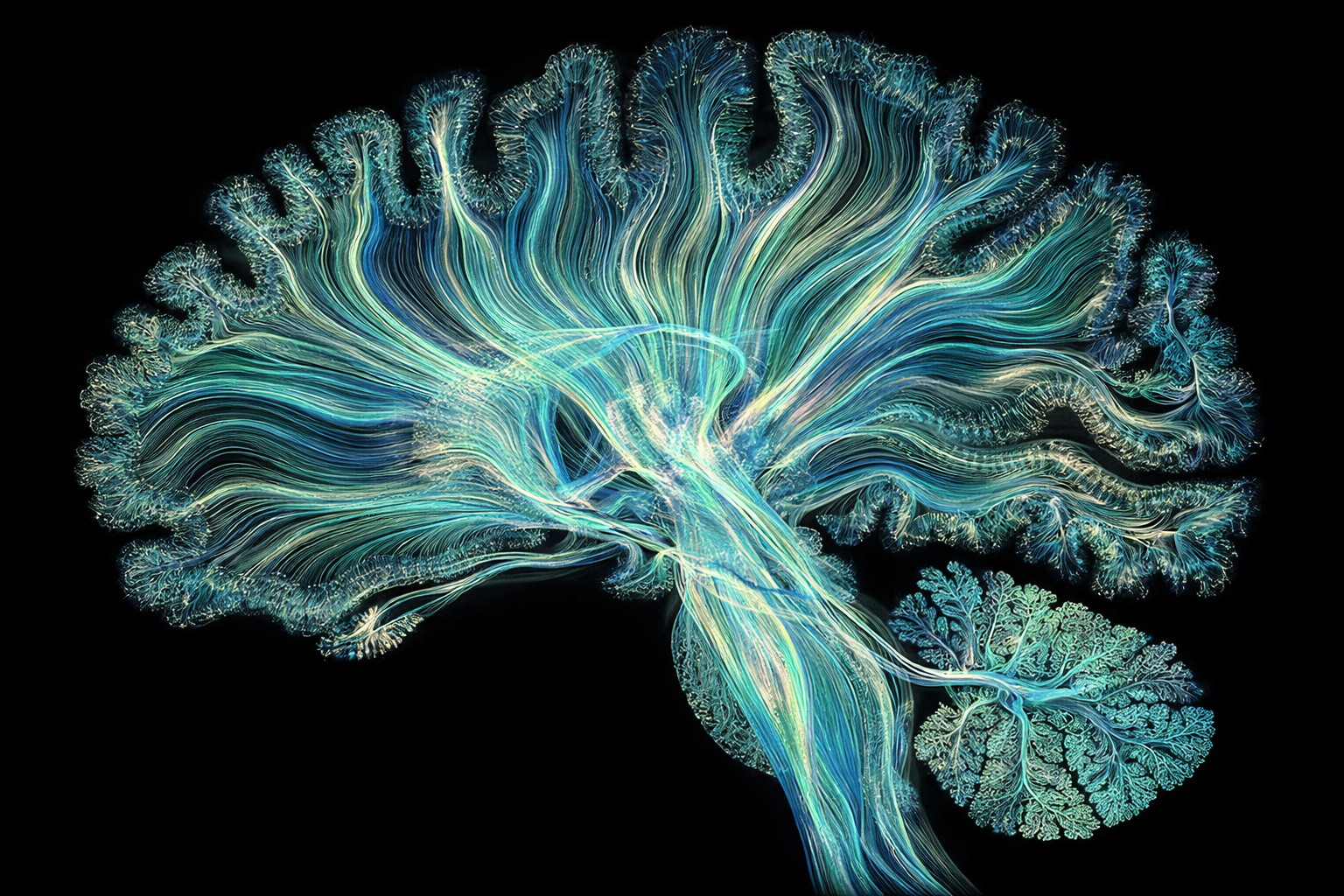
For decades, neuroscientists have been hunting for the seat of intelligence in the brain. Where does that elusive factor underlying our ability to reason, adapt, and solve problems actually live?
The answer, it turns out, is nowhere. And everywhere.
A groundbreaking study published in Nature Communications this January changes how we understand intelligence. Rather than residing in a single region like the prefrontal cortex, general intelligence emerges from the topology of the whole brain – meaning how it’s wired, how weakly connected nodes talk to each other across long distances, and how certain hub regions orchestrate the symphony.
And, what caught my attention, is how it explains fungal networks. We know fungi don’t have brains, so no neurons and no central nervous system, yet they behave as if they think.
This study suggests that intelligence is distributed and arises from connection and communication, not command and control. It challenges the idea that thinking is something humans own. Instead, it’s something nature does.
Let me explain why this matters, not just for neuroscience, but for anyone who wants to keep their brain healthy.
The Old Story
For years, the dominant theory was the Parieto-Frontal Integration Theory (P-FIT), which suggested that intelligence arises from a discrete network connecting the parietal and frontal lobes (regions involved in working memory, attention, and abstract reasoning).
It made intuitive sense. If you’re solving a complex problem, those areas light up. Damage them, and cognitive performance suffers.
But as brain imaging got better, cracks started to appear. Whole-brain models consistently outperformed localised ones. Between-network connections – not just within-network activity – seemed to matter more than anyone expected.
The New Story
Enter Network Neuroscience Theory (NNT), championed by Aron K. Barbey and colleagues at the University of Notre Dame and the University of Illinois.
Their hypothesis: general intelligence doesn’t come from a place. It comes from a pattern.
Specifically, it arises from the brain’s global network architecture, which describes how efficiently information flows across the entire connectome (a comprehensive map of neural connections within a brain), how flexibly different regions can be recruited, and how well the system balances local specialisation with global integration.
To test this, researchers analysed brain scans and cognitive data from 831 healthy adults in the Human Connectome Project. They used cutting-edge methods to jointly model both the brain’s structural wiring (white matter tracts) and its functional activity patterns (which regions co-activate during rest).
What they found was stunning.
Four Key Findings
1. Intelligence Is Distributed Across Multiple Networks
No single network predicted intelligence well on its own. The frontoparietal network (the supposed “intelligence hub”) explained only about 5.6% of the variance in g (general intelligence) scores. The auditory network did almost as well (5.4%). Even primary visual areas contributed.
But when they looked at the whole brain (all 12 major networks working together), predictive power jumped to 12%, a huge leap in neuroscience terms.
The takeaway is that intelligence isn’t localised. It’s emergent from distributed processing across the entire brain.
This is the first pillar of NNT: distributed processing matters more than any single “smart region.”
2. Weak, Long-Range Connections Are Critical
The connections that best predicted higher intelligence weren’t the strong, heavily-myelinated superhighways. They were the weak, long-range ties. The sparse, distant connections that link far-flung regions.
Think of it like this: in a city, you need highways for heavy traffic. But you also need back roads and bridges that connect distant neighbourhoods. Those weak ties enable flexibility, redundancy, and novel information flow.
In the brain, weak connections allow networks to reconfigure dynamically in response to new challenges. They’re the substrate of adaptability.
Stronger, shorter connections were also important, but mainly for local efficiency. The magic happened when the brain balanced both: strong local processing + weak global integration.
This is the second pillar: global coordination depends on weak ties.
3. Modal Control Regions Orchestrate the Symphony
Not all brain regions are created equal. Some sit at strategic positions in the network, where they can drive the brain into different functional states.
These are called modal control regions, and they’re located in places like the default mode network (DMN), the cingulo-opercular network (CON), and the frontoparietal network (FPN) – areas that can flexibly access and shift between different cognitive modes.
Think of them as the conductors in an orchestra, coordinating the ensemble.
The study found that individual differences in these regions’ “controllability” profiles significantly predicted g scores. People with higher intelligence had brains better able to reach difficult-to-access functional states, which is the cognitive equivalent of being able to improvise, pivot, and solve novel problems.
This is the third pillar: modal control drives global activity.
4. Small-World Topology Underpins It All
Finally, the researchers found that higher g was associated with a small-world network architecture, a topology that balances:
- High local clustering (densely connected modules for specialised processing)
- Short global path lengths (efficient long-distance communication)
This is the Goldilocks zone of network design. Too random, and you lose specialisation. Too regular, and you lose flexibility.
Sound familiar?
If you’re interested in mushrooms, then it should. It’s the same architecture found in mycelial networks, the underground fungal webs that connect trees in a forest and balance local nutrient exchange with long-distance signalling.
This is the fourth pillar: small-world topology enables system-wide communication and dynamics.
What This Teaches Us About Fungal Intelligence
This study helped me understand fungal intelligence on a deeper level
For years, scientists have debated whether fungi can be considered “intelligent.” They don’t have brains, neurons, or anything resembling a nervous system. How could they possibly be smart?
But this study explains how intelligence doesn’t require a brain. It requires a specific network topology: distributed processing, weak long-range connections, modal control hubs, and small-world architecture.
And fungi have all of this.
Research shows that mycelial networks exhibit the same four hallmarks of intelligent architecture found in human brains:
- they’re small-world networks with dense local clustering around nutrients and long-distance highways for system-wide communication
- they use weak ties to dynamically reconfigure when resources shift, rerouting through alternative pathways when damaged
- they have modal control hubs at thick mycelial junctions that integrate information and trigger colony-wide state changes (from foraging to fruiting, for example)
- and they exhibit pure distributed processing, with no decision centre—just local hyphae responding to chemical signals in ways that produce globally intelligent outcomes like efficient resource allocation and adaptive growth.
The Convergent Evolution of Intelligence
What we’re seeing here is something profound: convergent evolution of intelligent network architectures.
Brains and mycelial networks are separated by hundreds of millions of years of evolution. They also use completely different substrates (neurons vs. hyphae, electrical impulses vs. chemical gradients, synapses vs. anastomoses).
Yet they’ve both converged on the same fundamental design principles for expressing intelligence.
This has radical implications for how we think about intelligence itself. Intelligence isn’t something that only happens in brains. It’s a property of network organisation. It’s something that emerges whenever a system achieves the right balance of connectivity, flexibility, and distributed processing.
If so, then fungi are intelligent systems. Not in the way humans are as they don’t reason abstractly or use language. But in the way that matters for survival: they sense, adapt, solve problems, and make decisions that increase their fitness.
So What?
Understanding fungal intelligence is practically important and can help humanity with some of our most pressing issues.
If we accept that intelligence can exist without brains and that it’s fundamentally about network topology, then we can start learning from these systems in new ways.
We can ask:
- How do mycelial networks maintain resilience in degraded environments?
- What algorithms do they use for resource allocation under stress?
- How do they balance exploration and exploitation without centralised control?
- What can their topology teach us about designing more robust human systems, whether neural, technological, or social?
Decentralisation as a Design Principle
This study is about more than neuroscience. It’s about a fundamental shift in how we think about intelligence, health, resilience, and even conciousness.
For too long, we’ve been seduced by the idea of localisation. That complex functions must have discrete seats, that intelligence lives “somewhere,” and that problems can be fixed by targeting individual parts.
But nature doesn’t work that way. Forests don’t have a “command centre.” Immune systems don’t have a “boss node.” And the brain, it turns out, doesn’t have a “smart region.”
Intelligence is an emergent property of distributed, decentralised networks that balance local specialisation with global coordination.
This is the first-principles insight that unites so many threads:
- Metabolic health depends on distributed energy production (not just one pathway)
- Immune function depends on networked signalling (not just one cell type)
- Cognitive aging reflects network degradation (not just regional atrophy)
- Neuroplasticity is about reconfiguring connections (not just growing neurons)
And the tools we use should be chosen based on how well they support network-level properties: connectivity, flexibility, efficiency, and resilience.
The Forest and the Brain
There’s a poetic symmetry here.
The same principles that govern intelligence in the human brain also govern the resilience and adaptability of mycelial networks in forests.
Fungal networks don’t centralise. They distribute, balance, and adapt.
And now we can explain how they are very much intelligent systems, just running on different hardware to us.
And maybe the most intelligent thing we can do is learn from them.
Doo you feel like you’ve lost your mental spark?
This study reveals that intelligence emerges from network topology. But modern life systematically degrades it.
The Decentralised Brain Protocol is a 7-day system for reversing that damage. First-principles strategies to restore the metabolic and environmental conditions that let your brain’s network actually work.


4 thoughts on “The Brain’s Hidden Architecture Looks Suspiciously Like a Fungal Network, According to New Research”