
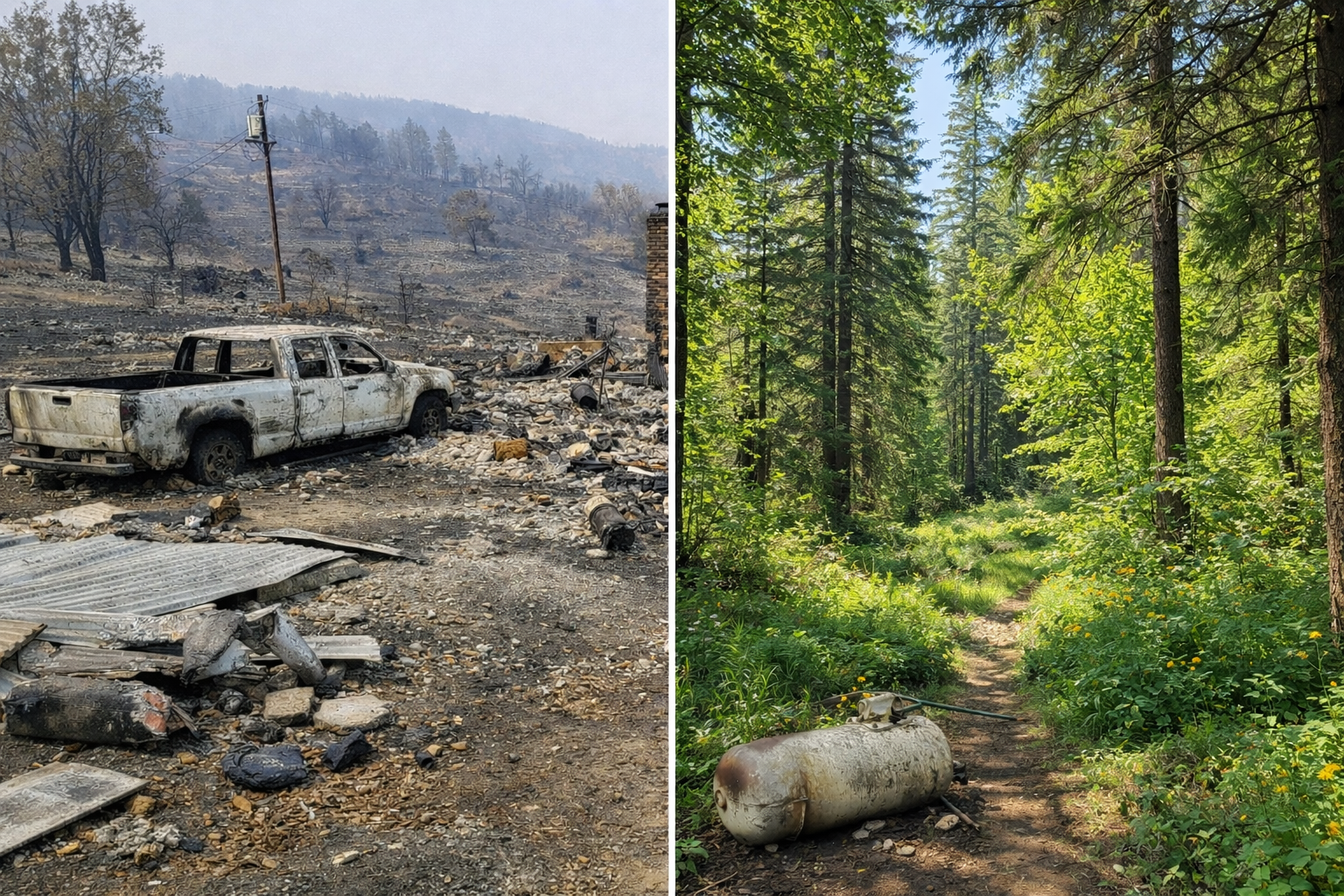
Picture the devastation following a wildfire. The earth is blackened. Charred wood everywhere. All of the life reduced to carbon and ash. Nothing could survive this, right?
Not quite.
While most life flees or perishes in flames, certain fungi are already moving in. These remarkable organisms have evolved to not just survive fire, but to thrive in its wake, literally eating the charcoal left behind in order to fertilise the ground for new life to emerge.
Charcoal Eaters
A fascinating study published in Proceedings of the National Academy of Sciences by Dr. Sydney Glassman and her team at UC Riverside reveals that the extraordinary pyrophilous fungi (fire-loving fungi) have developed sophisticated genetic machinery to digest what appears to be completely lifeless material.
The researchers collected 18 fungal species from California wildfire sites and decoded their genomes, uncovering three distinct evolutionary strategies these organisms use to break down charcoal’s rigid carbon structure. Some mass-produce enzymes through gene duplication. Others, like members of Basidiomycota, acquire key genes through sexual reproduction. One species, Coniochaeta hoffmannii, literally stole its charcoal-digesting genes from bacteria in an example of horizontal gene transfer.
Knowledge Transfer
Horizontal gene transfer – where organisms swap genetic material across species – is incredibly rare in fungi. But fire-scorched soil creates such extreme conditions that it seems to break the normal rules of evolution.
In the words of Dr. Glassman: “This kind of gene sharing across kingdoms is incredibly rare, but it gives this fungus the genes it needs to break down burn scars.”
This means the fungi are collaborating with bacteria at the genetic level to solve a shared problem. It’s nature’s version of open-source code, where organisms copy, remix, and adapt solutions from completely different domains of life.
The Cost of Adaptation
But evolution doesn’t offer free lunches. The study revealed a striking trade-off: fungi with the most charcoal-digesting genes grew the slowest. Members of Eurotiales packed the most enzymatic firepower but crawled along. Meanwhile, Pezizales species raced ahead with rapid growth but had fewer specialized genes.
But this isn’t a design flaw. Fast-growing fungi arrive first, capitalizing on the immediate nutrient pulse from dead biomass. Slower specialists move in later, methodically breaking down the recalcitrant carbon that nothing else can touch. Different strategies for different ecological niches, all contributing to the whole system’s regeneration.
Sound familiar? It mirrors how decentralized systems self-organize: no single optimal solution, just a diversity of approaches that collectively create resilience.
Lessons in Regenerative Design
These fire-loving fungi embody principles that regenerative systems designers dream about:
Turning waste into resource. Charcoal isn’t garbage to these fungi. They’ve evolved to see value in what appears valueless, transforming catastrophe’s byproduct into energy for regeneration.
Distributed strategies. No single species does everything. Some arrive fast, some break down complex molecules, some form extensive underground networks. Specialization plus cooperation equals system-level resilience.
Horizontal knowledge transfer. The bacterial gene swap represents decentralized innovation at the molecular level. Solutions emerging from the edges, not the center. Evolution as a commons.
Response over resistance. These fungi have adapted their entire genome to exploit the aftermath of wildfires. They turn destruction into opportunity.
Environmental Solutions
Climate change is intensifying wildfires globally. Roughly 4% of Earth’s land surface burns annually. So understanding these fungal strategies has never been more important. The researchers suggest these organisms could be harnessed for practical applications including cleaning up oil spills, breaking down industrial pollutants, and accelerating post-fire ecosystem recovery.
But there’s a deeper insight here about how complex systems regenerate after shock. Whether it’s forests after fire, communities after crisis, or economies after collapse, the pattern holds that regeneration emerges from diversity, not monoculture. From distributed inteligence, not central planning. From organisms that see waste as a resource, not a problem.
Fungi have been perfecting regenerative design for millions of years. They teach us that destruction is needed for new life to emerge.
In a world facing compound crises (ecological, social, and economic) we need regenerative approaches more than ever. We need systems that transform disruption into opportunity. Systems that, like these fungi, have evolved to thrive in conditions that would destroy their competitors.
Source: Sari, E., et al. (2026). Gene duplication, horizontal gene transfer, and trait trade-offs drive evolution of postfire resource acquisition in pyrophilous fungi. Proceedings of the National Academy of Sciences, 123(1), e2519152123.
Want more stories about fungi, regeneration, and decentralized systems? Subscribe to The Spore Report for weekly insights on how mycelial networks, ecological thinking, and distributed intelligence are reshaping our understanding of resilience.



One thought on “Scientists Discover Fungi That Eat Charcoal, And It Could Offer Hope To Our Ecological Crises”