
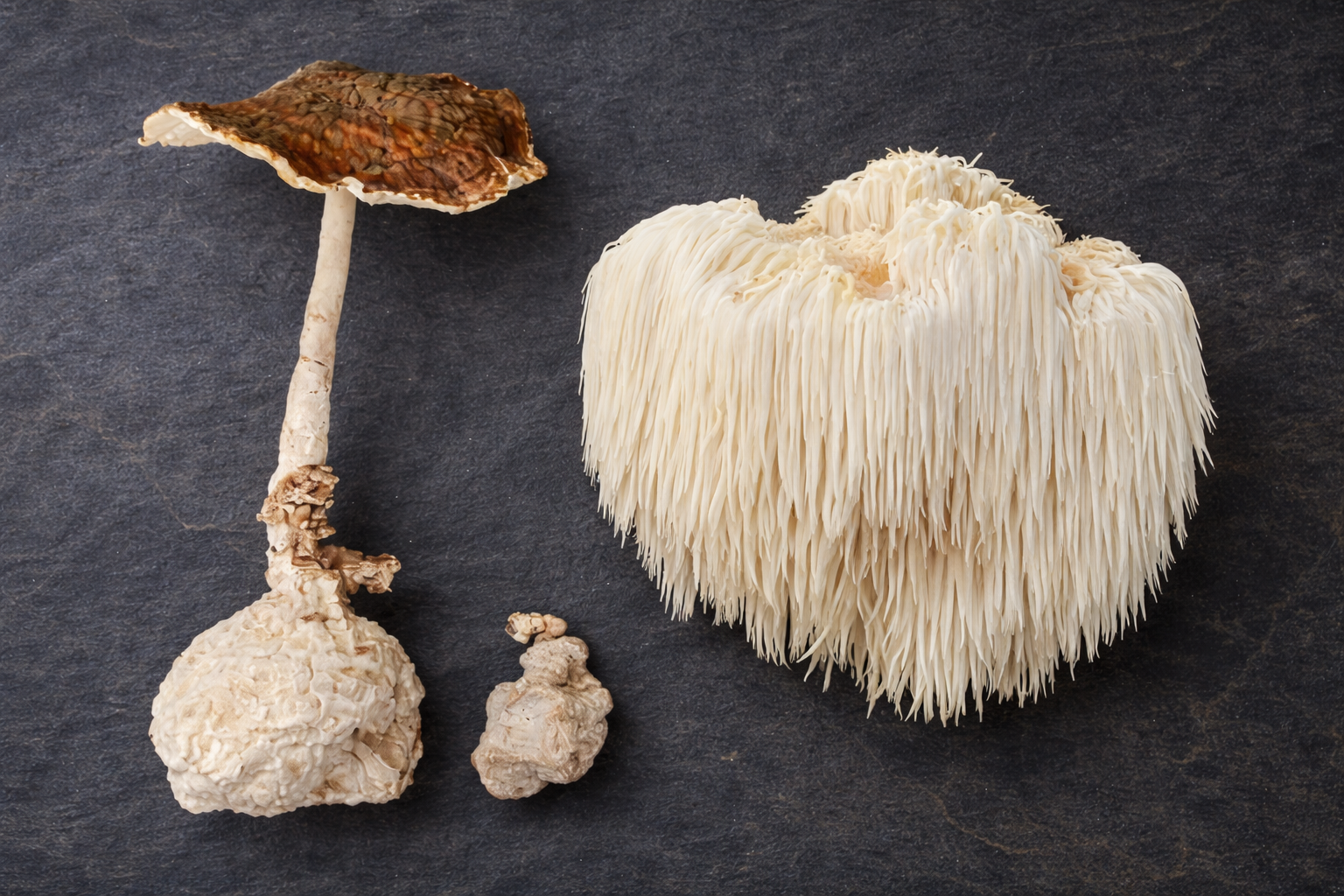
Lion’s mane has earned its reputation. Decades of research back its ability to support brain health, and it’s become the go-to functional mushroom for anyone serious about cognitive performance.
But there’s a lesser-known mushroom starting to turn heads in the same space: tiger milk.
Like lion’s mane, tiger milk has neuroprotective properties and promotes cognitive health. The interesting part is how it does it. While lion’s mane drives the production of nerve growth factor (NGF), tiger milk compounds appear to activate the same pathway from a completely different angle, binding directly to the receptor that NGF itself targets.
This raises an interesting question. Could these two mushrooms work better together than either does alone?
Lion’s mane explained
Also known as Hericium erinaceus, lion’s mane is a large, white, shaggy-looking mushroom found growing on dead hardwoods across the northern hemisphere. It’s been used in traditional Chinese medicine for centuries, is widely cultivated across Asia, and has found a second life in Western gourmet cooking for its steak-like texture when pan-fried.
Lion’s mane contains two classes of neuroactive compounds: hericenones, found in the fruiting body, and erinacines, found in the mycelium. Both have been shown to stimulate NGF production, though the evidence points to erinacines as the more potent driver. NGF is a protein essential for the growth, maintenance, and survival of neurons. By stimulating its production, lion’s mane supports cognitive function, memory, and mental clarity.
But the mechanism goes deeper than NGF production alone. A 2023 study published in the Journal of Neurochemistry found that hericerin derivatives, aromatic compounds purified from the fruiting body, activate neuronal survival and growth through ERK1/2 signalling independently of NGF. In other words, lion’s mane compounds don’t just tell your brain to make more NGF. Some of them bypass that step entirely and trigger the same downstream growth signals directly.
Research also suggests potential benefits in neurodegenerative conditions, with erinacine A-enriched extracts shown to reduce amyloid-beta plaque accumulation in animal models of Alzheimer’s disease.
Beyond the brain, lion’s mane offers anti-inflammatory and antioxidant properties, immune support via beta-glucans, digestive health benefits, and some evidence for cardiovascular and metabolic effects.
Tiger milk explained
Tiger milk mushroom (Lignosus rhinocerus) is a rare medicinal fungus native to the tropical rainforests of Southeast Asia, particularly Malaysia, Thailand, Indonesia, the Philippines, and Papua New Guinea. It’s been used by indigenous communities for centuries as a tonic and treatment for everything from chronic coughs to joint pain. It was reportedly used to treat the persistent cough of Malaysia’s former Prime Minister Tun Dr. Mahathir Mohamad. In the West, it’s only recently become available as a cultivated supplement.
Tiger milk’s cognitive benefits appear to come from a different mechanism. Research published in Scientific Reports found that hot aqueous extract of Lignosus rhinocerus stimulated neurite outgrowth in PC-12 cells comparable to NGF itself, without actually producing NGF. Instead, the extract appears to activate the TrkA receptor, which is the receptor that NGF binds to, triggering the same downstream signalling cascade via the MEK/ERK1/2 pathway.
In plain terms: lion’s mane increases the signal (NGF), tiger milk mimics the signal directly at its destination. Both result in neuronal growth and survival, but through distinct mechanisms.
Beyond cognition, tiger milk has a strong evidence base for respiratory health. A 2021 clinical study found that 600mg of tiger milk supplementation daily over three months produced significant improvements in pulmonary function and immune markers. A separate study found that 75% of around 100 participants with asthma, persistent coughs, sinus issues, and joint pain reported benefits. It also contains beta-glucans that support immune function, alongside antioxidant and anti-inflammatory properties.
Should you combine them?
Here’s where it gets interesting, and where I should be honest about what the evidence does and doesn’t show.
No study has tested lion’s mane and tiger milk together directly. What we do have is compelling indirect evidence that points in one direction.
A 2012 study published in Evidence-Based Complementary and Alternative Medicine found that tiger milk extract alone stimulated 24.4% neurite outgrowth in PC-12 cells. When NGF was added alongside it, that figure jumped to 42.1%, a 72% increase over tiger milk alone. The combination had additive effects. Tiger milk works better when NGF is present.
Lion’s mane raises NGF. That’s its primary mechanism. So if you’re taking lion’s mane and elevating your NGF levels, you’re potentially creating exactly the conditions under which tiger milk becomes more effective.
A separate study reinforces this from the other direction: when lion’s mane extract was combined with exogenous NGF, neurite outgrowth increased by 60.6% compared to NGF alone. And the 2023 Journal of Neurochemistry paper adds another layer, showing that hericerin derivatives activate ERK1/2 signalling independently of NGF entirely, meaning lion’s mane is hitting neuronal growth pathways from multiple angles simultaneously.
So the picture looks like this: lion’s mane raises NGF and activates ERK1/2 directly. Tiger milk activates the TrkA receptor that NGF binds to, and demonstrably works better when NGF levels are higher. Three distinct mechanisms, all converging on the same neuronal growth pathway.
This is a working hypothesis, not a confirmed finding. Tiger milk’s cognitive research is still mostly preclinical. Human trials for both mushrooms are still maturing. We’re not going to overclaim that.
What we can say is that both mushrooms independently support neuronal health through mechanisms that don’t overlap. The biological rationale for combining them is now supported by more than one study. And the logic is hard to dismiss: if tiger milk benefits from elevated NGF, and lion’s mane is one of the most effective natural ways to elevate NGF, the case for taking them together isn’t marketing. It’s mechanistically coherent.
For anyone already taking lion’s mane, tiger milk is a logical addition, not because the evidence guarantees a stacked effect, but because the mechanisms don’t overlap, they compound.
The Spore Report is a weekly newsletter that explores the science of fungi, regenerative biology, and what living systems can teach us about health. Sign up here.

I first heard the Amazing effects of Mushroom by the Man himself Paul Staymine? I heard him say incredible things about different mushrooms which he had such a passion for. The most that struck me was the effect on the immune system. Yet still many years later we are still waiting . All the best in your endeavors. T Thompson