There’s a metaphor that has colonised how we talk about the brain. You’ve seen it in self-help books, wellness apps, psychedelic marketing, and the corners of neuroscience pop science. The metaphor is rewiring. Fix the faulty circuit. Swap the old wiring for new. Update the software.
It’s a compelling image. It’s also wrong.
The Machine That Isn’t
The “rewiring” metaphor arrived from engineering, and it carries engineering’s assumptions with it. First, that systems have discrete components. Second, that faulty parts can be replaced with precision. And third, that transformation is a project with a clear completion state. Apply the right input, get the right output. Job done.
But the brain is not a machine. And understanding why changes how we think about change itself.
Hans Jonas, a philosopher writing in 1966, offered one of the sharpest critiques of the machine model of life ever put to paper. In The Phenomenon of Life: Toward a Philosophical Biology, his thought experiment goes like this: imagine a godlike being who knows the exact position and velocity of every particle in the universe. This being can predict the future trajectory of every atom. Now, could this being distinguish a living organism from a rock? Could it see the difference between a living body and a freshly dead one?
Jonas argued no. Because what makes an organism alive is not its material composition of atoms, but its organisation. A specific kind of self-referential process he called metabolism, a word derived from the Greek word metabolē, meaning ‘to change’. Life is not about particular atoms. It is about a pattern that persists through the constant flow of matter and energy. You are not the atoms you were ten years ago. You are the ongoing process that those atoms pass through.
This is not a minor philosophical distinction. It means that the machine model misses the thing that most needs explaining.
The Mycelium Network, Not the Circuit Board
Neuroplasticity researchers have arrived, through a different route, at something remarkably similar.
The brain does change. Synapses strengthen and weaken. Dendritic branches grow and retract. Functions reroute around damage. New neurons are generated in the hippocampus throughout adult life. These are real, measurable phenomena documented extensively in Kolb and Whishaw’s landmark review of brain plasticity and behaviour.
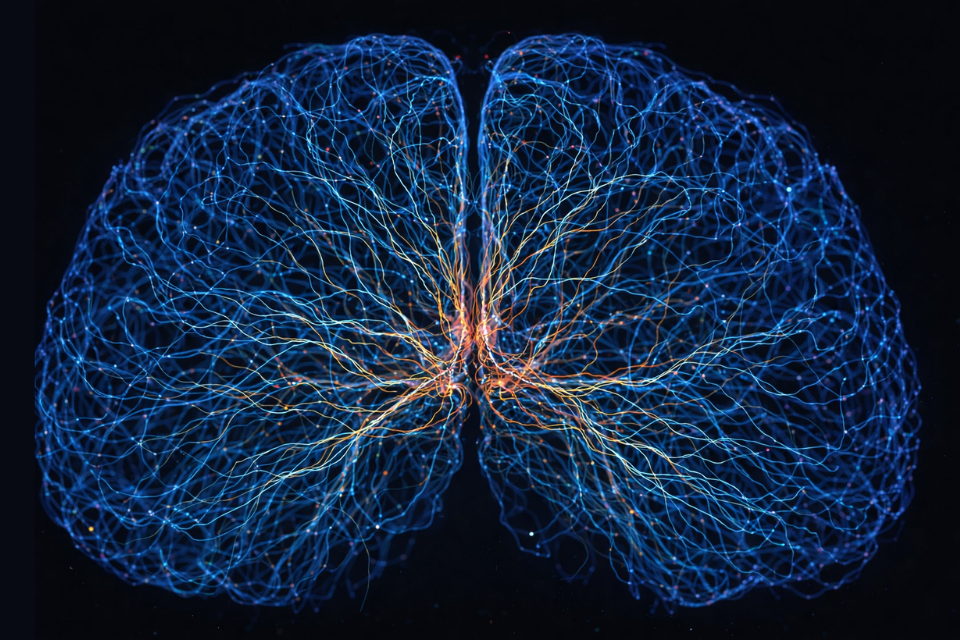
But the logic of these changes is not the logic of rewiring. It is the logic of a mycelial network. Hyphae extend toward nutrient-rich zones and strengthen with use. Pathways that lead nowhere thin out and are abandoned. Resources are continuously reallocated across the network in response to local conditions. Not by a central controller, but through distributed chemical signalling at every growing tip. The network is never finished. It is always becoming.
Your neural architecture works the same way. What looks like recovery from a stroke is the brain finding a detour, not restoring the original route. Old trauma pathways don’t disappear when therapy works. They become less dominant while alternative routes strengthen alongside them. The old hyphae remain in the substrate, potentially reactivatable under the right conditions.
This is slow, conditional, uneven biology. Not precision engineering. As Kolb and Whishaw documented, experience “alters the synaptic organisation of the brain” but always within a context shaped by hormones, trophic factors, stress, and illness. The same signal produces different growth in different soil, at different times. There is no app that bypasses these conditions. There is no insight profound enough to produce lasting neural change without the slow reinforcement of repeated behaviour.
And here is where Jonas becomes useful again. He wrote that life is defined by needful freedom: the organism is simultaneously free from its environment (as an individual with an interior) and utterly dependent on it (for the materials that sustain that individuality). Mycelium embodies this perfectly. It’s autonomous in its growth direction, yet entirely dependent on the substrate it inhabits. The brain’s plasticity operates the same way. It is free to change, but it is constrained by everything it needs to do so.
What Mycelium Knows
The mycelium network metaphor isn’t just poetic. It maps onto neural architecture with precision.
Both systems are distributed. No single node controls the whole. Both grow opportunistically, extending toward signal and resource rather than following a predetermined plan. Both strengthen active connections and prune dormant ones. Both reroute around damage without any centralised decision-making. And both are exquisitely sensitive to environmental conditions like temperature, chemistry, available substrate, and the presence of other organisms.
In mycelium, when a hyphal tip encounters a nutrient-rich zone, it branches and thickens. When a pathway fails to return signal, resources are withdrawn and redirected. The network encodes “memory” in the pattern of thick and thin connections distributed across the whole. There is no centre. There is only the ongoing adjustment of the network to its world.
This is also how neural plasticity works at the cellular level. Synaptic connections that fire together repeatedly get stronger (long-term potentiation). Those that go quiet get pruned. Dendritic branches extend toward active inputs and retract from silent ones. The brain’s “knowledge” isn’t stored in any one place. It’s encoded in the relative weights of billions of connections, distributed across the whole network, constantly being updated by use.
The parallel even holds for damage and recovery. When a mycelial network loses part of its structure, it doesn’t attempt to recreate the lost hyphae exactly. It routes around the gap, finds new paths, redistributes load. The network that emerges isn’t identical to what came before, but it is functional. Neuroscientists see the same pattern in stroke recovery. Not restoration, but distributed compensation.
This is also why psilocybin’s relationship with neuroplasticity is so interesting. A 2021 study by Shao et al. published in Neuron found that a single dose of psilocybin produced around 10% increases in dendritic spine size and density in the mouse frontal cortex, with structural changes detectable within 24 hours and still present a month later. Subsequent research has confirmed that psilocybin also upregulates BDNF, promotes hippocampal neurogenesis, and activates plasticity-related genes including c-Fos and mTOR. This was reviewed comprehensively by Lowe et al. in Neuropsychopharmacology (2022).
But the picture isn’t uniformly positive, though. Research on adolescent psilocybin exposure has documented lasting sex-dependent changes in brain structure, functional connectivity, and neuroplasticity markers – with effects not all pointing in a beneficial direction. Timing, dosage, and developmental context shape outcomes profoundly.
What psilocybin may do, at its most useful, is loosen the grip of over-consolidated pathways – the neural equivalent of mycelium clearing ground for new growth. But the new growth still has to happen. The conditions for it still have to be met. The compound opens a window of opportunity, but that opportunity still has to be seized.
A Better Story
Jonas argued that life always has purpose in the simple sense that an organism is always acting for the sake of something, even if that something is just staying alive. With complexity comes richer purpose, like maintaining relationships, making meaning, and building understanding.
The brain’s capacity for change serves that purpose. It is not an upgrade pathway. It is how a living system stays responsive to an ever-changing world.
The “rewiring” metaphor quietly removes this purposiveness. It turns the brain into a passive object to be modified by the right technique. It promises speed and precision in a domain that runs on slowness and repetition. And when the transformation doesn’t arrive on schedule, it turns biological limitation into personal failure.
The better story is harder but more honest. Your brain changes the way a mycelial network changes. Not by replacing old circuits with new ones, but by adjusting the weights of billions of connections in response to use, environment, and time. The hyphae that carry signal regularly become the dominant pathways. The ones that fall silent thin out. And new branches extend wherever the conditions are right.
Mycelium has been doing this for 500 million years. It just keeps extending, pruning, and rerouting. It’s endlessly adaptive, never finished, and always shaped by the substrate it inhabits.
That’s what change actually looks like, whether in the soil or in your head.
Want to Go Deeper?
If this framing resonates (the brain as a decentralised, adaptive network rather than a machine to be fixed) this is exactly the territory explored in the Decentralised Brain Protocol.
It maps the emerging science of brain health (signal quality, network coherence, cognitive clearance) onto practical protocols drawn from neuroscience, mycology, and systems thinking. No hacks. No “rewiring” promises. Just a grounded framework for working with your brain’s actual biology rather than against it.
Get the Decentralised Brain Protocol →
The Spore Report is a weekly newsletter that explores the science of fungi, regenerative biology, and what living systems can teach us about health. Sign up here.