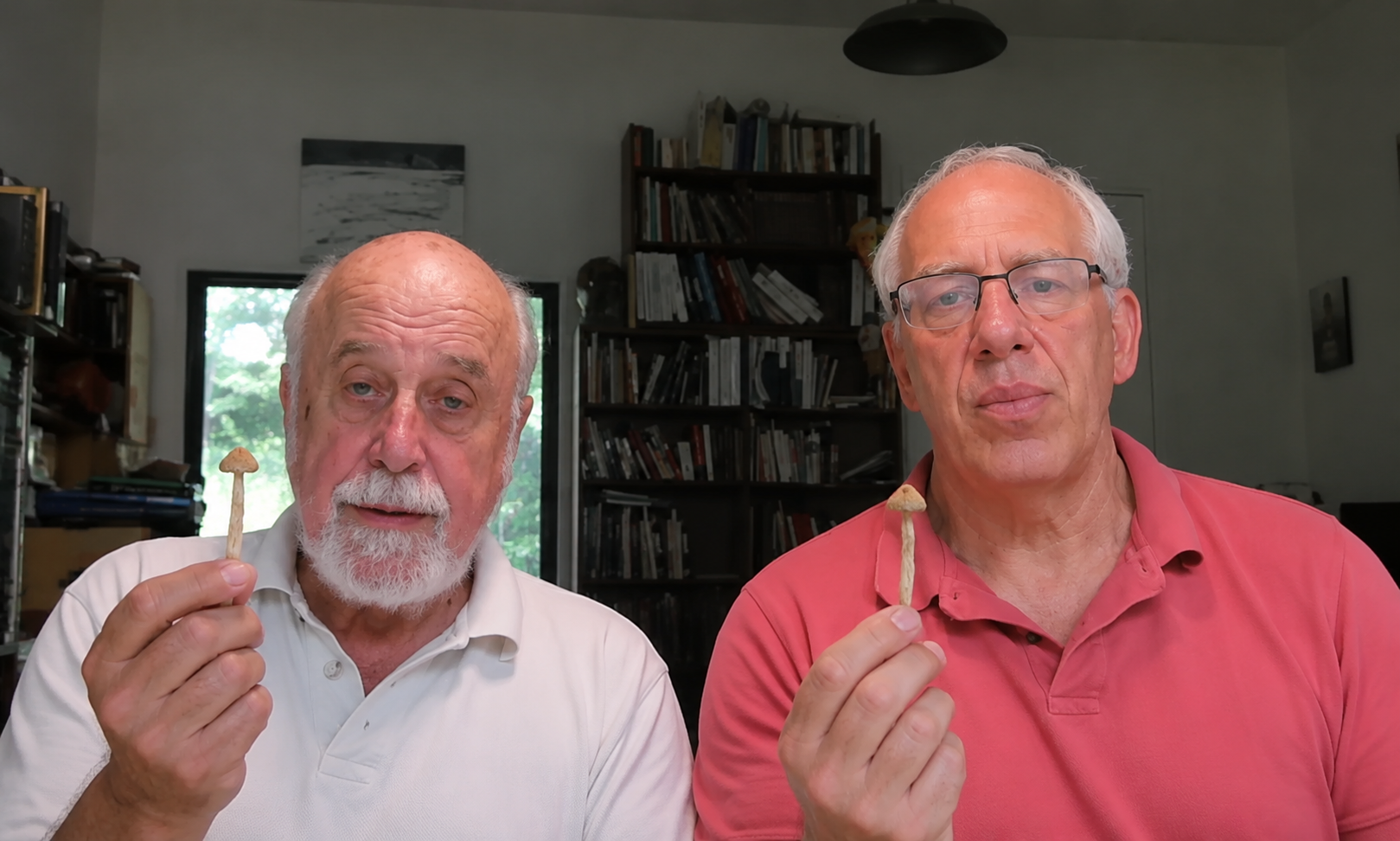
I watched Music for Mushrooms expecting something the usual promo reel for psychedlics. Two hours later I was still on the couch, slightly mind-blown and inspired by the film’s immense beauty.
The film follows East Forest – real name Krishna-Trevor Oswalt – a musician who has spent the better part of two decades composing music for psychedelic experiences. He started doing this in 2008, in New York City apartments, playing live for small groups of friends taking mushrooms.
There was no promotion. No brand strategy. Just a guy with instruments and a room full of people lying on the floor with their eyes closed. Those gatherings eventually moved to a farm upstate, grew by word of mouth over years, and now he has a touring show, a podcast, and this amazing documentary free on YouTube.
After watching, I went looking for more context and found a really good long-form interview Rolando García did with East Forest for High Times, published last month. A lot of what I’m writing here comes from sitting with both the film and that conversation.
The film
Director-wise, the pacing is patient. There are long stretches where you’re just watching people listen to music, which sounds boring on paper but works on screen because of genuine curiosity about what’s happening on those faces. Some of these people are on psilocybin. Some aren’t. The film doesn’t make a big deal of the distinction.
East Forest’s live shows run about two hours. People bring yoga mats, lie down and listen to him play. Somewhere between a concert and a ceremony, he says, though he avoids both words. In the García interview he’s pretty direct about the tension there. Some people show up wanting entertainment, others are looking for something closer to therapy, and he’s trying to hold space for both without pretending that’s easy.
The documentary weaves between performance footage, personal history, and conversations with people whose lives have intersected with this work. There’s no narrator hammering a thesis. The film trusts you to connect things yourself, which I appreciated.
The forgetting thing
There’s a line East Forest keeps returning to in the film, and García picks it up in the interview: sometimes you remember, and then you forget, and then you remember again.
He’s talking about that feeling psychedelics can produce. The oceanic sense that you’re connected to everything, that separation is a kind of illusion your nervous system maintains for practical reasons. Anyone who’s had a meaningful psilocybin experience knows exactly what he means. And anyone who’s had that experience also knows what happens three weeks later when you’ve all but forgotten and are back to doom-scrolling at midnight.
What interests me here is how closely this maps onto the neuroscience. Psilocybin temporarily quiets the default mode network (the brain’s self-referential chatter machine) and that’s correlated with those feelings of ego dissolution and interconnection. But the default mode network comes back online. It always does. And the walls rebuild.
So the question becomes: can you build a practice around remembering? Can music function as a kind of low-dose, repeatable way to keep touching that state without needing a full psychedelic session every time? East Forest seems to think so. The research coming out of Johns Hopkins and Imperial College on music’s role in psilocybin-assisted therapy suggests he might be onto something. Music selection during sessions has a measurable effect on emotional processing and therapeutic outcomes.
The scene
Late in the film there’s a sequence with young men from really rough backgrounds. We’re talking gang involvement, gun violence and poverty. None of them are on mushrooms here. It’s just East Forest playing music while they sit in a circle on the ground.
In the High Times interview, he describes one young man who wasn’t filmed. The toughest person in the room, a gang member who’d been shot nine times. He broke down sobbing. East Forest says the response was more intense than what he often gets from well-off wellness crowds.
That got me.
East Forest acknowledges that it’s hard to sit with your feelings when you’re hungry or unsafe. Basic needs come first. But the fact that music reached this particular person in this particular way, with no chemical assistance at all, says something.
Should you watch it
Yeah. Especially if you’re interested in the space between music and psychedelics and you’re tired of the two usual modes – either breathless evangelism or clinical detachment. This film lives in the middle, which is where most of the interesting questions are.
East Forest wants two uninterrupted hours of your attention. He put the film out for free. In an economy that makes its money by slicing your focus into smaller and smaller pieces, that combination feels like medicine in itself.
Music for Mushrooms is on YouTube. The hub is MusicForMushrooms.com.