What if the most influential religious text in human history was actually an elaborate code for psychedelic rituals?
It sounds unhinged, but this theory didn’t come from some fringe internet forum. It came from one of the most respected archaeologists of the 20th century. And 55 years later, science is starting to catch up with parts of his wild idea.
The Book That Ended a Career
In May 1970, John Allegro published The Sacred Mushroom and the Cross. Before this book, Allegro was a serious scholar. He was a leading expert on the Dead Sea Scrolls, the nearly 1,000 ancient Semitic texts discovered in caves along the Dead Sea beginning in 1947. He was credentialed, respected, and at the top of his field.
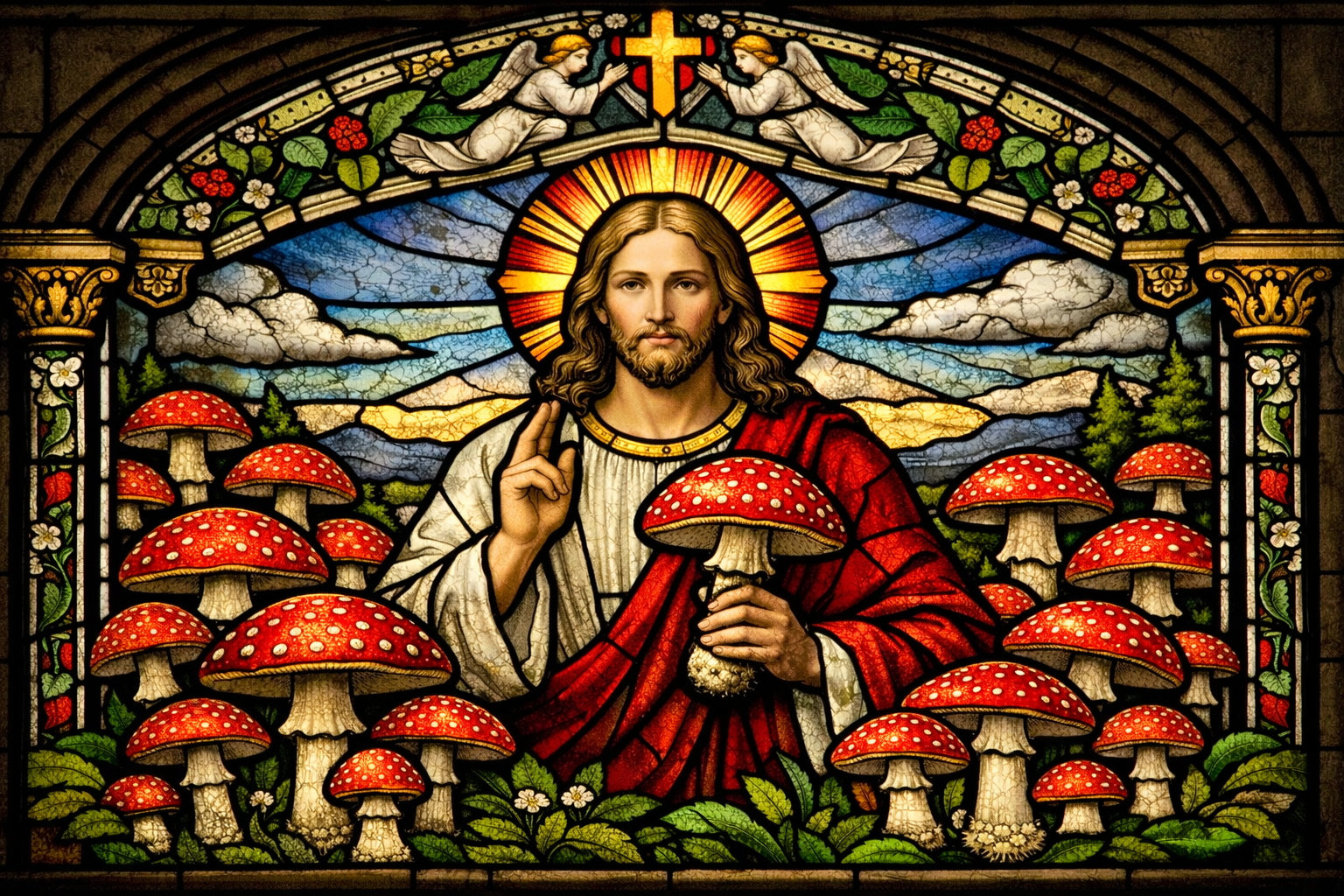
Then he dropped a bomb. The New Testament, he argued, was essentially an elaborate coded text. Through painstaking philological analysis and tracing root words back through Greek, Hebrew, Aramaic, and ultimately to ancient Sumerian, Allegro claimed the Bible’s authors were embedding secret references to a fertility cult from ancient Mesopotamia. And the cult’s central sacrament was none other than Amanita muscaria, the iconic red-and-white psychedelic mushroom.
According to Allegro, every divine encounter, miracle, and epiphany were allegories for psychedelic trips.
Perhaps unsurprisingly, the academic community destroyed him. The reviews were savage and colleagues publicly distanced themselves. As Elana Spivack reported recently in Popular Mechanics, the backlash was swift and career-ending.
Wrong Question, Right Answer
The truth is, Allegro’s method was almost certainly flawed. His entire thesis hinged on Sumerian being a kind of linguistic Rosetta Stone connecting Semitic and Western languages. As Geoffrey Smith, an associate professor of religious studies at the University of Texas at Austin, told Popular Mechanics, Allegro treated Sumerian as a “panacea to all the linguistic challenges” in biblical scholarship.
Specialists in the language weren’t buying it. Matthew Goff, a professor of religion at Florida State University, summarised the expert reaction bluntly, saying reviewers who actually knew Sumerian said his analysis didn’t hold up.
But Goff also offered a fascinating concession: “It’s possible his method was wrong, but he got to the right place.” In other words, the question Allegro was asking – were psychedelics involved in the formation of early Christianity? – might be far more legitimate than his botched attempt at answering it.
The Evidence Is Building
Allegro’s approach was purely linguistic. He didn’t back up his claims with archaeological evidence or biochemical analysis. But in the decades since, researchers working from completely different angles have been assembling a case that psychedelics played a much larger role in ancient religious life than mainstream scholarship has acknowledged.
A 2023 study published in Scientific Reports analysed a lock of hair from a Spanish cave and found evidence that humans were using plant-based hallucinogens as far back as 3,000 years ago. A separate 2024 paper, also in Scientific Reports, examined a 2nd-century BCE vase from Egypt and found traces of psychotropic substances.
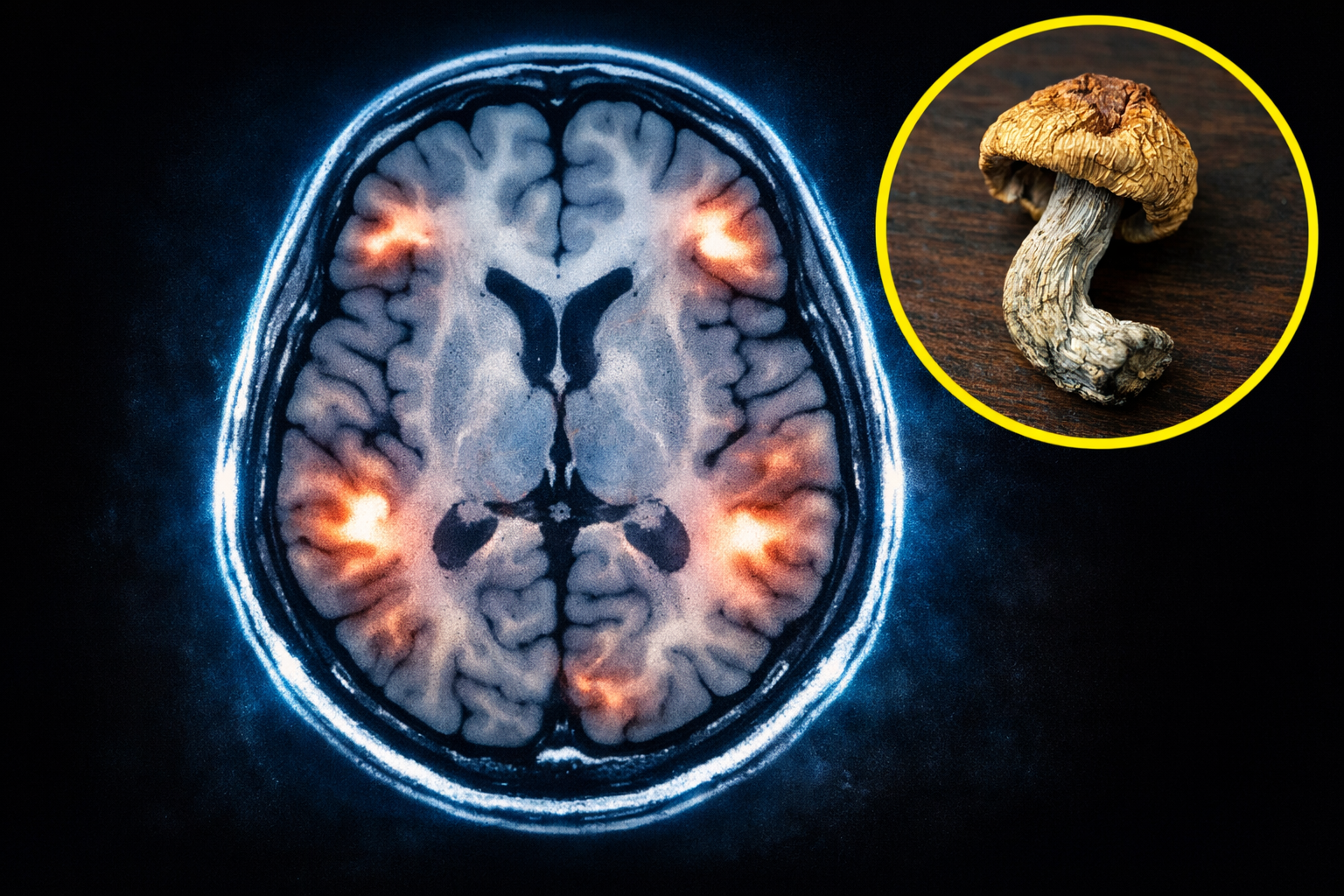
Meanwhile, neuroscience is revealing just how thin the line is between a drug-induced trip and a genuine religious experience. Andrew Newberg, a neuroscientist at Thomas Jefferson University, has shown that meditative and spiritual practices suppress activity in the frontal and particularly the parietal lobe, which governs our spatial sense of self. When it goes quiet, your sense of individual identity dissolves.
And psychedelics do exactly the same thing. Whether it’s drumming, meditation, or a psychoactive substance, the neurological mechanism overlaps significantly. The brain doesn’t seem to distinguish between the source of the experience.
The Immortality Key
Brian Muraresku took these threads and wove them into something far more rigorous in his 2020 book The Immortality Key: The Secret History of the Religion with No Name. Muraresku investigated whether early Christian communion wine might have actually contained psychoactive compounds. A spiked sacrament, essentially.
His research traced a line from the ancient Greek Eleusinian Mysteries (secret initiation rites that ran for nearly 2,000 years) through to early Christian practice, arguing that psychedelic experience may have been woven into the very foundations of Western civilisation. It’s a bold claim, but Muraresku grounded it in archaeological evidence, classical scholarship, and interviews with scientists.
As Muraresku told Popular Mechanics regarding Allegro’s original intuition: the idea that hallucinogens were ritually used across the Mediterranean and Near Eastern cultures that gave birth to biblical tradition “has witnessed some corroboration in recent years.”
New Study
And now, in 2026, the evidence just got stronger. A study published in Scientific Reports has experimentally demonstrated something that was previously only theoretical: that the toxic ergot fungus (Claviceps purpurea), which infects cereal grains like barley, can be chemically converted into psychoactive compounds using techniques that were readily available in the ancient world.
Specifically, the researchers showed that treating pulverised ergot with a simple alkaline lye solution (something the priestesses of Eleusis could absolutely have prepared) converts toxic ergopeptides into lysergic acid amide (LSA) and iso-LSA. These are psychoactive compounds related to LSD, though less potent. The yields were meaningful: about 0.54 mg of LSA per gram of ergot, right around the threshold for a psychoactive dose.
This is significant because one of the main objections to the “psychedelic Eleusis” hypothesis – first proposed by mycologist R. Gordon Wasson, chemist Albert Hofmann (yes, the man who synthesised LSD), and philologist Carl Ruck in their 1978 book The Road to Eleusis – was that nobody had demonstrated a plausible ancient method for detoxifying ergot into something both safe and psychoactive.
That objection just got a lot weaker.
The study doesn’t prove the Eleusinian kykeon was psychedelic. No residue analysis has been conducted on the actual vessels from the Telesterion at Eleusis. But it demonstrates feasibility using ancient technology, moving the hypothesis from speculative mythology into experimentally supported chemistry.
The Awakened Ape
Now lets’s take a step even further back and get a little more creative. Because although Cristian values (like the equal moral worth of every person) may seem obvious now, at one time they were revolutionary. And if psychedelics can open the mind enough to shape the evolution of early religious ideas, could they have shaped something even more fundamental, like human consciousness itself?
Dennis McKenna (brother of the late Terence McKenna, who first proposed the “Stoned Ape Theory” in 1992) has been making the case that we should probably rebrand it the “Awakened Ape Theory.” As we covered recently, new science in neuroplasticity and epigenetics is lending unexpected support to the idea that psilocybin mushrooms may have catalysed the rapid expansion of the human brain.
The argument isn’t that mushrooms caused consciousness. It’s that psilocybin – a compound now known to be one of the most powerful neuroplasticity promoters ever discovered – may have acted as a catalyst during a critical window of human cognitive evolution. Epigenetic mechanisms could have allowed psilocybin-induced neural changes to influence development across generations. A 2024 genomic study even found that psilocybin mushrooms evolved around 65 million years ago, and a preprint study on human gene expression discovered that psychedelic-responsive genes are disproportionately represented among human accelerated genes (aka genes shaped by recent evolutionary selection).
It’s circumstantial and of course unproven. But as Dennis McKenna argues, there’s enough evidence that “a jury of peers would convict.”
Fungal Transcendence
You don’t have to believe Jesus was literally a mushroom (Allegro’s linguistic case for that specific claim remains unconvincing) to recognise that something important is happening in this research space.
The converging evidence from archaeology, neuroscience, biochemistry, and now experimental chemistry is painting a picture where psychedelic substances were potentially central to the most transformative spiritual experiences in human history. The Eleusinian Mysteries ran for nearly 2,000 years. Plato and Socrates were initiates. Early Christianity emerged from this same cultural and geographic milieu.
As Goff told Popular Mechanics, there’s an undeniable conspiratorial appeal to these ideas that resonates with our current cultural moment. But strip away the conspiracy and what remains is a legitimate academic question. Were ancient religious rituals enhanced by psychoactive substances?
The evidence increasingly suggests probably, at least some of them.
And if that’s true, it doesn’t diminish those experiences. If anything, it enriches our understanding of how humans have always sought transcendence – and how nature, through fungi and plants, has been offering us the tools to find it for millennia.