
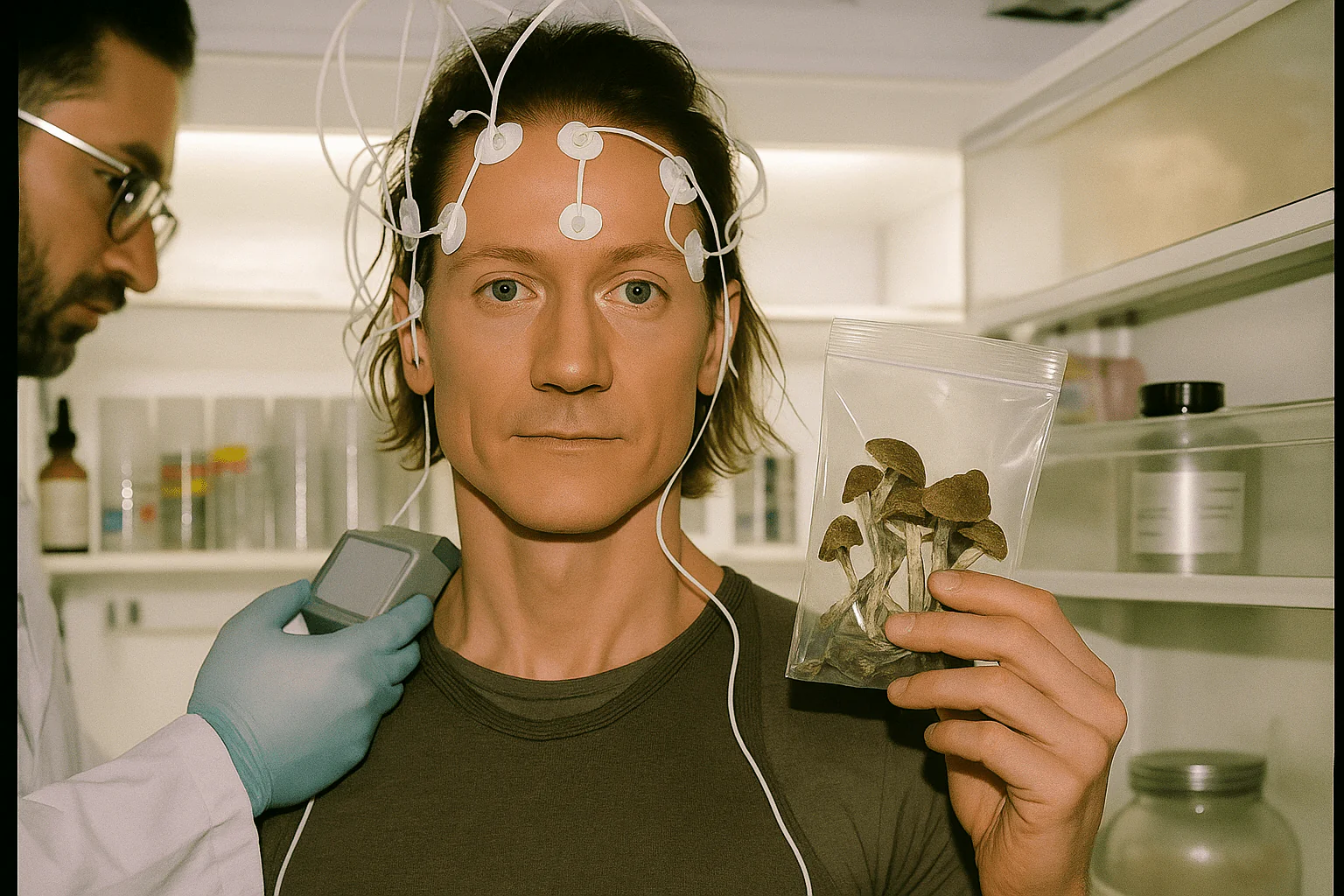
A few weeks ago, Bryan Johnson – the guy who’s spent millions trying to reverse aging and famously got blood transfusions from his son – downed 5 grams of mushrooms, strapped on fancy brain-scanning headgear, and livestreamed the whole thing while vibing to Grimes.
It was bizarre. But also potentially one of the most important self-experiments in the emerging field of psychedelic longevity research.
The Study That Started It All
In July 2025, researchers at Emory University and Baylor College of Medicine published something remarkable in npj Aging. I’m pretty sure this is what sent Johnson down the mushroom rabbit hole in the first place.
Led by Louise Hecker and her team, the study provides the first experimental evidence that psilocybin doesn’t just affect your consciousness. It fundamentally impacts cellular aging at multiple levels throughout your entire body.
What they found in cells was striking:
Psilocin (the active form of psilocybin) extended cellular lifespan by 29-57% depending on dose. It preserved telomere length (one of the key markers of cellular aging). It reduced oxidative stress, improved DNA stability, and increased SIRT1, which is basically a master regulator of cellular aging and metabolism. It’s the same longevity protein that gets elevated during caloric restriction.
The mouse data was even more dramatic:
Monthly psilocybin treatment increased survival from 50% to 80% in 19-month-old mice (roughly equivalent to 60-65 human years). The treated mice looked younger, with smoother coats, darker fur regrowth, and healthier skin. And the mice that started treatment late in life still saw improvements.
Perhaps the most fascinating part was when researchers tested psilocin on isolated fibroblasts in a petri dish – cells with absolutely no connection to a brain whatsoever – they still got the lifespan extension and metabolic improvements.
Read that again. Cells in a dish. no brain, no consciousness. Just direct cellular effects.
A Metabolic Reset
For a long time, we’ve been thinking about psychedelics purely in terms of consciousness, neuroscience, and mental health. They’ve often been said to reset the brain – a framing that made intuitive sense.
But the Emory/Baylor study reveals that psilocybin works through multiple simultaneous mechanisms:
Direct cellular effects: The compound acts on cells throughout your body, not just neurons. It activates the same longevity pathways triggered by caloric restriction and improves fundamental metabolic processes.
Systemic receptor activation: The 5-HT2A serotonin receptor that psilocybin activates isn’t just in your brain. It’s expressed in fibroblasts, heart cells, immune cells, endothelial cells, and throughout metabolic organs like the liver and pancreas.
Mitochondrial improvements: Enhanced function at the most fundamental energy-production level of your cells. This matters enormously if you think about metabolic health from first principles, as mitochondria are essentially the CEOs of cells running everything.
The researchers found that 5-HT2A stimulation induces SIRT1-dependent expression of antioxidant enzymes. SIRT1 overexpression has been shown to extend lifespan in both C. elegans and mice.
So Johnson’s metabolic improvements might be coming from both top-down neuroplastic changes and direct molecular effects on his liver, pancreas, fat tissue, and basically every other metabolic organ in his body simultaneously. A true holistic effect.
Johnson’s First Experiment
For his experiment, Johnson took 5 grams of dried Psilocybe cubensis (the B+ strain, for the mycology enthusiasts), which contained about 25mg of psilocybin – actually quite low for 5 grams. He then measured his brain activity using Kernel Flow sensors at multiple points: during the peak, coming down, end of day, and the next morning.
His hypothesis was that the neuroplasticity and mental shifts from psychedelics could be as important for longevity as all the cellular stuff (telomeres, methylation, senescent cells). What if how your brain feels and functions matters just as much?
About 3-4 hours in, his brain looked radically different:
His prefrontal cortex dimmed. This is the part that plans, controls, keeps you “adulting.” Meanwhile, his sensory and motor regions lit up like a Christmas tree. Auditory processing, speech areas, touch and movement centers became hyperconnected and firing. His Default Mode Network (the brain network associated with self-referential thinking, your inner narrator) started to quiet down.
Johnson’s subjective experience matched the brain scans perfectly. He reported feeling like his “consciousness was dialed up to 10/10.” He became obsessed with staring at light refracting through water. Touch felt revelatory. Food tasted explosive. His brain wanted to “deploy its sensors into the world and discover all things.”
His brain essentially regressed to a childlike state – a pure, curious, everything-is-new-and-amazing way kids experience the world before they develop all their mental shortcuts and filters.
At the peak, maximum chaos: Sensory information that normally gets filtered came flooding through. Everything became vivid, immediate, significant. He experienced touch “with awe.” The normal dulling that happens as we age vanished. “Factory settings restored,” as he put it.
Five hours in, integration began: His prefrontal cortex started coming back online. His experience shifted from pure sensation to meaning-making. He moved from “wow, water is amazing” to deep philosophical reflection about mortality, AI, and the future of human evolution. The brain started organising all that chaotic sensory input into narratives and insight.
The next morning, the afterglow: His prefrontal cortex was still partially inhibited. His speech generation areas showed intensified connectivity. Senses remained sharper than baseline. The Default Mode Network stayed partially suppressed.
Subjectively he felt calm, clear, emotionally open, and uninhibited. He reported being more comfortable with self-deprecating humour and had a burst of creative writing energy.
Johnson’s Second Experiment
This is where Johnson’s obsessive measurement protocol really shone. He tracked everything before and after his second trip, and some changes are striking.
Inflammation basically disappeared: His hsCRP (a marker of systemic inflammation) dropped from 0.23 mg/dL to below the detection limit of 0.15 mg/dL – over 35% decrease. This aligns with actual clinical studies showing reduced inflammatory markers like CRP, TNF-alpha, and IL-6 after high-dose psilocybin.
Stress markers tanked: Five days post-trip, cortisol dropped 42% and DHEA-S fell 45%. Now here’s the nuance: cortisol actually spikes during the trip itself, but afterwards, his body shifted into deep parasympathetic dominance (a sustained relaxation mode). He describes feeling sustained joy and relaxation, consistent with the documented psilocybin “afterglow effect.”
Estradiol tripled: From 11.3 to 36 pg/ml, likely because psilocybin activates 5HT2A receptors that stimulate aromatase, the enzyme converting testosterone to estradiol. His testosterone stayed the same, his body just compensated. And estradiol isn’t problematic here. It’s actually neuroprotective and anti-inflammatory.
Thermal imaging: Johnson went full mad scientist, creating thermal maps of his face and body during the trip. Apparently a first-of-its-kind visualisation. His core body temperature rose about 1.5-2°F. His chest and throat heated up 2.5°F. His nose and lips cooled (indicating emotional intensity). Cheeks warmed (joy, connection, sadness). Forehead cooled (introspection, cognitive effort). Arms cooled from peripheral vasoconstriction.
During the peak at 2.5 hours, his heart rate jumped from 55 to 70 bpm, and fingertip oxygen saturation dropped from 99% to 94% – all signs of sympathetic nervous system activation and reduced blood flow to extremities.
Health Breakthrough
Looking at Johnson’s dramatic glucose improvements through the lens of the Emory research, everything suddenly makes more sense.
If psilocybin is simultaneously:
- Activating 5-HT2A receptors in pancreatic cells
- Reducing oxidative stress in liver tissue
- Improving mitochondrial function in muscle and fat cells
- Rewiring neural circuits that regulate metabolic homeostasis
…then of course you’d see rapid, dramatic changes in glucose regulation that persist after the drug clears your system.
The Emory study’s finding that these effects come from changes in fundamental aging pathways – SIRT1, telomeres, oxidative stress, DNA damage responses – suggests this isn’t just temporary drug action. It’s actual reprogramming of cellular aging processes.
From a metabolic perspective, this makes perfect sense. Energy metabolism isn’t just about insulin and glucose. It’s about mitochondrial function, cellular stress responses, inflammation, and the complex signaling networks that coordinate metabolic homeostasis across your entire body.
Holistic Longevity
Here’s Johnson’s deeper hypothesis, and I think he’s onto something: aging isn’t just cellular decay. It’s also the calcification of mental patterns, the narrowing of perception, the dampening of curiosity. The accumulation of filters and assumptions that makes life feel more predictable and less vivid.
There’s solid data backing the mental wellbeing-longevity connection:
- Happiness in older adults correlates with 22% reduced mortality risk
- Optimism is linked to 35% fewer heart attacks
- Having a strong sense of purpose reduces mortality by 17%
And we know that treating depression with psychedelics can actually reverse biological age markers.
So what if periodically “resetting” your brain to a more flexible, curious, youthful state is as valuable for longevity as fixing your mitochondria or clearing senescent cells?
The Emory researchers suggest psilocybin could represent a “disruptive pharmacotherapy” as a geroprotective agent. Given that the FDA has already designated it as a breakthrough therapy for depression, and given the safety data from clinical trials, the pathway to studying this for metabolic health and longevity seems surprisingly clear.
The Paradigm Shift Happening in Real-Time
We’re witnessing a fundamental reframing of what psychedelics are and how they work in real time.
For decades, the model was: psychedelics are consciousness-altering drugs that work on the brain to produce psychological effects.
The new model emerging from this research is: psychedelics are systemic metabolic compounds that work throughout the body at the cellular and mitochondrial level, with profound effects on fundamental aging processes that happen to also produce consciousness-altering experiences through their effects on the brain.
This isn’t just semantic. It completely changes how we think about therapeutic applications and mechanisms.
This is fascinating. We’re not talking about a drug that requires massive infrastructure or complex medical interventions. We’re talking about a naturally occurring compound from mushrooms that you could theoretically cultivate yourself, that acts on fundamental biological processes shared across all your cells.
It’s almost regenerative in the truest sense, helping cells restore their fundamental metabolic capacity rather than just treating downstream symptoms.
What Johnson Actually Experienced
Beyond all the numbers and mechanisms, there’s something genuinely touching in what Johnson wrote the day after. He called it “one of the best days of my life,” describing it as “healing, energizing and full of love.”
He livestreamed the whole thing with his team, and it became this shared experience that had people calling their parents and loved ones afterwards to express gratitude.
There’s something poignant about someone who’s built his entire brand on optimisation and data suddenly talking about hope and human connection. About dissolving his “aged numbness” and returning his perception to “factory settings.” About remembering what it felt like to be fully alive, fully present, and fully curious.
The Bigger Picture
Look, Bryan Johnson is a lot. The whole longevity obsession can feel dystopian. But what he’s doing here – measuring the physiological impacts of psychedelics with serious rigour – is genuinely valuable.
This is n=1 data from someone who can afford to measure every possible biomarker. It’s compelling, but it’s not clinical research. And 5.24 grams is a hefty dose, not something to casually try at home.
But Johnson’s self-experiment, as messy and preliminary as it is, might have accidentally documented something genuinely revolutionary: the first detailed human observation of psilocybin’s geroprotective metabolic effects.
The results suggest psilocybin can push biology “into a low inflammation, low stress configuration that is theoretically favourable for longevity.”
We’re at the beginning of understanding how psychedelics work as systemic metabolic agents. The fact that they simultaneously act on consciousness, cellular aging, mitochondrial function, inflammation, and metabolic regulation suggests they’re tapping into something fundamental about how biological systems maintain and restore their capacity to function.
And maybe watching Silicon Valley’s most obsessive biohacker find healing through mushrooms and come out talking about love and connection is exactly the cultural moment we need.
What a time to be alive.


Wow…Just wow
I know, right…