There’s this eggshell-white mushroom growing on hardwood trees in forests around the world. It’s fuzzy, about the size of a cauliflower, and looks like it’s dripping white icicles. And it contains some of the most powerful compounds for brain health we’ve ever found in nature.
I’m talking about Lion’s Mane, and if you’ve been anywhere near the wellness internet lately, you’ve probably heard someone say it “cured their brain fog.” Which naturally makes you wonder if this is real, or are we in another overhyped supplement cycle?
Let me take you through what I learned digging into the research, because the lion’s mane story is fascinating, starting with ancient royals and culminating in cutting edge neuroscience labs.

The Royal Mushroom
Lion’s Mane (Hericium erinaceus, if you want to get technical) has an interesting history. The first written record comes from China’s Tang Dynasty, where it was reserved for royalty. This was not just because of its health benefits, but because wild Lion’s Mane is generally rare and difficult to find.
Lion’s Mane is native to Asia, Europe, and North America. Its genus stretches back millions of years. This mushroom predates humanity itself. Which means different cultures, completely isolated from each other, were all independently discovering and using this thing.
In Japan, monks called it “yamabushitake” (mountain monks mushroom) and foraged it alongside other medicinal plants. Oral history suggests Indigenous peoples in North America consumed it too. Ancient Chinese texts describe it as nourishing the spleen and stomach, boosting qi, and calming the spirit – language that, if you translate it into modern terms, sounds a lot like metabolic support and nervous system regulation. More on that later.
What Makes It Special?
Okay, so Lion’s Mane is nutrient-dense – low fat, high fibre, loaded with potassium, magnesium, copper, B vitamins, vitamin D, selenium. It’s got antioxidants like ergothioneine and immune-supporting polysaccharides. Great for your gut biome, metabolically supportive.
But that’s not the headline story.
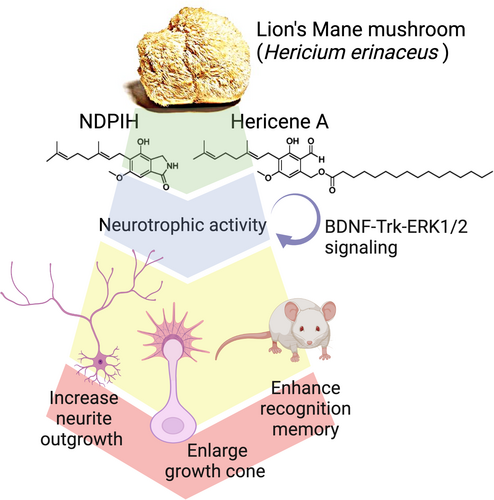
The real magic is in two unique bioactive compounds that Lion’s Mane produces: hericenones and erinacines. These molecules can cross the blood-brain barrier and have been shown to stimulate something called Nerve Growth Factor (NGF).
NGF is a protein that’s essential for the development, maintenance, and survival of nerve cells, especially in your peripheral nervous system. You produce it throughout your life, but as you age NGF signaling declines, particularly in the brain regions responsible for learning and memory.
Researchers at the University of Queensland captured this on video, showing neurons sprout new connections in real-time after being treated with Lion’s Mane extract. One neuron sits there normally on the left. On the right, you can see it branching out, creating new pathways.
Your brain is constantly rebuilding itself, but it needs the right raw materials and signals. Lion’s Mane appears to provide both the metabolic support AND the specific compounds to trigger neuroregeneration.
What The Science Shows
Let’s get into the studies, because this is where it gets juicy.
The most talked-about research comes from Japan and focuses on older adults with mild cognitive impairment (often a precursor to Alzheimer’s). They tracked 30 participants (ages 50-80) who took Lion’s Mane supplements for 16 weeks. The results were noticeable improvements in cognitive function compared to the placebo group. But there’s a catch. When they stopped taking it, their scores declined again.
This tells us something important about how Lion’s Mane works. It’s not a one-time fix. It’s more like ongoing metabolic support. Think of it as feeding a regenerative system rather than flipping a switch.
Another pilot study looked at early-stage Alzheimer’s patients who took an erinacine-enriched Lion’s Mane extract for nearly a year. Those in the Lion’s Mane group maintained better cognitive function and improved their ability to perform daily tasks compared to placebo. Research also suggests it may help reduce beta-amyloid plaques, one of the key pathological features of Alzheimer’s.
But what about healthy people? One study explored whether Lion’s Mane could enhance memory in adults with no cognitive decline. Over 12 weeks, participants took daily supplements, and the results were underwhelming. There was a slight boost in one memory test, but nothing groundbreaking.
This is actually useful information. It suggests Lion’s Mane might be more of a regenerative support system that’s most effective when there’s actually something to regenerate or repair. If your metabolic and cognitive systems are humming along fine, the effects might be subtle.
Beyond The Brain
The cognitive stuff gets all the attention, but Lion’s Mane has some more wide-ranging effects:
- It can support gut health by acting as a prebiotic, feeding beneficial gut bacteria
- Protects the stomach lining from damage and inflammation
- It can enhance immune function by modulating protective cell activity
- Acts as an antioxidant to reduce oxidative stress in the brain
- Research suggests it may alleviate symptoms of depression and anxiety
- Animal studies show improvements in blood sugar and cholesterol levels
This is particularly interesting if you’re thinking about metabolic health holistically. Blood sugar regulation, cholesterol management, inflammation, brain function – these aren’t separate systems. They’re all connected through your metabolism and energy production at the cellular level.
My Honest Assessment
So is Lion’s Mane all hype? No. The research is genuinely promising, especially for cognitive support in aging populations and people with mild impairment.
Is it a miracle cure? Also no. Most studies have small sample sizes and short follow-up periods. We need larger, long-term clinical trials to fully understand its therapeutic potential.
But here’s what is compelling. This mushroom has been used for thousands of years across multiple continents. Modern science is now discovering specific molecular mechanisms that explain why it works. Ancient wisdom is being explained by modern research.
From a first principles perspective, Lion’s Mane makes sense. It provides metabolic support, contains compounds that stimulate nerve regeneration, and appears to work through ongoing supplementation rather than as a one-time intervention. Like how fungi regenerate the forest, it appears to support your body’s natural regenerative processes.
So the question to ask isn’t “does Lion’s Mane work?” It’s “what is it actually doing, and who benefits most?”
If you’re experiencing cognitive decline, brain fog, or want to support healthy aging, the evidence suggests Lion’s Mane is worth trying. If you’re young and healthy, the benefits might be more subtle. Think of it as preventive metabolic maintenance rather than a noticeable cognitive boost in this case.
And if you do try it, find a reputable source that actually tests their products and tells you what’s in them (like Mushies).
What’s your experience with Lion’s Mane? Have you noticed any effects on energy, cognition, or metabolic health? I’m genuinely curious how this plays out in the real world beyond the controlled studies.