If you’re sick of cookie cutter true crime Netflix documentaries and are looking for something that will stimulate you intellectually, emotionally, and spiritually, I’ve got just the one for you.
Unraveling the Dream is a brand new documentary about the history and science of psychedelics. Produced by Sam Harris and directed by Jake Orthwein, I would say it is the most comprehensive film that’s ever been made on the current frontier of psychedelic research.
While most films about psychedelics give you the history or give you the science. Very few manage both, and fewer still in such a beautiful and honest way. This film explores the neuroscience, traces it back to its philosophical roots, and then asks what it can teach us and how it can apply to our own lives.
The Reducing Valve
The documentary opens with Aldous Huxley’s 1953 mescaline experiment, the experience that produced The Doors of Perception and arguably seeded everything that followed in Western psychedelic culture. Huxley’s central metaphor, borrowed from Henri Bergson, was that the brain functions as a “reducing valve”: a biological filter that narrows the full spectrum of possible experience down to the bandwidth required for survival. Most of reality is screened out before it reaches consciousness.
This might have seemed like mysticism at the time, but it maps surprisingly well onto what neuroscience is now describing.
Karl Friston’s contribution to the film adds another layer. The Free Energy Principle, which Friston has spent decades developing, proposes that living systems (from single cells to entire brains) are fundamentally prediction machines. Rather than passively receiving the world, they constantly generate models of it and act to minimise the difference between what they expect and what they encounter.
This means that the brain you walk around with is not a neutral observer, but an inference engine running on prior examples, filtering experience through the accumulated weight of everything you’ve already believed. It’s essentially Huxley’s reducing valve, translated into computational neuroscience.
REBUS and the Anarchic Brain
Robin Carhart-Harris, who appears extensively in the film, provides the clearest mechanistic account of what psychedelics actually do to this system. His REBUS model (Relaxed Beliefs Under Psychedelics) proposes that psychedelics like psilocybin and LSD work primarily by reducing the “precision-weighting” of top-down predictive signals. In plain language, the rigid models your brain uses to interpret the world temporarily lose their stranglehold on perception, bottom-up sensory signals get more weight, and the hierarchy flattens.
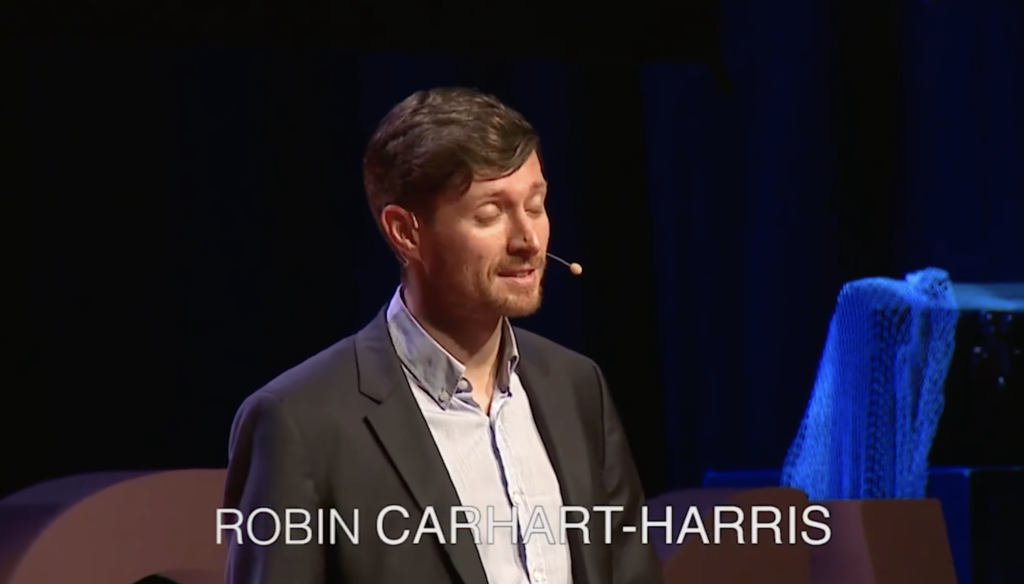
The result is what Carhart-Harris calls an “entropic brain state” – higher neural entropy, more flexible and less constrained information processing. Which explains why things look and feel so different under psychedelics. So the drug is not adding something or producing hallucinations. It’s actually removing the filter, or opening Huxley’s doors of perception, if you will.
This is network reorganisation at scale. The entropic brain state under psychedelics becomes more distributed, plastic, and responsive. Old pathways lose their dominance and new connections become possible.
This is exactly what makes the post-psychedelic window therapeutically interesting. The evidence from Roland Griffiths’ work at Johns Hopkins, highlighted in the final act of the documentary, suggests that a single psilocybin session can produce lasting positive changes in outlook and psychological flexibility in patients facing life-threatening illness. Through a single reorganising event (say 5g of psilocybin mushrooms), the brain briefly becomes more plastic, opening a window to rewrite some of its priors.
If you’re interested in the evolving story of fungi, psychedelics, and nature’s intelligence, our weekly newsletter The Spore Report is worth your time.
Read The Spore Report →First Wave
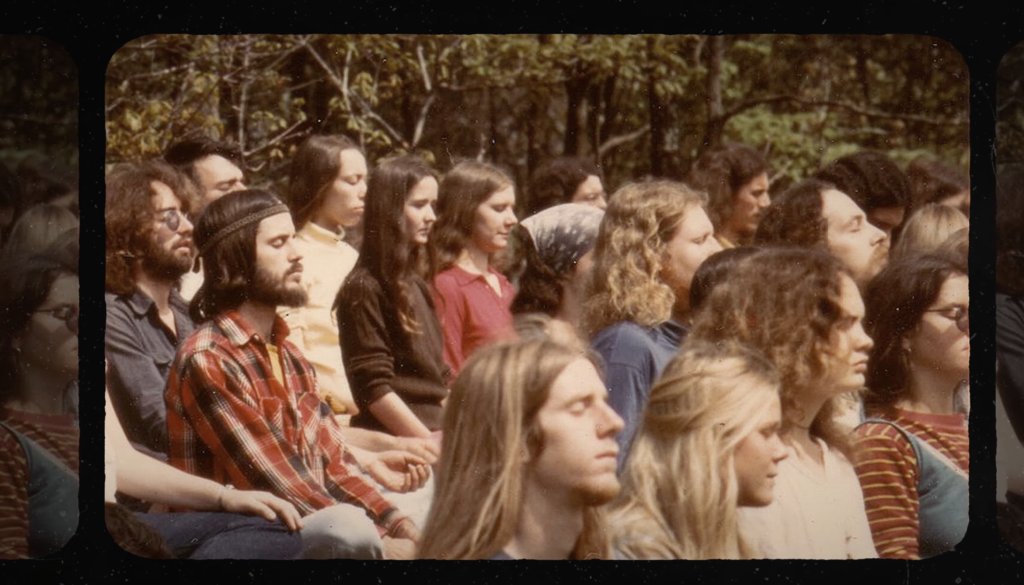
The documentary provides a rich historical overview, from the ancient Eleusinian Mysteries – where initiates may have consumed a psychedelic brew to “die before they die” – to the 1960s counterculture explosion led by figures like Timothy Leary and Richard Alpert (Ram Dass). In fact, the documentary is candid about the counterculture movement of the 1960s. It traces the arc from real research promise through the cultural explosion, the backlash, and the forty-year freeze on research that followed.
And the lesson is an important one. Context matters enormously when it comes to psychedelics. A culture organised around the dissolution of the self, without adequate frameworks for what comes next, will eventually collapse under its own incoherence.
The same is true on a personal level, and I think this is one of the most important arguments made in the film. Experiencing ego dissolution can be profound and healing. But it’s also over in a flash. Integration after the experience is another, arguably more important, task.
Missing Piece
The film’s final position is an important one. And it’s why I recommend this film to even if you’re not interested in psychedelics. It suggest that meditation is a vital piece of the puzzle. Where psychedelics briefly demonstrate is possible, meditation positioned as the sustainable technology that offers similar insights and benefits but over the long term.
If the entropic brain state is therapeutic because it loosens the precision-weighting of rigid self-models, then anything that does this reliably, without pharmacology, becomes extraordinarily valuable. Contemplative practice, done properly, trains exactly that capacity. Forget enlightenment. It’s about becoming more flexible in how your brain models the self and the world. That flexibility, sustained over time, is what the film calls “everyday mysticism.”
Anil Seth, who also appears in the film, frames consciousness itself as a controlled hallucination: a best-guess rendering of the world constructed from incomplete data. The self is not exempt from this. What you experience as “you” is a model, a prior, a prediction. Psychedelics expose this temporarily. Meditation, the film argues, teaches you to hold that knowledge in ordinary waking life.
I agree. The goal is not to dissolve the self through chemistry for a few hours or over a weekend at some idyllic retreat in Costa Rica. The goal is to recover the brain’s native plasticity and to apply that capacity intentionally in order to grow or mature as a person. Psilocybin can open a window, sure. But what you do while that window is open, and whether you’ve built the habits to sustain the view afterward, is the real work.
Unlike some films, Unraveling the Dream doesn’t evangelise for a psychedelic revolution. It explains where we are right now, acknowledges we we know and what we don’t, and leaves you with the profound question that if capacity for transformation is not only possible, but readily available, what will you, and we as a species, choose to become?
Watch the documentary on YouTube here. This isn’t an ad or sponsored post. I’m recommending it because it’s genuinely the best documentary on this subject I’ve encountered.
If you’re interested in the evolving story of fungi, psychedelics, and nature’s intelligence, our weekly newsletter The Spore Report is worth your time.
Read The Spore Report →