German author Norman Ohler recently gave a talk at the Oxford Union covering the sweep of his research career: methamphetamine in the Wehrmacht, Hitler’s opioid habit, the SS’s early interest in psychoactive truth drugs, LSD’s path from Sandoz to the CIA.
Partway through, he set all of that aside for a personal story about his mother. A clip of that section has since racked up 4 million views on Instagram.
A family running out of options
Ohler’s mother has Alzheimer’s. While researching a book on LSD’s suppressed history, he came across clinical work suggesting the compound could support the very brain functions that degenerate in dementia. He brought it home to his father, a retired judge who had spent his career sentencing people for drug offenses. “You’re telling me I should give my wife an illicit substance,” his father said, “but this is illegal, not only in Germany, across the world.”
As a judge, he told his son that establishing truth rarely means finding absolute proof. It means finding the account that rings true, built from evidence. So Ohler went looking for it through archival research into how LSD, discovered by accident in 1943, but had ended up walled off from medical study for decades, and through the emerging clinical literature on psychedelics and the aging brain.
The family eventually tried it. Ohler describes his mother’s first microdose landing on Mother’s Day, with him and his father present. She had grown withdrawn as her illness progressed. On the dose, she was noticeably more present, spoke more easily, and read a newspaper headline aloud for the first time in over a year. His father called it a medicinal miracle.
Ohler wanted to title the resulting book LSD for Mom. His publisher went with Tripped instead. He still prefers the original.
Restrictions
Ohler has since written about what happened next, and it isn’t the ending anyone would want. His mother’s LSD treatment has stopped. The reasons are practical rather than medical. LSD remains illegal in Germany, and she now lives in a care facility bound by strict regulations that leave no room for the arrangement his family once managed at home. Legal status and logistics, not evidence of harm, ended the treatment.
Ohler doesn’t pretend the interruption has been neutral. Her Alzheimer’s, he writes, remains a devastating illness that medicine still knows too little about treating. He’s also blunt about where he places the blame, calling it a kind of collective irrationality for a society to tolerate Alzheimer’s while criminalizing substances that might help treat it, especially when far more dangerous drugs remain legal and widely used every day.
What the science says
The Beckley Foundation has documented a comparable case. A 97-year-old woman with advanced Alzheimer’s and vascular dementia, in a near-vegetative state, whose family turned to microdosed LSD as a last resort. Her caregiver and family reported that she came back to full awareness, wit, and a restored sense of self, regaining her ability to talk, read, and connect with people around her. That case became the basis for what Beckley describes as the first controlled clinical trial of LSD microdosing for Alzheimer’s, now underway with the University of Basel’s geriatrics department.
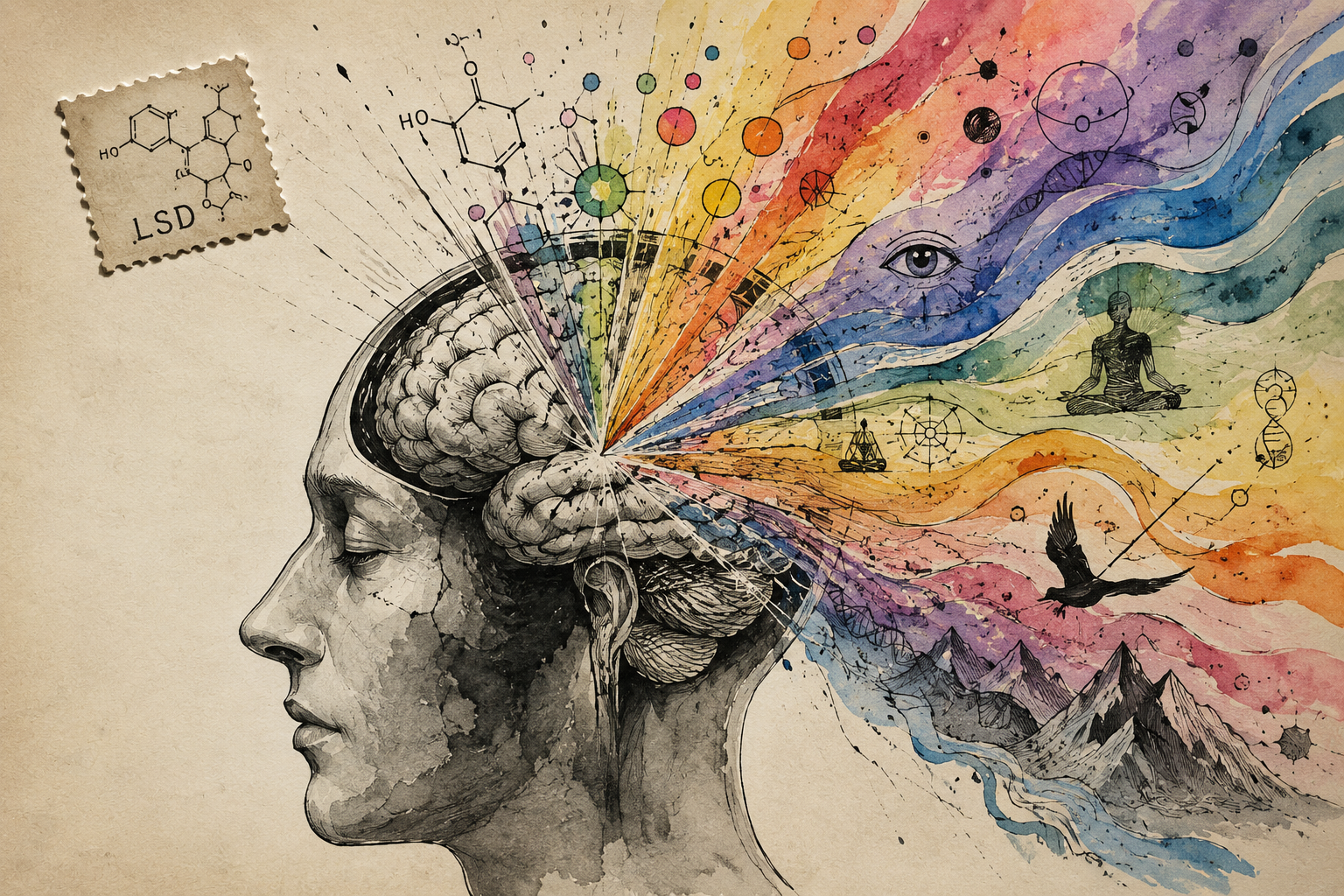
The biological rationale isn’t purely anecdotal, either. A 2020 white paper from Eleusis Therapeutics argues that low-dose LSD could be disease-modifying rather than just symptom-relieving. Its action at 5-HT2A receptors appears to touch amyloid processing, neuroinflammation, and BDNF-driven neuroplasticity, all mechanisms now tied to Alzheimer’s progression.
A 2024 review of psychedelics for Alzheimer’s-related dementia reaches a similar conclusion, pointing to how LSD, psilocybin, and DMT act on serotonergic and glutamatergic signaling to support neural plasticity, an underexplored but increasingly plausible route to treatment.
We’ve also recently reported on a an 80-year old woman with late stage Alzheimers who was given 5g of psilocybin mushrooms and started speaking again.
None of this amounts to proof. Older adults remain badly underrepresented in psychedelic trials, and formal dementia studies are still early. But the direction suggests Ohler’s story isn’t an outlier. It’s an early data point in a field only just beginning to ask whether these compounds can do for an aging brain what they’ve already shown they can do for a depressed one.
Keep up with the research here.