

There’s little worse than witnessing a loved one with advanced Alzheimer’s disease. You grieve someone while they’re still there as they lose the ability to speak, care for themselves, and even remember who you are.
For decades, the scientific consensus has been clear that once Alzheimer’s reaches its final stages, those functions don’t come back.
But a case report just published in Frontiers in Neuroscience in May 2026 challenges that assumption, and the implications are profound.
The patient
The report describes an 80-year-old Japanese-American woman with a decade of progressive cognitive and functional decline. For the last five years of that, she had been reduced to monosyllabic speech, chronic urinary incontinence, a lack of outward emotional expression, an inability to dress herself, and near-total dependence on caregivers for basic mobility.
By any clinical measure, she was in advanced Alzheimer’s disease. The standard prognosis is continued decline until death.
Then she was given 5 grams of psilocybin mushrooms – specifically the Enigma strain, a high-potency cultivar known for unusually dense fruiting bodies and strong effects.
What happened?
The first several hours were not pleasant. She became agitated, sweated heavily, and entered what the researchers describe as “a prolonged deep sleep-like state”. So deep they suspected unconsciousness.
Then, approximately 19 hours after administration, something remarkable happened. She woke up and started talking in full sentences. She even started recounting events from her life that she hadn’t been able to articulate in years, with conversations lasting several hours.
Over the days and weeks that followed, the improvements compounded:
- She regained urinary continence, including at night, after more than five years of chronic incontinence
- She began dressing herself independently
- She made and sustained eye contact
- She recognised family members and remembered social interactions
- She engaged in spontaneous, lucid conversation
- She laughed
One month later, she remained continent and functionally improved. The researchers administered a second, lower dose of 3 grams. During that session she described “emotionally positive imagery involving surfing with her son on a peaceful island.” Her facial expressivity, humour, and walking agility all improved further.
She spontaneously told those around her: “It is pleasant to come here.”
What the researchers say
The authors are scrupulous about the limits of this report. It’s a single case. There’s no control group, no formal neuroimaging, and no standardised cognitive assessment. Causality cannot be established.
But within those limits, they offer the hypothesis that residual functional capacity may persist in late-stage Alzheimer’s disease, and may become transiently accessible under specific neuromodulatory conditions.
In other words, the functions were still there, and psilocybin may have unlocked them.
The neuroscience
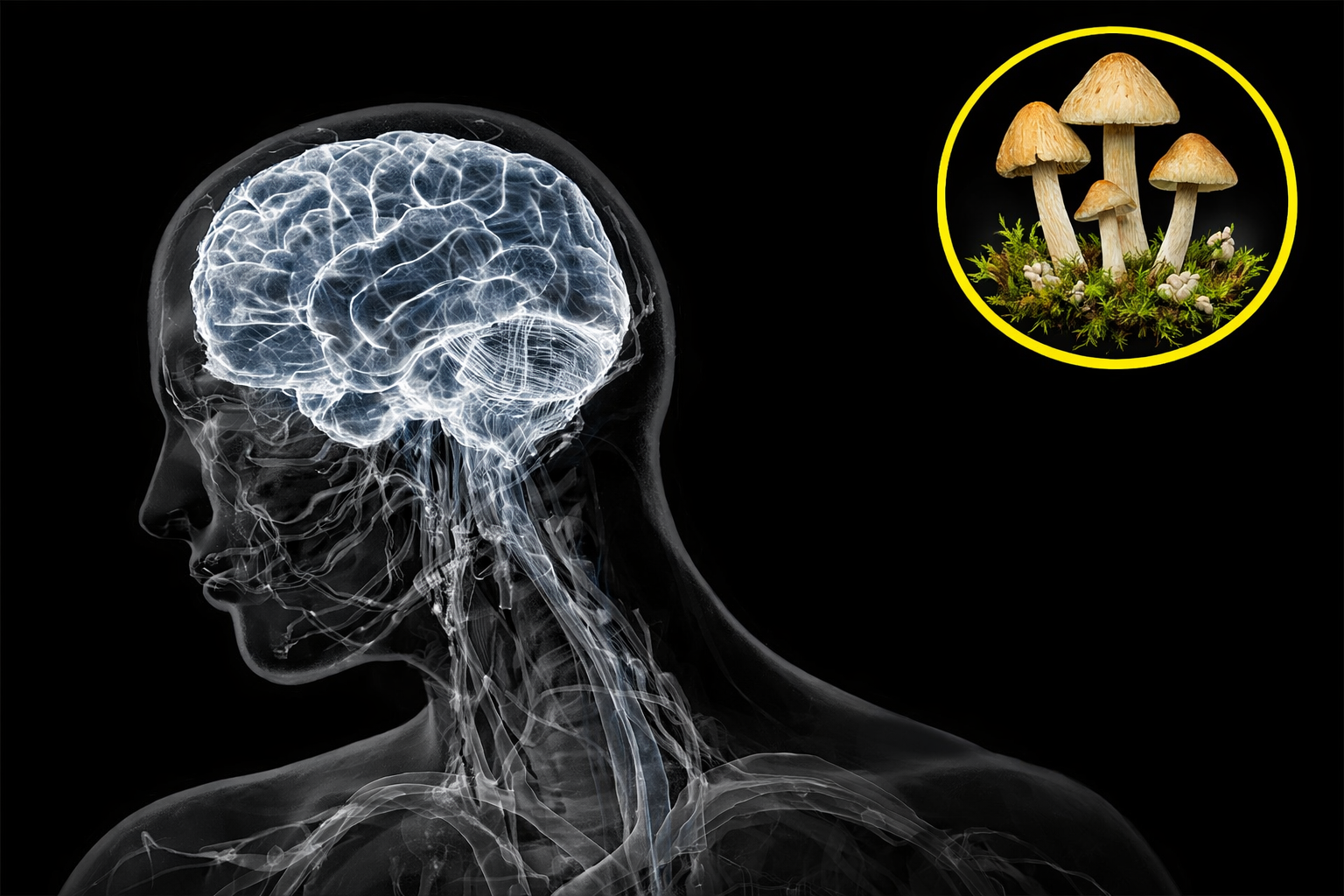
Psilocybin’s primary mechanism is activation of serotonin 5-HT2A receptors, which are densely distributed across the cortex. When those receptors activate, they produce a cascade of effects on large-scale brain network dynamics – effects that neuroimaging researchers have been mapping in increasing detail over the last decade.
Two findings are particularly relevant here.
First: psilocybin transiently disrupts the default mode network (DMN) – the deeply grooved pattern of self-referential activity that dominates ordinary waking consciousness. In healthy brains, this disruption is experienced as ego dissolution or altered self-perception. In a brain locked into the rigid, degraded network architecture of advanced Alzheimer’s, the same disruption might temporarily loosen functional bottlenecks.
Second: psilocybin promotes what researchers call “global functional integration” – a state in which normally segregated brain systems temporarily communicate more freely with each other. A 2024 paper in Nature (Siegel et al.) described this as psilocybin “desynchronising” the human brain in ways that increase cross-network connectivity. A brain that has lost the normal infrastructure for this kind of integration may, under psilocybin, access it through alternate routes.
There’s also a structural plasticity dimension. Preclinical studies have shown that serotonergic psychedelics can promote dendritic growth and synaptic remodelling (the physical rebuilding of neural connections). Whether this applies meaningfully in a brain with advanced Alzheimer’s pathology is unknown, but it’s possible.
The prolonged sleep-like state observed in this patient also invites speculation. Sleep is one of the brain’s primary mechanisms for synaptic consolidation and waste clearance. Whether the 19-hour deep sleep served a functional role in what followed is unknown, but the researchers note that psilocybin’s interaction with sleep architecture in Alzheimer’s-affected brains may be meaningfully different from its effects in healthy volunteers.
The latent capacity hypothesis
The most quietly radical idea in this paper is the one buried in the conclusion: that functional capacity believed to be irreversibly lost may actually still be present in late-stage neurodegeneration, just inaccessible under normal conditions.
This reframes the question of late-stage Alzheimer’s. The standard model assumes that lost function reflects destroyed substrate. But what if, in at least some cases, the substrate is still there, just functionally silent? What if the architecture of advanced neurodegeneration isn’t absence but disconnection?
Psilocybin, by temporarily reorganising large-scale network dynamics, may be doing something like pulling a jammed drawer free. The contents were always there. They just couldn’t be reached.
This is speculative. But it’s a hypothesis that the data from this single case genuinely supports, and one with profound implications if it holds up in controlled studies.
What this isn’t
This is not evidence that psilocybin cures or reverses Alzheimer’s disease. The woman’s neurodegeneration continued. The improvements were transient and there was no biomarker confirmation of diagnosis, no polysomnography, and no long-term follow-up beyond the initial weeks.
A single case report does not establish a treatment. But it does generate a hypothesis. And this hypothesis – that residual function persists in late-stage Alzheimer’s and can be transiently unlocked via neuromodulation – is one that controlled clinical investigation urgently needs to test.
Beyond the headline
We are at the beginning of understanding what psychedelics actually do to the brain. The psychiatric applications in depression, PTSD, and addiction are the visible frontier. But the neurodegenerative frontier is opening, and the stakes there are arguably even higher.
Over 55 million people worldwide are living with dementia. The vast majority of them are receiving care that is entirely supportive, with no meaningful expectation of functional recovery.
If there is residual capacity in late-stage Alzheimer’s that can be accessed, even transiently, that changes the texture of what end-stage care might look like. Not necessarily in terms of disease trajectory, but in terms of human presence. In terms of lucid moments. In terms of saying goodbye.
The mushroom didn’t cure this woman. But for a period of weeks, it brought her back.
That’s not nothing. That might be everything.

Interesting