
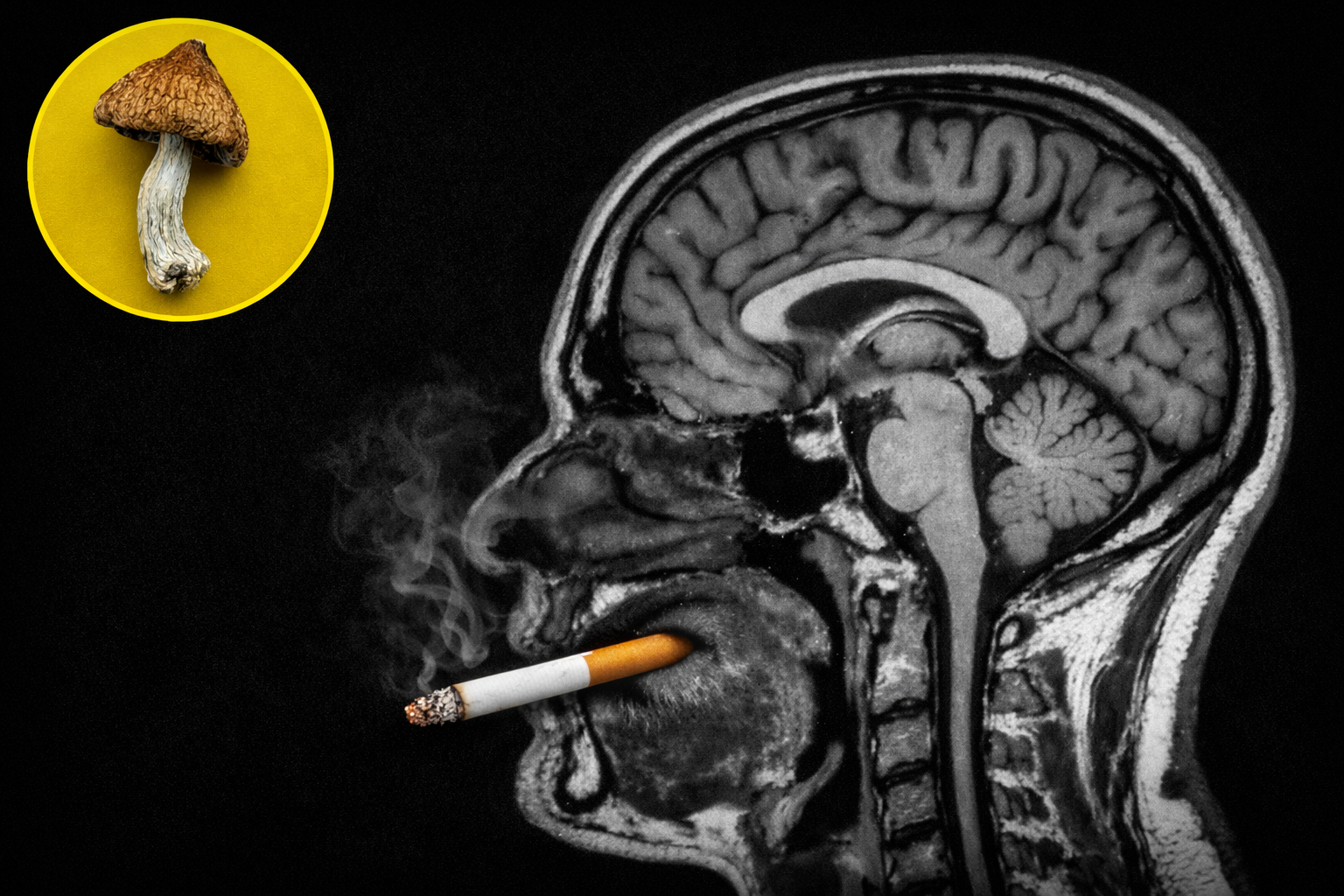
The statistics around quitting smoking are bad. Only one in ten who try actually succeed. That means nine out of ten people who wanted to stop, couldn’t. You might think they lacked willpower, but there’s more to it. It’s more to do with how the brain is wired. Once it’s organised itself around a substance or a habit, is extraordinarily reluctant to let go.
This context is vital to understanding the findings of a new study published in JAMA Network Open this week that found a single dose of psilocybin was significantly more effective than nicotine patches at helping people quit smoking.
The Study
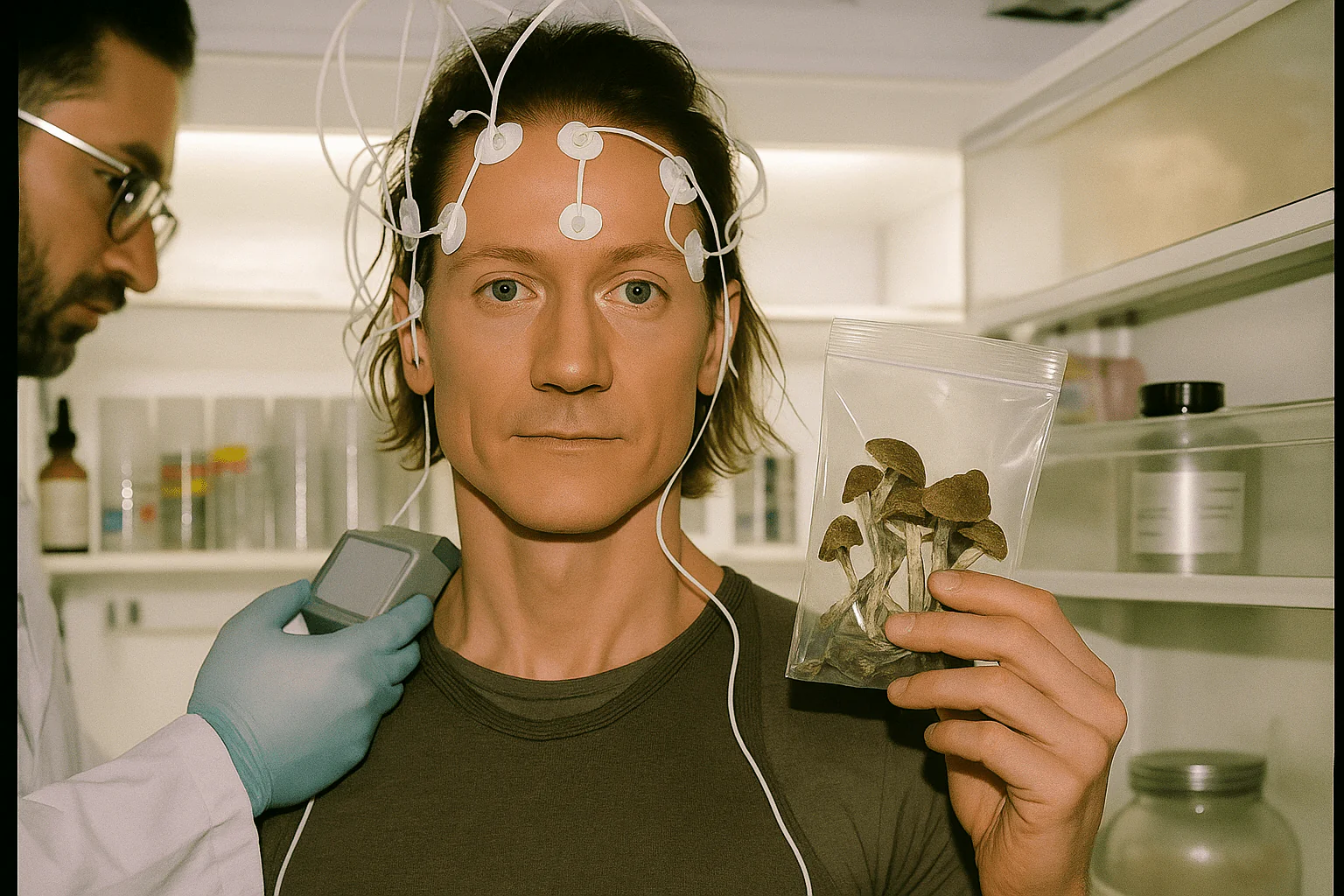
Researchers at Johns Hopkins University ran a randomised trial with 82 adult smokers described as “psychiatrically healthy”. The trial compared two things: a standard course of nicotine replacement patches given over eight to ten weeks, and a single high dose of psilocybin. Both groups also received thirteen weeks of talk therapy.
At the six-month mark, over 40% of the psilocybin group had stopped smoking. In the nicotine patch group, that figure was 10%. Those who received psilocybin were three times more likely to have avoided cigarettes in the previous week, and six times more likely to stay off nicotine long term.
Lead researcher Matthew Johnson, a professor of behavioural pharmacology at Johns Hopkins, was candid about being surprised by his own results. He described his participants not as curious psychonauts, but as exhausted people who had run out of options. “They’d say things like, ‘I’ve tried everything but the kitchen sink,'” he told Thornton. These were people for whom the decision to try a psychedelic wasn’t countercultural. It was practical.
This isn’t about nicotine
The tempting interpretation of this study is that psilocybin is simply a more powerful craving-suppressor. A better patch, if you will. But Johnson’s explanation of the mechanism is more interesting than that, and it connects to something that researchers in addiction science have been building a case for over the past decade.
Johnson suggests psilocybin worked not by targeting withdrawal or altering how nicotine behaves in the body, but by “influencing psychological systems, changing self-perception and influencing behaviours.” Which is a clinical way of saying: the brain, briefly, saw itself differently. And in that window, something shifted.
Biologically, the picture involves neuroplasticity, which is the brain’s capacity to form new connections and reorganise existing ones. Under psilocybin, Johnson explains, “the brain is communicating with itself in a radically different way.” The normal hierarchies of neural activity – the well-worn grooves of habit and compulsion – are temporarily loosened.
New understanding of addiction
This is where the metabolic theory of addiction becomes relevant. The traditional view of addiction frames it primarily as a chemical dependency: the substance hijacks the dopamine reward system, withdrawal is painful, and the cycle reinforces itself. But a growing body of research suggests that addiction may be as much a story about energy metabolism in the brain as it is about neurotransmitters.
The addicted brain doesn’t just crave a substance. It reorganises its energy expenditure around obtaining it. Neural circuits associated with compulsive seeking become metabolically dominant. They consume more glucose. They become the brain’s default mode.
This reframes what recovery actually requires. The standard prescription of pure willpower is asking the prefrontal cortex to override systems that have been metabolically entrenched. It’s asking a relatively energy-limited part of the brain to outcompete circuitry that the brain has, in effect, invested in. The odds aren’t great.
Psilocybin may work, at least in part, by temporarily disrupting that metabolic dominance. By forcing the brain into a state of dramatically altered connectivity, it breaks the energetic routine. And crucially, there’s evidence that psilocybin promotes neurogenesis and synaptic plasticity in ways that persist well beyond the acute experience.
This doesn’t mean psilocybin is a silver bullet. Johnson is careful to emphasise that psilocybin is not physically addictive, but the experience itself demands careful supervision. Some participants experienced significant anxiety during the session. “People can be really anxious, even terrified,” Johnson noted. that said, no serious adverse events were reported in this trial.
The Bigger Picture
This was a small study (just 82 people) built on Johnson’s earlier pilot work. The researchers are clear that larger, more diverse trials are needed. And funding has historically been the problem. Between 2006 and 2020, the National Institutes of Health provided no direct grant support for standalone clinical trials of therapeutic psychedelic use.
That’s slowly changing. Several companies are now pursuing FDA approval for psilocybin-based treatments. There’s political interest too, with US Health Secretary Robert F. Kennedy Jr. speaking about expanding psychedelic access for veterans with PTSD, and the Trump administration signalling it wants clinical availability this year. but Johnson is pragmatic about the commercial angle, saying large trials are expensive, and without industry participation, they probably won’t happen.
What lingers, though, is the human scale of the problem these researchers are trying to solve. Smoking kills around 480,000 people in the US every year. More than 8 million globally. Nine in ten people who try to quit don’t manage it with the tools currently available. And yet a single guided experience with a compound that grows in the ground appears to outperform the best pharmaceutical option by a factor of four, through a mechanism that we’re only beginning to properly understand.
That’s a signal.
The brain is plastic. It can change. The question addiction research has always struggled to answer is how to create the conditions for that change in a brain that has spent years organising itself against it. Psilocybin, it turns out, may be one of the more effective answers we’ve found.
Source: Psilocybin or Nicotine Patch for Smoking CessationA Pilot Randomized Clinical Trial
If this kind of thinking sits at the intersection of where you spend your time — the science of the brain, consciousness, and what these compounds are actually doing under the hood — The Spore Report goes deeper. It’s a newsletter worth reading slowly, not skimming.

I want to be in a study or find a place that’s good and does this cessation with psilocybin