
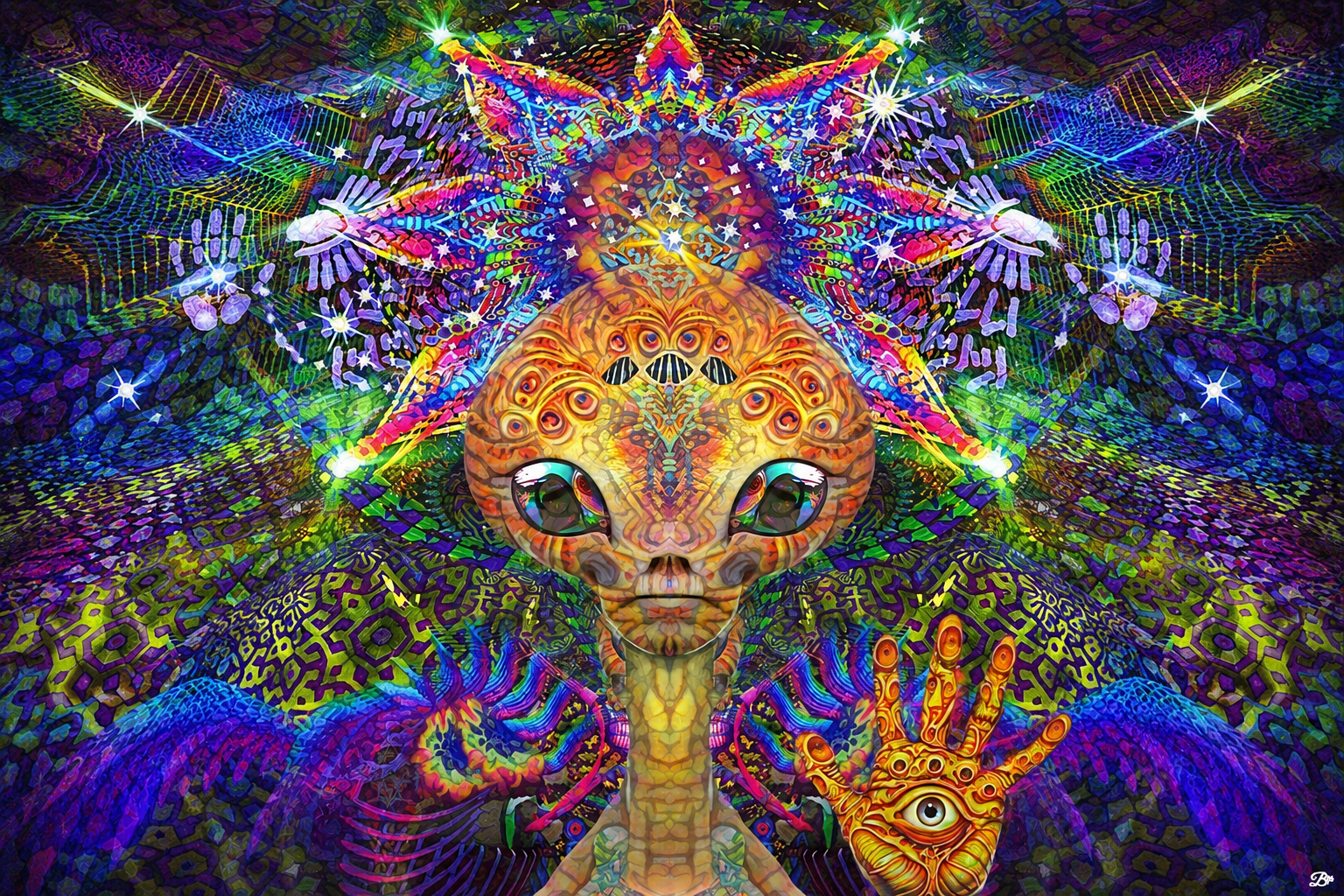
A landmark preprint from Andrew Gallimore, Donald Hoffman, and Niffe Hermansson proposes that the beings encountered in the DMT state could be formally modelled, empirically tested, and potentially real in a sense that neither materialist neuroscience nor mystical tradition has been equipped to handle.
If you’ve ever taken a high dose of DMT, you’ll know that the most striking feature of the experience is seeing and interacting with seemingly conscious beings.
They are more than vague presences or symbolic archetypes. They appear autonomous, intelligent, and frequently described as more real than real. But they also manipulate impossible geometries, transmit vast amounts of incomprehensible information, and behave in ways that are fundamentally outside your ability to anticipate or control.
The standard scientific response has always been that they are simply elaborate hallucination. The brain, loosened from its normal top-down constraints, runs its pattern-detection machinery unchecked and conjures autonomous beings from noise. Case closed.
But a new preprint, Traces of the Other: Are DMT Entities Real?, just published on PsyArXiv, suggests the case is not closed. It’s barely been opened.
Written by Andrew Gallimore (Okinawa Institute of Science and Technology), Donald Hoffman (UC Irvine), and mathematician Niffe Hermansson (The Trace Institute), the paper takes the entity question seriously at the level of formal mathematics, derives testable predictions from first principles, and proposes experiments to distinguish between hallucination and something else.
The authors are making a radical claim that the entities could be traces of conscious agents that are normally imperceptible to us because our perceptual systems aren’t built to perceive them.
Reality as a Network of Minds
To follow the argument, you need to start with the framework the paper builds on – Donald Hoffman’s conscious realism.
The Hard Problem of consciousness (how subjective experience arises from physical matter) remains unsolved despite decades of neuroscience. Hoffman’s response is to flip the question. Rather than asking how matter produces consciousness, he asks, what if consciousness is the fundamental thing, and matter is what consciousness looks like from the outside?
In conscious realism, reality consists entirely of interacting conscious agents. So the brain and its neurons aren’t the ones generating experience. It’s consciousness interacting with itself in structured ways that give rise to what we experience as the physical world.
This is backed by evolutionary game theory, where simulations consistently show that perceptual systems tuned to fitness outcompete those tuned to truth. Natural selection produces minds that see reality usefully, not necessarily accurately. The world we perceive is more like a user interface than a transparent window. The icons on your desktop are designed to let you work, not to show you what’s happening inside the machine.
Why Most of Reality is Invisible
If reality is a vast network of conscious agents and our perceptual systems are fitness-optimised interfaces, it follows that we only ever perceive a tiny fraction of the agents that actually exist.
The paper formalises this with the concept of a trace. Agent A perceives Agent B when B’s actions propagate through the world and reach A’s perceptual system in a way that actually influences A’s experience. If B’s actions don’t land within the subset of world-states that A’s perceptual system is sensitive to, B is simply imperceptible.
The range of agents we normally perceive is called the Consensus Reality Space (CRS): a stable region of possible experience, shaped by evolutionary pressure to track whatever agents mattered for our ancestors’ survival. The paper notes that the space of possible conscious agents is effectively infinite. Even for an experience space with just ten states, the mathematical object describing all possible transition structures is 90-dimensional with ten billion vertices. Scale that up and you have an incomprehensibly vast diversity of possible minds.
We’re just not seeing them because we were never evolved to see them.
DMT as Interface Perturbation
The paper’s core proposal is that DMT perturbs the human perceptual interface sufficiently to push consciousness outside the CRS, into regions where different dynamical rules apply and where traces of normally imperceptible conscious agents can be rendered as stable, coherent, meaningful structure.
The neuroscience is surprisingly consistent with this. Psychedelics increase cortical entropy, flatten the brain’s control energy landscape, and expand the repertoire of states the cortex can explore. Under DMT, the brain is measurably visiting territory well outside its normal range.
What would it feel like to encounter traces of conscious agents with radically exotic dynamics? The paper derives three predictions from the mathematics, then notes they map almost exactly onto DMT phenomenology.
Higher-dimensional phenomenology. If the agents you’re now receiving traces from require richer geometric structure than a 3D interface can support, you’d experience spatial dimensionality appearing to expand or warp. More directions in space than there should be. This is among the most commonly reported features of breakthrough DMT.
Extreme complexity and otherness. Agents operating in a higher-dimensional experiential space would appear, to a lower-dimensional observer, to be performing godlike feats. They may be operating where what looks to us like miraculous capability is routine competence, much as a trivial operation in a higher-dimensional mathematical space can encode particle interactions that look impossibly complex when computed in ordinary spacetime.
Independent agency. If an entity is driven by an external conscious agent rather than your own cognitive machinery, you’d expect it to be genuinely unpredictable and capable of surprising you in ways you couldn’t have generated yourself. DMT users describe exactly this: entities that teach, demonstrate, and behave with complete autonomy from the experiencer’s intentions.
The Anomaly the Hallucination Model Struggles With
When the brain’s top-down constraints loosen in dreams or psychotic hallucinations, experience fills with humans and familiar animals. This makes sense as those are exactly the beings the brain’s pattern-detection machinery evolved to model.
DMT does something categorically different. Humans appear in fewer than 5% of entity encounters. The beings reported have no referent in the human ancestral environment, inhabiting worlds of structural complexity bearing no relationship to normal waking life.
I must make clear that the paper doesn’t claim this proves the entity hypothesis. But it does offer a genuine empirical challenge to the hallucination model that warrants serious scientific attention.
DMTx Experiments
The paper outlines experimental paradigms made feasible by the DMTx technique (target-controlled intravenous infusion that can maintain stable DMT effects for up to two hours, already validated in clinical settings). For the first time, subjects can spend extended periods in the DMT state under controlled conditions.
They propose single-subject experiments that ask whether DMT experiences are systematically constrained by variables outside the subject’s own cognitive processes. In one paradigm, a computer in a separate room randomly switches between two states (a blue or yellow screen), unknown to both subject and experimenter. Can an entity track this hidden variable and express it in the subject’s experience at statistically significant rates?
Multi-subject experiments could test for shared structure across independent experiences. Can two isolated subjects encountering the same entity show non-trivial correlations in their reports? Can information be deposited with an entity by one subject and retrieved by another in a separate session?
Why This Matters
The paper doesn’t naively claim DMT entities are real. It simply asks whether the human perceptual interface is capable of hosting traces of conscious-agent dynamics that normally lie beyond its representational reach. That question is formally tractable and empirically testable in a way that neither dismissive hallucination models nor credulous entity-worship has managed to be.
The entities may be hallucinations. The experiments may return null results. That’s science. But the paper makes a compelling case that we haven’t actually tested the alternative yet. Given what’s at stake for our understanding of consciousness, perception, and the structure of reality, perhaps it’s time we did.
Gallimore AR, Hermansson N, Hoffman DD. Traces of the Other: Are DMT Entities Real? PsyArXiv. 2026.



Where can you get DMT treatment
It’s very easy and cheap to make yourself. You’ll only get 5 or 10 minutes, but for many people, that’s plenty, to start with at least.
As far as I know the only place DMTx trials are ongoing is Colorado
Noy true. There is a company based in FL which has a facility in Bahamas.
Where can I volunteer for for testing?
У Льва хватит ли смелости пройти это?
Any research done in Canada?