
There’s a strange question gaining traction in scientific circles, one that would have seemed absurd a decade ago: could fungi be conscious?
It sounds kind of woo, but a growing number of researchers are taking it seriously. And even those who are sceptical of the consciousness angle are admitting that fungi are far more capable than we ever gave them credit for.
What fungi are actually doing underground
Most of what we call a “mushroom” is the tip of the iceberg. Beneath the soil, fungi extend networks of hair-like filaments (called hyphae) through the earth, seeking food, sensing their environment, and routing resources across what can amount to vast biological networks.
Cecelia Stokes, a fungi researcher at the University of Wisconsin-Madison, puts it plainly: fungi have developed a remarkably efficient way of navigating minute environmental changes, and they do it without a brain or central nervous system. “That alone,” she says, “is amazing.”
The experiments making scientists rethink fungi
The real spark for the consciousness debate has come from a series of experiments at Tohoku University in Japan, led by Dr Yu Fukasawa.
In one study, Fukasawa’s team offered a wood-decomposing fungus two blocks of wood, one small and one larger. The fungi didn’t just grow toward the nearest option. They appeared to weigh up the better resource and redirect accordingly. More striking: after being moved to new ground, they continued to grow in the direction where the bait had originally been, as if holding onto a kind of spatial memory.
Fukasawa is careful with his language. The memory, he explains, is probably structural: the fungi grew more on one side, and that architecture carries the “record.” But he argues it still qualifies as a form of memory in a meaningful sense. “A kind of structural memory in the mycelial system,” as he puts it.
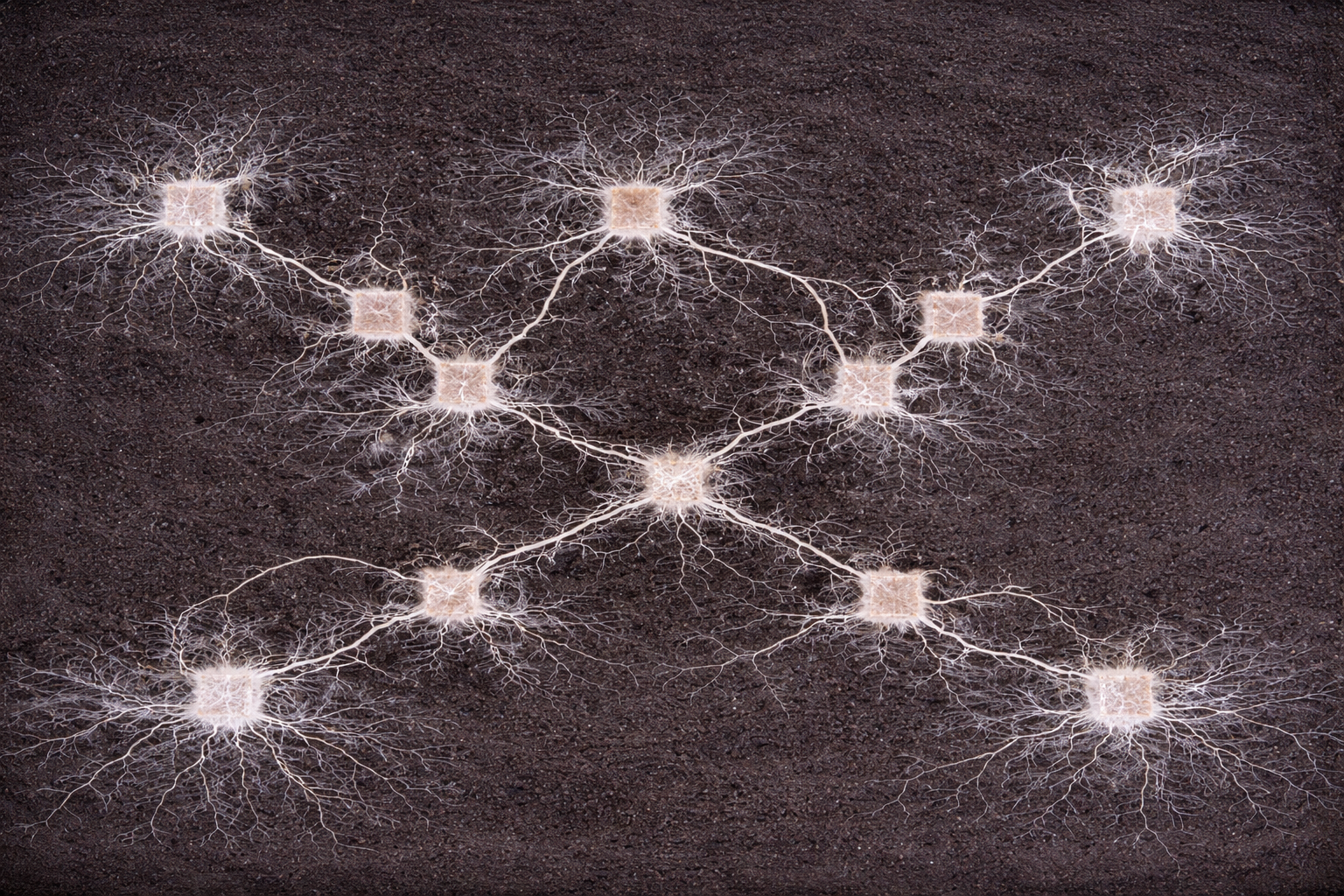
A more recent experiment looked at whether fungi could engage in something resembling pattern recognition. Fukasawa’s team arranged nine wood blocks in either a cross or a circle on soil and observed how fungi spread from the centre outward. In the cross arrangement, the fungi eventually abandoned the middle blocks to push toward the outer ones. In the circle, they left the centre clear, apparently “deciding” that the resources at the perimeter were enough.
These are natural foraging behaviours. But the fact that fungi distinguish between inward and outward, and adjust behaviour accordingly, led the researchers to describe what they saw as a form of pattern recognition: the same term used to describe how computers identify data, or how we recognise faces.
Intelligence or consciousness?
The intelligence findings are interesting enough. But some researchers have taken a more provocative step, asking whether fungi might also be conscious.
The most prominent version of this argument comes from fungal biologist Dr Nicholas Money, who proposed the idea of a “fungal mind” in an essay in Psyche magazine in 2021. Money’s position isn’t that fungi think like we do. It’s that if we’re willing to expand what we mean by consciousness, to see it as something distributed across a spectrum of life rather than a binary that humans (and maybe some animals) possess, then fungi might sit somewhere on that continuum.
Similar arguments have been made for slime moulds and plants. Electrical signals detected in fungi have been compared to the signals associated with nerve cells in animals, prompting some to ask whether a brainless nervous system is possible.
The sceptic’s case
Stokes, for her part, is unconvinced, and her objection is worth taking seriously.
“All cells generate electricity from movement of ions across membranes,” she points out. The fact that we can detect electrical signals in fungi doesn’t automatically mean those signals are doing what nerve impulses do in animals. The underlying mechanism matters, and the evidence for a fungal nervous system is nowhere near established.
Her broader concern is that anthropomorphising fungi, framing their behaviour in terms borrowed from human cognition and neuroscience, can obscure what actually makes them fascinating. “We’re dismissing a lot of really fascinating biology they have that’s different from us,” she says.
It’s a concern that echoes criticisms levelled at the “wood wide web” narrative, the idea that trees communicate with each other via fungal networks. That theory has spread widely, but many scientists now argue the evidence for deliberate tree-to-tree communication is much thinner than the popular version suggests.
What we can say with confidence
So where does this leave us?
Fungi can process environmental information and respond adaptively. They appear to “remember” spatial positions through structural changes to their networks. They can distinguish between different configurations of resources and adjust their behaviour accordingly. These are genuinely remarkable capacities, achieved without anything resembling a brain.
Whether that constitutes intelligence depends on how broadly you define the term, and Fukasawa argues there’s real value in widening that definition: not to project human qualities onto other organisms, but to understand how intelligence might have evolved across radically different body plans.
Whether it constitutes consciousness is a different, much harder question, and the science isn’t there yet.
For now, the most accurate thing we can say is this: fungi are solving problems. They’re doing it without neurons. And we’re only beginning to understand how.
Want to go deeper on fungal science, psychedelics, and the biology of the mind? The Spore Report covers it all. Subscribe to the newsletter here.


What if life and consciousness is the same?
What if life and consciousness is the same?