
For most of the last century, the search for intelligence in the brain has looked a lot like a treasure hunt in the brain. Find the right region, and you’ll find the “smart” part. The prefrontal cortex got most of the glory. Case closed, or so it seemed.
A study published in Nature Communications this January puts that treasure hunt to rest. General intelligence, the researchers argue, isn’t hiding in one region at all. It emerges from the topology of the whole brain, from how the system is wired, how its weakest and longest connections carry information across distant regions, and how a handful of hub regions orchestrate the rest.
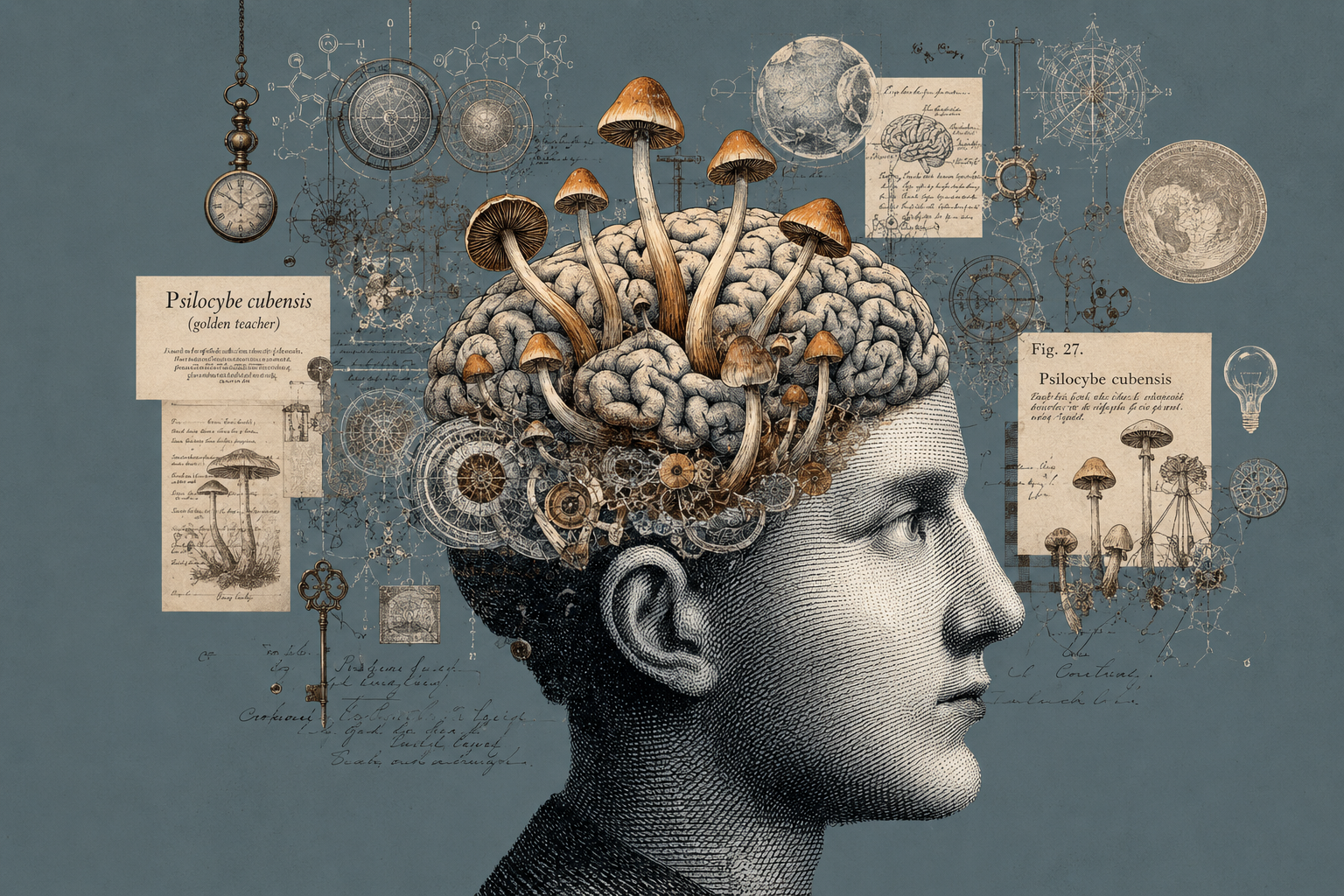
If that’s true, it changes the question we should be asking about our own minds, and it opens up an interesting hypothesis about psilocybin.
The Study: Intelligence as a Network Property
The research, led by Aron Barbey’s team and grounded in Network Neuroscience Theory (NNT), analyzed brain scans and cognitive test data from 831 healthy young adults in the Human Connectome Project (with a second sample of 145 used to check the findings held up). Instead of looking for a single “intelligence center,” the team jointly modeled two things at once: the brain’s structural wiring (the physical white matter cables, mapped with diffusion imaging) and its functional activity (which regions light up together, mapped with resting-state fMRI).
Four things stood out.
First, intelligence didn’t belong to any single network. A model using connections from across the whole brain predicted general intelligence (g) far better than any model built from a single network alone, and removing any one network from the whole-brain model barely dented its accuracy. Intelligence, in other words, is a team sport.
Second, the weak, long-distance connections mattered more than the strong, local ones. In people with higher g scores, the connections that were doing the most work tended to be weaker in strength but longer in reach, linking distant, otherwise loosely-related regions. These weak ties are thought to allow the brain to reconfigure itself quickly in response to new problems, rather than being locked into rigid, well-worn pathways.
Third, certain “modal control” regions, concentrated in the default mode, cingulo-opercular, and fronto-parietal networks, seemed to act as conductors, steering the whole system into states it wouldn’t reach on its own. People’s intelligence scores tracked how strongly these orchestrating regions were engaged.
Fourth, and maybe most elegantly, higher intelligence correlated with a small-world network architecture: a brain organized with both dense local clustering (for efficient, specialized processing) and short global paths (for fast, system-wide communication). People with lower g scores tended to show more randomly organized networks, with weaker local clustering, the opposite of this efficient balance.
The paper’s authors frame this as a genuine paradigm shift, away from localist models of intelligence and toward one grounded in the global architecture and dynamics of the human connectome.
A Different Question to Ask
Most of us ask “how smart am I?” as though intelligence were a number stamped on us at birth, something to be measured once and filed away.
But this research points toward a different question: how coherently is my brain’s network currently functioning?
Those aren’t the same question, and they don’t point toward the same answer. The first treats intelligence as a fixed trait to be assessed. The second treats it as a dynamic state, one that can be cultivated, protected, or eroded depending on what’s happening in your biology day to day.
You are not your IQ score. You’re the current state of roughly 86 billion neurons, trying to coordinate across a metabolic, structural, and environmental context that either supports that coordination or undermines it.
And if intelligence really is a network property, then the levers for improving it are whatever restores or enhances whole-brain connectivity, metabolic efficiency, and network flexibility. That’s a very different, and much more actionable, list than “study harder.”
Where Psilocybin Enters the Picture
Psilocybin has repeatedly been shown to increase connectivity between brain networks that don’t normally talk to each other much, to promote synaptic plasticity (the physical growth of new neural connections), and to improve markers of brain metabolism.
Line those findings up against the NNT framework, and a hypothesis practically writes itself: if intelligence depends on whole-brain connectivity, long-range weak ties, and metabolic efficiency, and psilocybin measurably improves all three, then psilocybin may, at least transiently, support the very network properties this study identifies as the basis of g.
Now, let be clear that nobody has run people through an MRI scanner on psilocybin and directly measured whether their small-world topology or modal control profiles shift the way higher-g individuals’ do. That study doesn’t exist. What we have is two independent, well-supported bodies of research (the architecture of intelligence, and the network effects of psilocybin) that point in a strikingly compatible direction. The bridge between them is a hypothesis, a promising one, not a proven result.
The Mycelial Precedent
There’s a reason this network framing feels intuitive to anyone who spends time thinking about fungi. Mycelium, the underground web of filaments that makes up the bulk of a fungus, has no brain and no neurons, and yet it solves problems, maps terrain, and reroutes resources with striking efficiency.
In 2022, researchers at the University of the West of England recorded electrical impulse patterns running through fungal networks that shifted in response to changes in temperature, humidity, and nutrients, patterns that resembled neural activity without any central processor behind them.
Fungal intelligence, as we’ve explored before, looks like intelligence as a system rather than a self: distributed, relational, and dependent on how efficiently information moves through the whole web rather than how powerful any single node is. Human brains work by the same underlying logic, forming, pruning, and reinforcing connections through neuroplasticity, allowing us to learn, heal, and adapt. The lesson is the same in both cases. Intelligence isn’t about central command. It’s about how well information flows.
Other Mushrooms, Same Story
The network-and-connectivity story isn’t limited to psilocybin. A paper published earlier this year in Food & Function looked at data from the National Institute for Longevity Sciences Longitudinal Study of Aging (NILS-LSA), a Japanese cohort followed from 2002 to 2022. Researchers tracked mushroom consumption (in grams per day) against digit span scores, a standard measure of short-term and working memory, in more than 3,100 adults with an average age of around 58.
The finding was that higher mushroom intake tracked with better short-term and working memory as people aged. It’s an association, not a controlled trial, so it can’t prove that mushrooms caused the memory advantage. But it fits neatly alongside the ergothioneine research we’ve covered before, and it adds one more thread to a growing pattern that fungi, in various forms and through various mechanisms, keep showing up in the story of a well-functioning brain.
The Takeaway
Intelligence, on this emerging picture, isn’t a fixed number waiting to be measured. It’s closer to a weather system – a state of network coherence that depends on structural wiring, metabolic health, and how flexibly information can move across the whole brain.
Psilocybin’s known effects on connectivity, plasticity, and metabolism place it squarely among the plausible levers for supporting that coherence, even if the direct experiment linking psilocybin to a shift in small-world brain architecture hasn’t been run yet.
Meanwhile, everyday fungi, and possibly even the underground networks that never developed a brain in the first place, keep offering the same steady reminder that connection is the thing, not command.
Put this into practice here.
Keep up with the research here.


One thought on “Can Magic Mushrooms Make You Smarter?”