Researchers took some mice the rough equivalent of a 15-year-old humans, and for ten days, every other day, gave them a dose of psilocybin. They were then left for a few months.
When researchers come back they ran a bunch of tests – scanning the brain, testing behaviour, and analysing blood.
The team led by Craig F. Ferris at Northeastern University were investigating how psilocybin affects the young brain and the paper was just published in Neuropsychopharmacology.
The study is titled “Sex-dependent developmental changes in behavior, brain structure, functional connectivity, and sensory perception following exposure to psilocybin during adolescence” – which is a mouthful, but the findings inside are worth unpacking carefully.
Timely
Psilocybin is rightfully having a moment. Clinical trials are showing real promise for depression, addiction, and anxiety. Public interest is surging. And with that surge comes the worry of young people experimenting with it.
The 2021 US National Survey on Drug Use and Health found that nearly 10% of young adults reported lifetime psilocybin use. A separate 10-year analysis tracking psilocybin-related poison control calls found that cases among adolescents more than tripled in 2022 compared to previous years.
However, there’s very little research looking at what psilocybin actually does to a brain that isn’t finished developing yet. Until now.
The Study
The team took 28 mice (half male, half female) and started dosing them on postnatal day 40, which maps roughly onto mid-to-late adolescence. They gave oral doses of 3.0 mg/kg of psilocybin every other day for 10 days (five total exposures). The control group got plain saline.
Then they waited. Between roughly 6 and 20 weeks after the last dose, the researchers put the mice through a comprehensive battery of tests:
- Behavioural testing (open field, light/dark box)
- Brain structure scans using voxel-based morphometry (VBM) – essentially measuring brain volume region by region
- Diffusion weighted imaging (DWI) – looking at how water moves through brain tissue, a proxy for the microstructure of grey and white matter
- Resting-state fMRI – measuring which brain regions are talking to each other even at rest
- Odour-stimulated BOLD imaging – scanning the brain’s response to rewarding (almond) and fear-inducing (fox scent) smells while the mice were fully awake
- Western blot protein analysis of the prefrontal cortex – checking specific molecular markers tied to neuroplasticity and epigenetics
This is a remarkably thorough approach. Most animal studies pick one or two methods. This team used all of them, giving a rich dataset.
The Findings Explained
1. Behaviour: It’s the females who show it first
The light/dark box (a standard anxiety test) showed nothing significant. But the open field test told a different story.
Typically, female mice are more active and exploratory than males. That’s normal. But female mice that had received psilocybin during adolescence were significantly less mobile. Their natural exploratory drive had been blunted. The males, interestingly, showed no significant behavioural difference from controls.
This is a counterintuitive finding that keeps recurring throughout the study: females show the behavioural changes, males show the structural and molecular changes. They’re being affected differently, not necessarily more or less.
2. Brain Volume: Shrinkage, and it’s sex-specific
Both male and female mice showed significant reductions in whole brain volume after adolescent psilocybin exposure. But where the reductions happened was strikingly different between sexes.
In males, the affected regions included the cerebellum, hypothalamus, thalamus, sensorimotor cortex, and white matter tracts.
In females, only the basal ganglia and prefrontal cortex showed significant reductions.
There was zero overlap between the two. Same drug, same dose, completely different architecture of impact. The researchers are careful not to call this neurodegeneration. The volume reductions happened alongside increased functional connectivity, suggesting this might be a reorganisation rather than a simple loss. But it’s a finding that demands more investigation.
3. Water Diffusivity: A paradox in the data
Now this is a strange finding.
The team measured two markers of how water moves through brain tissue: fractional anisotropy (FA) and apparent diffusion coefficient (ADC). Normally, when one goes up, the other goes down as they tend to move in opposite directions. Increased ADC usually signals reduced tissue density; increased FA usually signals better organised, more structured white matter.
But in the psilocybin-exposed mice, both went up simultaneously, across dozens of brain regions.
The researchers interpret this as potential evidence of accelerated synaptic pruning – the brain’s normal adolescent process of cutting redundant connections and strengthening the useful ones, perhaps being amplified or distorted by the psychedelic. It’s a hypothesis that fits with other work showing psilocybin can rapidly increase dendritic spine density in adult animals, but in a developing brain the timing and context are very different.
4. Functional Connectivity: Everything became more connected
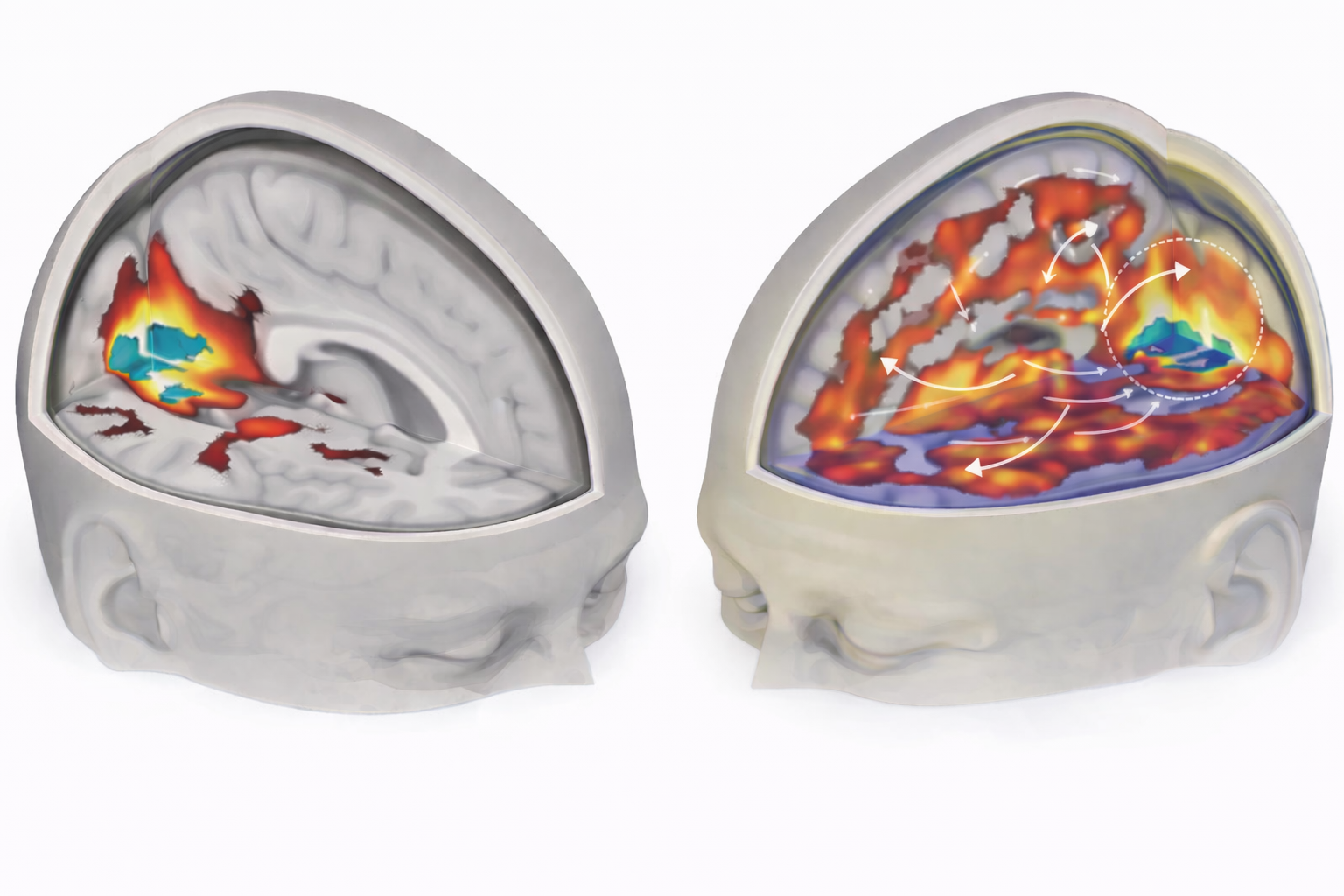
Resting-state fMRI showed that global functional connectivity was significantly elevated in psilocybin-exposed mice, meaning their brains had more connections firing between more regions, even at rest.
The prefrontal cortex was a particular focal point. In vehicle-treated mice, the prefrontal cortex had 62 connected nodes. In psilocybin-exposed mice, that jumped to 90. The hypothalamus, thalamus, and midbrain all showed dramatic increases in their connections to the prefrontal cortex.
This aligns with something called the entropic brain hypothesis. The idea, developed by researcher Robin Carhart-Harris, suggests that psychedelics increase neural entropy and network integration. What’s different here is that these changes weren’t acute and temporary. They persisted for months after the last exposure.
5. Sensory Processing: The world became quieter
In one of the study’s most evocative experiments, mice were placed in a scanner and exposed to the smell of almonds (rewarding) and then, two weeks later, fox urine (innately terrifying for rodents).
The psilocybin-exposed mice showed blunted responses to both. Less activation to the rewarding almond smell. More suppressed negative response to the fear-inducing fox smell. Their brains were, in a real sense, less reactive to the emotional weight of the world around them.
The researchers suggest this might reflect a sensory gating effect, where the enhanced baseline connectivity reduces the brain’s dynamic range for responding to individual stimuli. A brain that is already running at higher baseline connectivity may have less room to spike in response to something new.
6. The Molecular Story: Males carry it in their proteins
Perhaps the most mechanistically significant finding is in the molecular data. The team looked at a panel of proteins in the prefrontal cortex associated with neuroplasticity and epigenetic regulation.
In male mice, there were significant reductions in:
- REST (a transcription factor that regulates neuronal maturation and gene silencing)
- RCAN1 (a regulator of calcineurin, important for synaptic plasticity and long-term depression)
- H3C3 (a histone variant critical for memory, learning, and epigenetic regulation)
- AQP4 (a water channel protein, a potential marker for gliogenesis)
- Acetylated lysine (a broad marker of chromatin remodelling)
In female mice? None of these changes.
Despite no difference in the administration of the psilocybin, the males are carrying a completely different molecular signature months later. The researchers describe this as a form of “developmental memory” – the brain encoding the psilocybin exposure as a lasting shift in how genes are expressed.
What To Make Of It?
To be clear, these mice were not obviously unwell. There were no dramatic behavioural collapses. By conventional measures, they looked largely normal.
But the authors are careful to note that conventional behavioural tests may simply not be sensitive enough to capture the full scope of what’s happening. A reduced sensitivity to reward and fear stimuli, for example, might not show up in a standard anxiety test. But it could have real-world implications for how an organism navigates risk, seeks pleasure, and responds to threat.
The study also has limitations. Small sample sizes. A single dose regimen. Mice, not humans. No long-term follow-up into old age. No dose-response data. All of this needs further work.
Nuance
This study doesn’t argue that psilocybin is harmful to teenagers. It argues that we don’t know enough yet. Adolescence is a period where the brain is genuinely different, more plastic, and more vulnerable to lasting reorganisation by neurologically active compounds.
The therapeutic potential of psilocybin in adults is real and the research is compelling. But the adolescent brain is not a small adult brain. It’s a brain in the middle of one of the most profound reorganisation processes it will ever undergo, and we are only beginning to understand what happens when you introduce a potent psychedelic into that process.
The authors put it well: sex should be a critical consideration in both research on developmental psychedelic exposure and in clinical applications involving adolescent populations. The pronounced differences between male and female responses here suggest we’ve been thinking about this too broadly.
Keep Learning
If you’re interested in psychedelics, understanding the neuroscience behind them isn’t just nerd trivia. It’s how you make sense of who these substances are appropriate for, under what conditions, and why timing and context matter as much as dose.
The Ferris et al. 2026 paper is a significant piece of that puzzle. It’s not a reason for panic, but it is a reason for nuance, which is exactly what this space needs right now.
Want to stay on top of the emerging science around psilocybin, fungi, and the wider world of psychedelics? The Spore Report is a newsletter that gets into what the research actually says.
Subscribe to The Spore Report →
Reference: Sahoo, I. et al. (2026). Sex-dependent developmental changes in behavior, brain structure, functional connectivity, and sensory perception following exposure to psilocybin during adolescence. Neuropsychopharmacology. https://doi.org/10.1038/s41386-026-02356-8