Could psilocybin change brain activity in someone who has almost no consciousness left?
In a recent conversation on Psychedelics.com Youtube channel between Professor Robin Carhart-Harris (one of the most prominent researchers in psychedelic neuroscience) and Tommaso Barba, a PhD candidate at Imperial College London, the question came up.
And rather than an interesting thought experiment, the researchers were able answer based on a real case.
A Last Resort
His wife had suffered a severe road traffic accident. She had entered a minimally conscious state, could not speak or communicate in any meaningful way, and breathed through a tube. He had already tried all conventional medications and interventions. Eventually, he tried magic mushrooms.
This was not a clinical trial. There was no protocol, no ethics committee approval, and no control group. Just a man trying to reach his wife.
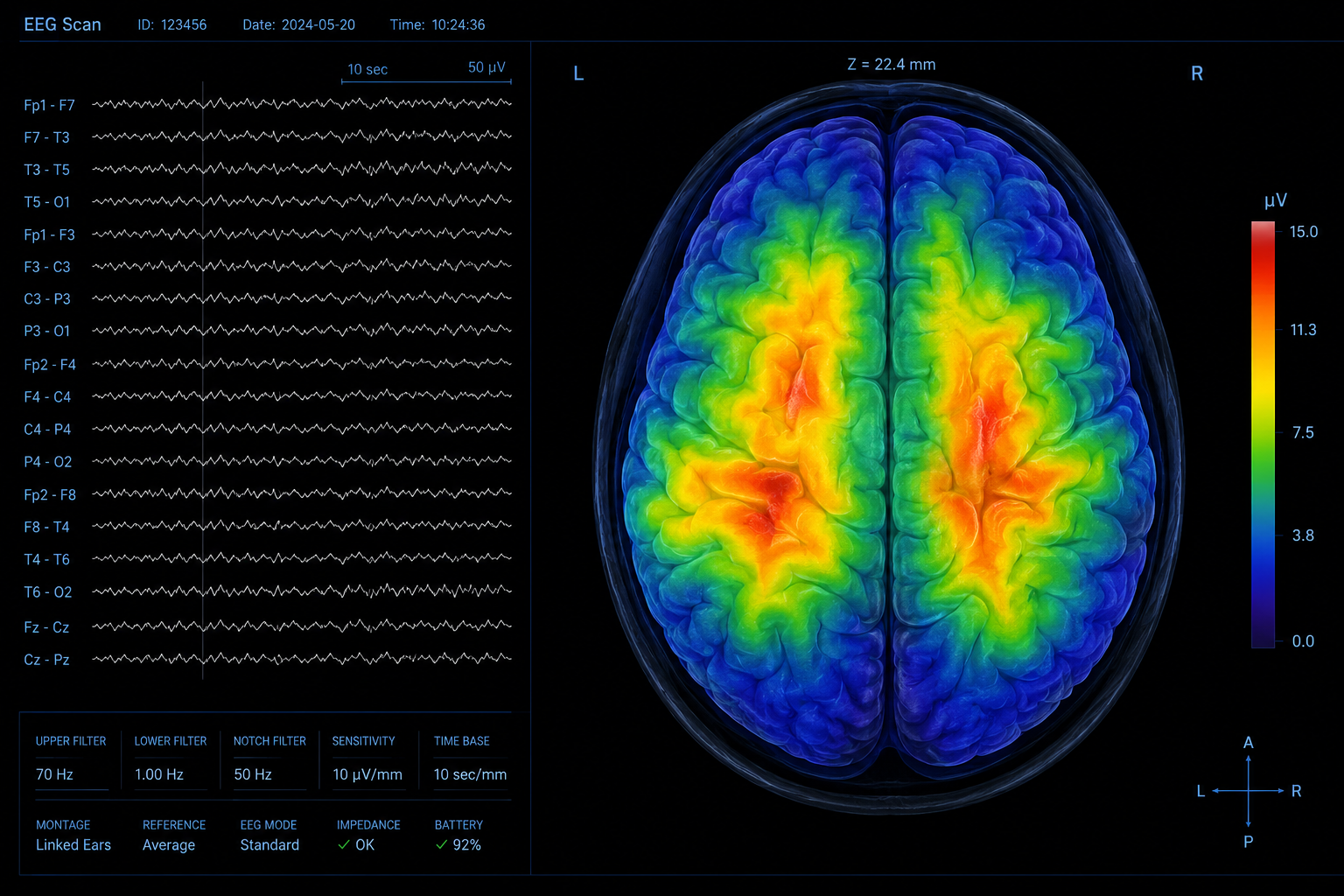
Professor Carhart-Harris, on hearing about the case, suggested that if this was going to happen regardless, they should at least record her brain activity using EEG.
To understand what they were looking for, it helps to understand how Carhart-Harris thinks about consciousness itself.
He breaks it into layers. At the base sits sentience: the bare fact of having any experience at all. Pain. Warmth. Sound. An inner world in its most minimal form. Above that sits reflective awareness, the ability to know you are having an experience. And above that sits ego consciousness, the full-blown sense of being a person with a name, a past, a future, and a position in the world.
A brain can show activity without producing communication. An inner world can show sign of activity without a person being able to signal that it has. This matters enormously when you are trying to interpret what EEG readings from a coma patient actually mean.
Brain Entropy
The measurement Carhart-Harris focused on was brain entropy. Think of it this way. If the same musical note repeats indefinitely, the pattern is predictable. That is low entropy. If a jazz musician starts improvising, the pattern becomes unpredictable, complex, alive with variation. That is high entropy.
In the brain, entropy describes how rigid or flexible neural activity is over time. Deep sleep, anaesthesia, and disorders of consciousness are all associated with low entropy states. The brain gets stuck in repetitive loops, like a record skipping.
Psychedelics are known to increase brain entropy dramatically. This is part of why psychedelic experiences feel so expansive. The brain enters a high-complexity state it rarely accesses otherwise. The question posed here was whether elevating entropy in a brain locked in low-complexity disorder of consciousness could, in some way, lift the level of awareness inside it.
What the EEG Showed
The psilocybin appeared to change something. The signal became less predictable, more variable, more like what researchers would expect if the compound was having a neurological effect. Her brain entropy increased. Behaviourally, Carhart-Harris noted she appeared different and was doing things she did not ordinarily do. But she did not wake up.
It seems something happened inside her brain. And still, she did not regain communication. She could not return to her husband. And she later passed away.
Tommaso Barba explained that temporarily altering brain state is one challenge. But sustaining that change is another entirely.
There are cases in neurology where certain medications can produce something resembling a brief awakening in patients with severe disorders of consciousness, only for the person to return to their previous state once the drug clears the system. The brain is not a machine that just needs a voltage boost. It is a living ecosystem shaped by injury, by severed networks, by cellular damage accumulated over time. Increasing entropy is not the same as restoring the biological infrastructure that stable awareness depends on.
A psychedelic can push the system into a different mode. But if the underlying tissue cannot hold that mode, the change will not persist.
The Honest Position
Carhart-Harris says the experience tempered his enthusiasm for the idea – a humbling calibration of what the entropy framework can and cannot claim.
The case is sad but the result is neither a failure to be buried nor a breakthrough to be amplified. It is important and a reminder that consciousness remains one of the most poorly understood phenomena in all of biology.
Based on a conversation between Professor Robin Carhart-Harris and Tommaso Barba at Imperial College London with Psychedelics.com. Watch the full interview here.