

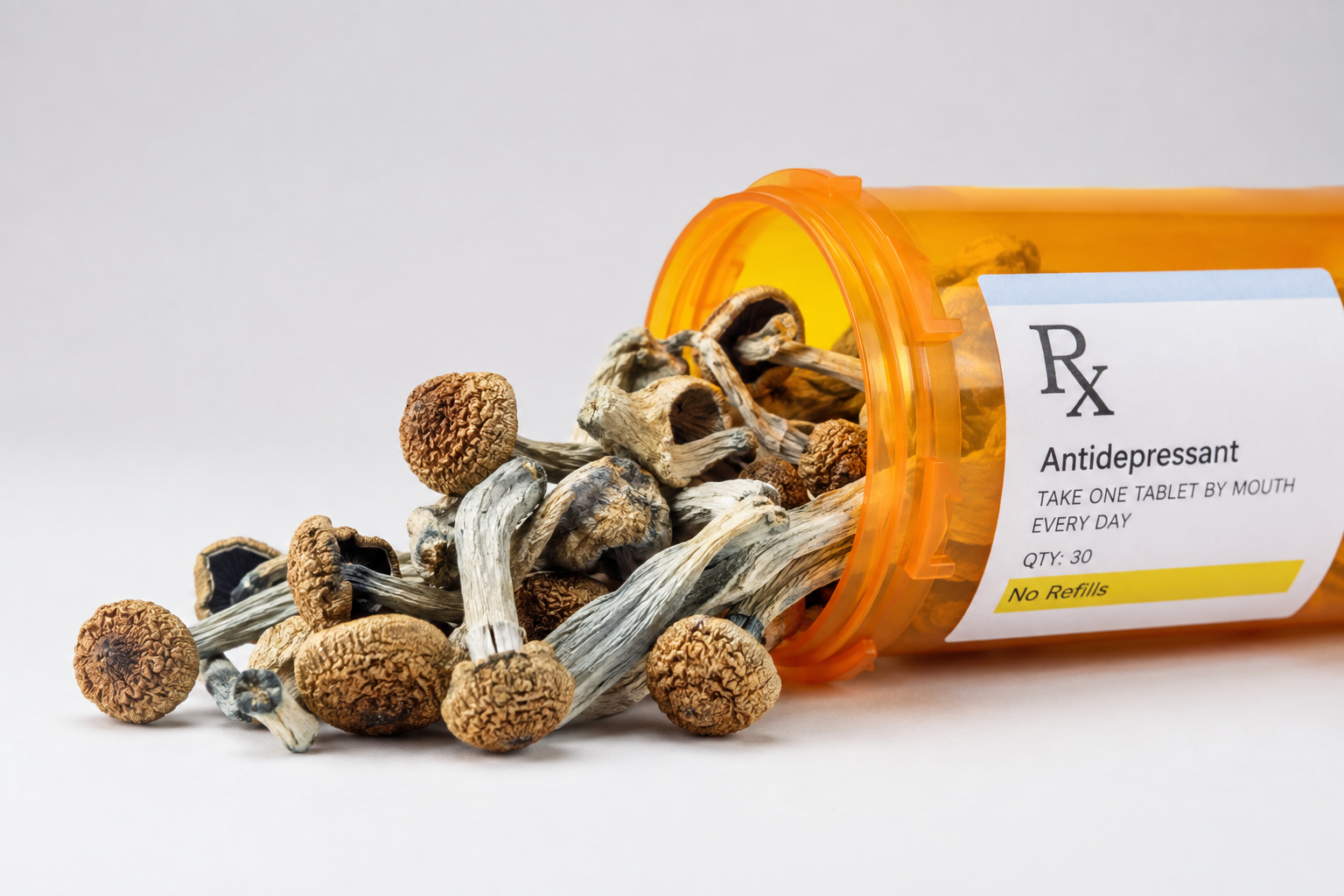
While everyone’s been focused on heroic doses for mental health, researchers have discovered that tiny, imperceptible amounts of psilocybin might be the metabolic intervention we’ve been searching for. And the evidence is stacking up fast.
Metabolic Microdoses
Published in Pharmacological Research in February 2026, researchers led by Sara De Martin from the University of Padova gave mice with diet-induced metabolic syndrome just 0.05 mg/kg of psilocybin for 12 weeks. These aren’t psychedelic doses. The mice were not tripping. It equates to around 3.5 mg in a 70kg human, or about 0.3 g of dried average P.cubensis (note: potency can vary significantly).
The mice were fed a high-fat/high-fructose diet (the rodent equivalent of processed junk food every day) and developed full blown metabolic disease: obesity, fatty liver disease, type 2 diabetes, insulin resistance, and muscle weakness. Essentially, the Western lifestyle in a mouse.
Researchers then gave them the daily microdoses of psilocybin.
Remarkably, the treated mice experienced near-complete metabolic reversal. Body weight gain was significantly reduced, despite no change in diet. Their livers normalised, blood sugar dropped back to healthy ranges, and insulin resistance was slashed by nearly 70%. Their muscles also got stronger and maintained function, despite remaining on the same terrible diet.
The Mechanisms
It’s well established that psilocybin works primarily through the 5-HT2A serotonin receptor in the brain. That’s what drives the psychedelic effects. But the Italian researchers discovered that psilocybin’s metabolic benefits come from a completely different receptor: 5-HT2B. And psilocybin acts as an antagonist there, blocking it rather than activating it.
To confirm this, they used CRISPR gene editing to knock out the 5-HT2A receptor in liver cells. Psilocybin still worked. Then they tested a selective 5-HT2B blocker and got identical results. This is a separate mechanism from the psychedelic one entirely.
The implications are quite significant, pointing at profound metabolic benefits without any psychedelic effects.
What Happened Inside The Body
The researchers took a deep look at the liver tissue, mapping gene activity and fat content in fine detail. What they found was that the high-fat diet had essentially reprogrammed the liver into a fat-hoarding, metabolically broken state. Psilocybin reversed nearly all of it. Of 185 different fat molecules measured, most returned to healthy levels. A gene called Cidea, which acts like a signal telling liver cells to store more fat, was significantly switched off.
Psilocybin also restored leptin signalling, in both the liver and muscles. Leptin is the hormone your fat cells produce to tell your brain you have enough energy stored. In obesity, the brain stops listening to it, like a smoke alarm with a dead battery. Everything keeps accumulating, but the warning never lands. Psilocybin appears to replace the battery.
This matters for muscles too, because metabolic disease doesn’t just make you fat or diabetic, it makes you weak. The mice on junk food lost significant strength over the course of the study. The psilocybin-treated mice didn’t. At the molecular level, a key regulatory system controlling how muscles produce energy and resist breakdown was fully restored.
Finally, electron microscopy of the pancreas showed that the high-fat diet had visibly damaged the cells responsible for making insulin, their internal structures swollen and distorted. In psilocybin-treated mice, those cells looked healthy, and a full panel of metabolic hormones came back into normal range.
Two Mechanisms, Working Together
In July 2025, researchers at Emory University and Baylor College of Medicine published findings in npj Aging showing that psilocybin fundamentally impacts cellular ageing at multiple levels throughout the entire body.
They found that psilocin extended cellular lifespan by 29-57% depending on dose, preserved telomere length, reduced oxidative stress, improved DNA stability, and increased SIRT1, the master regulator of cellular ageing and metabolism that rises during caloric restriction.
Crucially, when researchers tested psilocin on isolated fibroblasts in a petri dish, cells with absolutely no connection to a brain, they still got lifespan extension and metabolic improvements. No brain, no consciousness, and no mystical experience required.
So psilocybin appears to be hitting metabolic dysfunction from two completely different angles simultaneously:
Via 5-HT2B antagonism (the Italian discovery): Direct effects in the liver blocking fat accumulation and improving insulin signalling. Organ-specific, no brain involvement.
Via 5-HT2A activation (the Emory discovery): Systemic activation of cellular ageing pathways throughout the body, including SIRT1, improved mitochondrial function, reduced oxidative stress, and better DNA stability.
At low doses, you could theoretically access both without psychedelic effects.
Real-World Signal: Bryan Johnson
Bryan Johnson, the biohacker who has spent millions attempting to reverse his biological age, took 5 grams of psilocybin mushrooms in late 2025 and measured everything before and after with the kind of obsessive rigour only someone with his resources can manage.
The metabolic data was particiulary interesting, especially when considered alongside the tow studies we just covered. His hsCRP, a marker of systemic inflammation, dropped over 35%, falling below the detection threshold entirely. Cortisol fell 42% in the days after the experience. And he reported rapid, dramatic changes in glucose regulation that persisted well after the compound had cleared his system.
Psilocybin appeared to have pushed his biology into a low-inflammation, low-stress configuration theoretically favourable for longevity. Looking at his results through the lens of the Italian and Emory research, the mechanisms underlying those changes are becoming clearer. If psilocybin is simultaneously activating 5-HT2A receptors in pancreatic and liver cells, reducing oxidative stress, improving mitochondrial function in muscle and fat cells, and restoring leptin sensitivity, then sustained improvements in metabolic markers make sense. It may be genuine reprogramming of cellular ageing processes.
Johnson himself described it as pushing his biology back to “factory settings”, and he might be right.
What This Means
Metabolic-associated steatotic liver disease affects roughly 30% of the global population. Type 2 diabetes is approaching epidemic proportions. These conditions are deeply interconnected, each making the others worse, creating a vicious cycle of inflammation, insulin resistance, fat accumulation, and progressive organ damage.
Current treatments are limited. For MASLD, there are essentially no approved medications. For diabetes, most drugs manage symptoms without addressing the underlying metabolic dysfunction.
What this body of research points toward is a therapy that addresses multiple aspects of metabolic dysfunction simultaneously, working through mechanisms that sit below consciousness, at the level of organelles, receptors, and gene expression.
By modulating the 5-HT2B receptor, restoring leptin sensitivity, and activating cellular longevity pathways, it appears to allow the body’s own distributed intelligence to reassert itself.
A Word of Caution
Before anyone rushes out to microdose for metabolic health: this is primarily mouse data. Many promising animal findings don’t translate to humans. Dose matters enormously. Controlled pharmaceutical-grade psilocybin is not the same as self-experimentation with mushrooms of variable potency. And in most jurisdictions, psilocybin remains a controlled substance.
Johnson’s data is n=1, from someone with extraordinary measurement capability. It’s compelling, but far from clinical research.
That said, the convergence of the Italian metabolic study, the Emory ageing research, and Johnson’s documented biomarker shifts is fascinating. These threads are pointing in the same direction, and that direction is increasingly hard to ignore.
A New Chapter
The old model: psychedelics are consciousness-altering drugs that work on the brain.
The emerging model: psychedelics are systemic metabolic compounds that work throughout the body at the cellular and mitochondrial level, with profound effects on fundamental ageing processes. Effects that happen to also produce consciousness-altering experiences at higher doses.
In an age of metabolic disease epidemics, this research offers something rare. A genuinely novel mechanism, operating across multiple interconnected systems, with early safety data that holds up. Keep watching this space.
References
Colognesi, M., et al. (2026). Low, non-psychedelic doses of psilocybin as a novel treatment for MASLD, obesity and type 2 diabetes via 5-HT2B receptor-dependent mechanisms. Pharmacological Research, 224, 108080.
Hecker, L., et al. (2025). Psilocybin extends cellular lifespan and improves healthspan across multiple aging hallmarks. npj Aging, July 2025.


I wonder if it could help someone with MND
Iam so appreciative of the help you give me . I have tried everything.