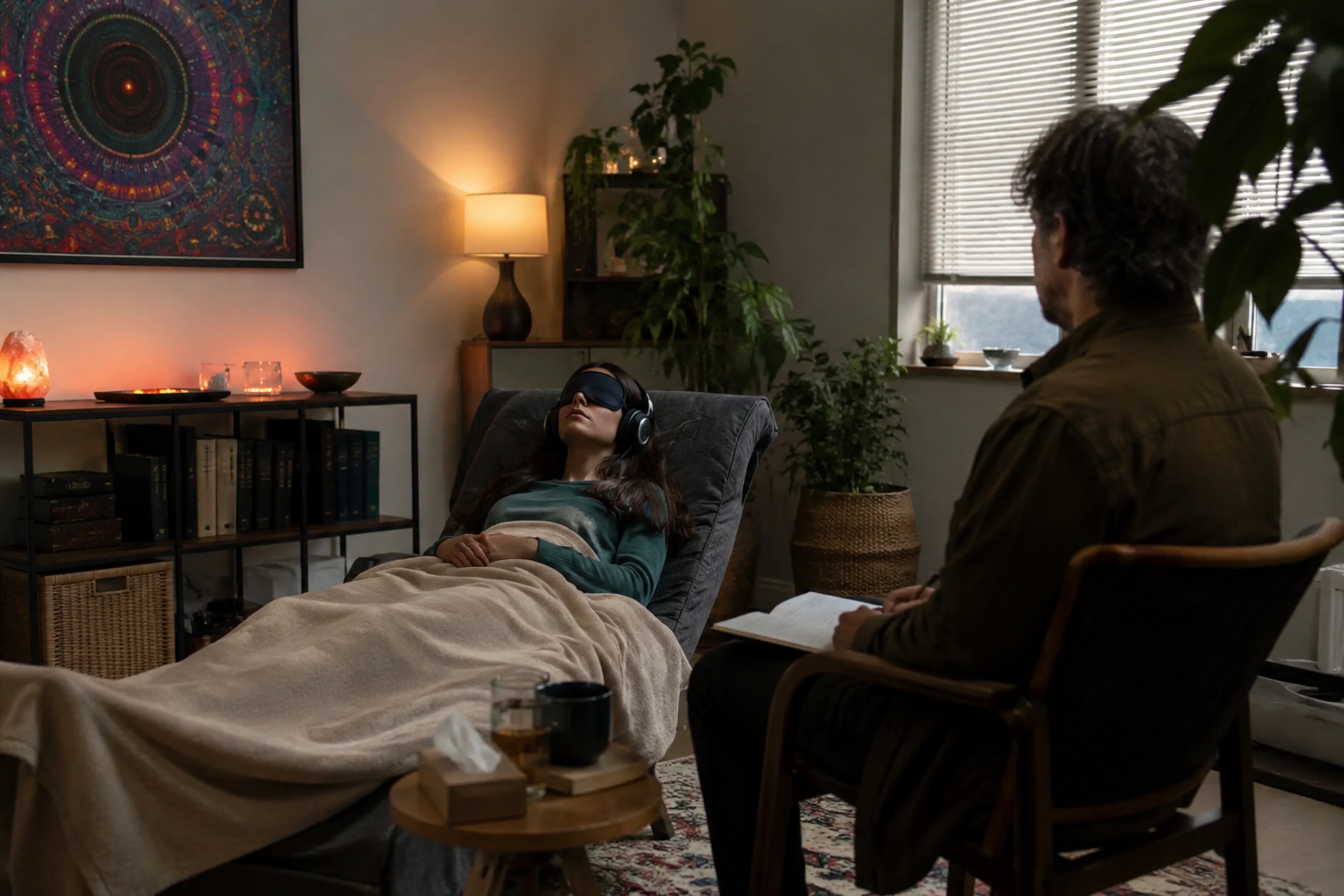
A woman known only as EB has won a landmark High Court case in the UK after being denied legal aid to pursue access to psilocybin-assisted therapy, the only treatment that had ever helped her severe anorexia nervosa.
The February 2026 ruling doesn’t hand her the treatment she needs, but it does put on official record that treating a seriously ill person’s request for continued medical supervision as a drug possession issue is, in the court’s own words, clearly wrong.
The case has since been analysed by Prof. Muireann Quigley and Dr. Louise Hatherall of the University of Birmingham, writing for Drug Science, the independent scientific body founded by Professor David Nutt. Their breakdown of the judgment sheds important light on both what the ruling means and what it still leaves unresolved.
Who Is EB, and What Happened?
EB has lived with anorexia nervosa since she was a teenager. The condition has affected almost every area of her life, from her ability to work and travel to managing a basic daily routine. She tried multiple conventional treatments but none of them worked.
In 2022, she joined a clinical trial investigating psilocybin as a therapy for eating disorders. For the first time, something helped. Then the trial ended.
Because psilocybin is a Schedule 1 controlled substance under the Misuse of Drugs Act 1971, she had no legal route to continue accessing it. The only theoretical option was to apply to the Home Office for an individual licence to possess and use the substance under medical supervision. Current policy doesn’t allow this, but EB wanted to try anyway.
The estimated cost of that application was around £40,000, requiring specialist legal expertise she couldn’t afford. She applied for exceptional case funding, a form of legal aid available when refusing it might breach someone’s human rights.
The Director of Legal Aid Casework turned her down. Their reasoning being that the case wasn’t really about healthcare. It was, in their words, about EB’s “proposal, as an individual, to possess and take psilocybin” whose therapeutic value had “not yet been proven scientifically.”
What the Court Found
Judge Alegre didn’t hold back. She found the Director had made a series of fundamental errors, the most significant being the mischaracterisation of EB’s situation as a drug use issue rather than a healthcare one. That assumption, the Judge ruled, was “clearly wrong.” The Director had “patently failed to consider the importance of the issues at stake.”
As Quigley and Hatherall highlight in their Drug Science analysis, the Director appears to have approached the entire decision-making process through the lens of drug misuse rather than therapy. By doing so, they never actually engaged with the real question: whether denying a seriously ill woman access to the only treatment that had helped her risked breaching her human rights.
The assumption that someone seeking access to psilocybin must be seeking personal, unsupervised drug use reflects attitudes rooted in decades of prohibitionist policy. Psilocybin sits in Schedule 1 of the Misuse of Drugs Regulations, a category reserved for substances with no accepted medical use. But as the Drug Science authors point out, that classification is increasingly hard to square with the evidence. The idea that there is “no accepted medical use” is clearly incorrect.
The Judge also noted that EB is now experiencing her condition worse than before the trial, in part because she has lost hope of recovery. The High Court quashed the refusal and ordered a fresh decision to be made.
The Bigger Problem This Case Exposes
EB’s situation is extreme, but the underlying structure is not unique to psychedelic research. Clinical trials are not treatment programmes. When a trial ends, participants don’t automatically keep access to the medicine they’ve been receiving, even if it worked, and even if nothing else has.
For most medicines, there is at least a pathway. Trials lead to regulatory approval, which leads to prescriptions. It’s slow and imperfect, but a route exists.
For psilocybin, the barriers are considerably higher. As a Schedule 1 substance, accessing it legally requires not just regulatory approval but a change in the law, specifically rescheduling under the Misuse of Drugs Regulations. That requires political will. And as this case demonstrates, political will requires institutional understanding that is still inconsistent at best.
What EB’s case makes visible is what Quigley and Hatherall call an “access gap”: a patient finds something that works, the trial ends, and there is no clear legal mechanism for what comes next. For EB, that gap has meant years of declining health and a legal battle that shouldn’t have been necessary.
What Happens Now
The ruling is a significant win, but a partial one. The decision on legal aid must be made again, but there’s no guarantee of a different outcome. Even if EB secures funding, she would still face the near-impossible task of obtaining an individual Home Office licence that current policy explicitly doesn’t support.
What the case does do, as the Drug Science analysis makes clear, is create a public legal record. A High Court judge has formally found that treating psilocybin-assisted therapy as personal drug use is a fundamental misunderstanding. The human cost of the post-trial access gap is now documented in judicial findings.
That is a precedent. And in a legal and policy landscape that has been slow to update its assumptions about psychedelic medicine, having those assumptions corrected on the record is a small but significant step.
Analysis by Prof. Muireann Quigley and Dr. Louise Hatherall (University of Birmingham) published by Drug Science, June 2026. Primary source: R (On the Application of EB) v Director of Legal Aid Casework [2026] EWHC 402 (Admin).