A study that tracking over 3,000 people for an average of ten years has found finding a meaningful link between mushroom consumption and memory performance.
Published earlier this year in Food & Function, the paper looked at data from the National Institute for Longevity Sciences Longitudinal Study of Aging (NILS-LSA) in Japan, running from 2002 to 2022. The researchers were asking a specific question: does eating more mushrooms associate with better short-term and working memory as people age?
The answer, it turns out, is yes.
What They Actually Measured
The study tracked 3,162 Japanese adults between the ages of 40 and 85, with a mean follow-up of 10.5 years. Dietary intake, including mushroom consumption in grams per day, was assessed at baseline using 3-day food records. This is more rigorous than usual longitudinal food studies as participants actually weighed their food and photographed meals.
Memory was assessed using the digit span test from the Wechsler Adult Intelligence Scale. Forward digit span measures short-term memory (repeat a sequence in order). Reverse digit span measures working memory (repeat it backwards). Both are well-validated proxies for general cognitive capacity.
The statistical models were adjusted for age, sex, APOE genotype, energy intake, physical activity, smoking, education level, depressive symptoms, and multiple health conditions. So confounders were taken seriously.
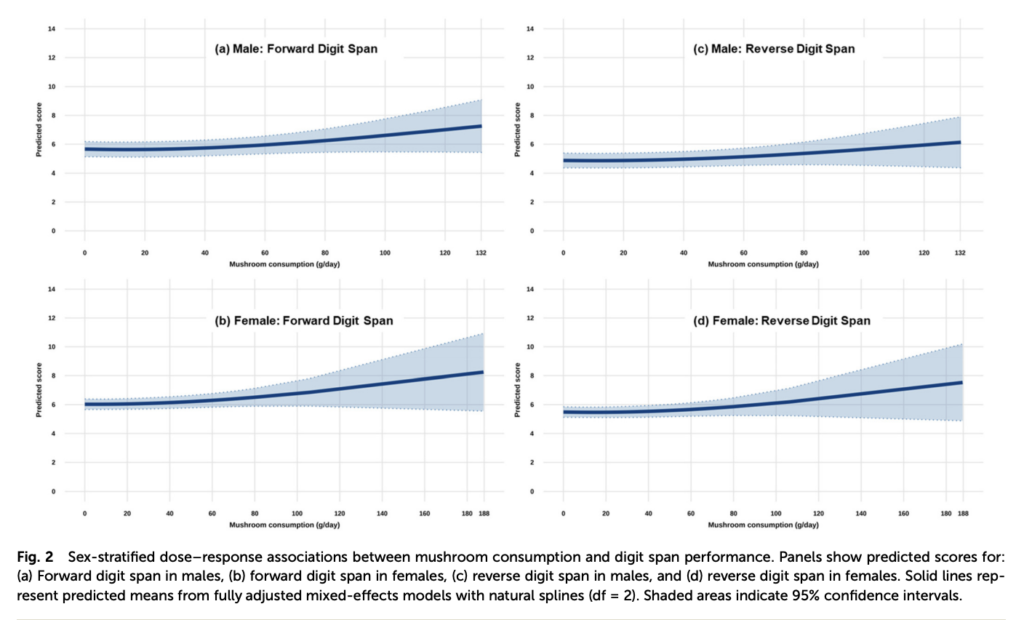
What emerged was a non-linear, positive association between mushroom intake and both memory measures. Higher consumption predicted better scores on both tests, with the benefits becoming more pronounced at moderate to high intake levels rather than scaling linearly from the first bite.
The Compounds Behind the Effect
The paper points to several candidate mechanisms, and this is where it gets interesting for anyone already tracking the functional mushroom literature.
Ergothioneine gets the most attention, and rightly so. This rare amino acid accumulates preferentially in brain tissue, where it appears to act as a longevity antioxidant, protecting neurons from oxidative damage. Working memory, specifically, relies heavily on prefrontal cortex integrity and is particularly sensitive to oxidative stress. A 2020 randomised controlled trial referenced in the paper found that ergothioneine supplementation improved cognitive function in both healthy volunteers and people with mild cognitive impairment.
Erinacines, the active compounds found in lion’s mane (Hericium erinaceus), are thought to stimulate nerve growth factor synthesis, with particular benefit to hippocampal regions involved in memory consolidation. The landmark 2009 trial by Mori et al. showing cognitive improvements in mild impairment patients sits in the same evidence ecosystem as this larger population study.
Beta-glucans round out the mechanistic picture via a different route entirely: the gut-brain axis. Research published in Frontiers in Nutrition has shown that three different types of beta-glucan can enhance cognition through gut microbiome modulation. This fits the broader picture of mushrooms as ecosystem compounds rather than single-molecule interventions.
The Study Limits
This is observational research. It cannot establish causation. Dietary habits were assessed at baseline rather than tracked longitudinally, which likely means the true effect is being underestimated (a phenomenon called regression dilution bias). The cohort was Japanese, and average mushroom intake in Japan is nearly four times higher than in the US or UK, so translating intake thresholds directly to Western populations requires caution.
The study also couldn’t differentiate between mushroom species, so we don’t know whether shiitake, maitake, lion’s mane, or a combination is driving the signal.
What It Adds Up To
This study does something valuable. It extends the evidence chain from short-term clinical trials and cross-sectional snapshots into long-term, community-level data. The earlier Ohsaki Cohort study found that eating mushrooms three or more times per week was associated with significantly reduced dementia incidence in over-65s. The NILS-LSA data now suggests that the benefit starts earlier, at the level of working memory, and in middle age.
A brain operates more like an ecosystem than a machine, and it needs the right substrate. Regular mushroom consumption, across species and preparations, appears to be vital part of that substrate.
The fungal kingdom has been modulating animal nervous systems for hundreds of millions of years. We’re only just beginning to document how.
Source: Zhang S, Ba DM, Nishita Y, Tange C, Zhu J, Otsuka R, Muscat J. Association between mushroom consumption and digit span performance among middle-aged and older community-dwelling Japanese: the NILS-LSA project. Food & Function, 2026, 17, 3265–3274. DOI: 10.1039/d5fo04625d
The Spore Report covers the science of fungi, neuroplasticity, and regenerative health every week. If this kind of research is what you want more of in your inbox, subscribe here.