
The food on your plate is missing a nutrient that your brain depends on.
Ergothioneine is an amino acid produced almost exclusively by fungi and certain soil microorganisms. It circulates in your blood, concentrates in tissues under the highest oxidative load (the liver, kidneys, bone marrow, brain), and operates as what researchers describe as a “longevity vitamin”. It’s a compound so important to cellular protection that humans evolved a dedicated pathway to absorb it from food and ferry it to wherever the body is under stress.
The problem is that most of us have chronically low levels of it. And the primary reasons is how we grow our food.
A Nutrient That Travels Through Soil
Ergothioneine doesn’t come from plants directly. Plants acquire it through their roots via mycorrhizal symbiosis, drawing it up from the fungal networks woven through healthy soil. When soil fungi are abundant, crops accumulate ergothioneine in proportion. When soil fungi are disrupted, the supply chain breaks.
Researchers at Penn State, led by food scientist Robert Beelman, have been mapping this connection in detail. Across multiple field trials comparing intensive tillage, minimal tillage, and no-till farming in maize, soybeans, and oats, they found a consistent pattern: ergothioneine concentrations declined as tillage intensity increased, with reductions from no-till to intensive moldboard plowing of approximately 30% across all three crops. Because yield also fell with more aggressive tillage, the total ergothioneine produced per hectare dropped even further.
A 2024 paper went further, proposing that low ergothioneine may be a direct risk factor for neurodegeneration, not merely a correlate. The paper proposes that restoring ergothioneine levels could help mitigate the risks of cognitive impairment, dementia, and Parkinson’s disease. Earlier cohort work established the association. A cross-sectional study of 496 participants found that the incremental decreases in ergothioneine levels along the cognitive impairment-to-dementia clinical continuum suggest that low levels are associated with disease severity and could be a potential biomarker for cognitive impairment.
A subsequent longitudinal study confirmed that lower plasma ergothioneine levels were associated with poorer baseline cognitive performance and faster rates of decline across multiple domains including memory, executive function, attention, visuomotor speed, and language. The research is still building, the causal chain has not been definitively closed in humans, but the pattern across studies is strong enough to take seriously.
What Conventional Farming Does to the Fungal Web
To understand why this matters beyond ergothioneine alone, you need a clearer picture of what the plough actually does.
Mycorrhizal fungi, particularly arbuscular mycorrhizal fungi (AMF), form symbiotic relationships with the roots of roughly 80% of all land plants. They extend hyphal networks – structures far finer than plant roots – into soil pores that roots cannot reach, accessing phosphorus, nitrogen, water, and micronutrients in exchange for photosynthate carbon from the plant. These networks can extend a plant’s effective root surface area by orders of magnitude. They also connect neighbouring plants in common mycorrhizal networks, allowing nutrient transfer and stress signalling between individuals.
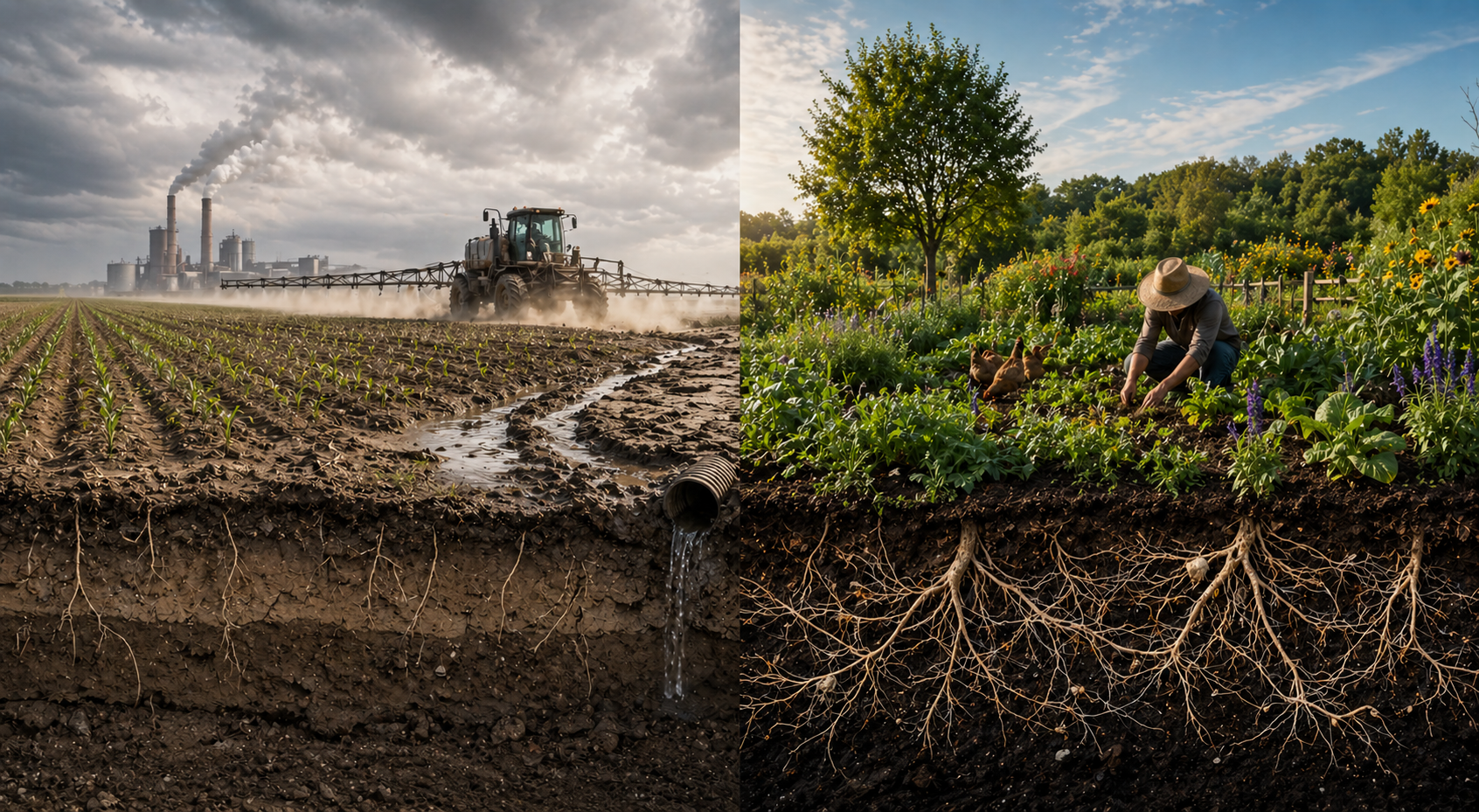
Conventional tillage physically destroys this infrastructure. A single pass of a plough severs the hyphal networks that take months to years to mature. Synthetic fertilisers, by flooding the soil with immediately available phosphorus and nitrogen, remove the selection pressure that makes these fungal partnerships worth maintaining from the plant’s perspective. A plant drowning in applied nutrients has less reason to invest carbon in sustaining a mycorrhizal network. Over time, the fungi thin out, the soil biology simplifies, and the system becomes dependent on external inputs to function at all.
This is the degenerative loop of industrial agriculture. Inputs suppress fungal activity, which reduces nutrient cycling, which increases input requirements, which further suppresses fungal activity. Bender and van der Heijden’s landmark 2015 review documented this directly, connecting reduced soil biota diversity to measurably lower crop yields, impaired nutrient uptake, and increased nitrogen leaching.
The Ecosystem Beneath Your Feet
The regenerative model is, at its core, an ecosystem model. Healthy soil is a living network. Fungi, bacteria, protozoa, nematodes, earthworms, arthropods, all operating in dynamic relationship. Mycorrhizal fungi are the connective tissue. Remove them and you the whole system degrades.
Trichoderma, another fungal genus found abundantly in healthy soils, illustrates a different dimension of this. These organisms act as natural biocontrol agents, suppressing pathogens and pests, stimulating plant immunity, and improving root development. A 2026 study used machine learning to correlate genomic data from 37 Trichoderma strains with over 140 phenotypic traits (observable traits), and determined Trichoderma to be an ancient, genetically cohesive, and physiologically diverse genus.
Conventional tillage and fungicide use destroy this layer of protection, and synthetic pesticides then fill the gap, at cost to the broader ecological network.
What Regenerative Practice Restores
The practices that make up regenerative agriculture (minimal tillage, cover cropping, organic mulching, polyculture, and the avoidance of synthetic fungicides) actively rebuild fungal communities and the services those communities provide.
Cover crops maintain living root exudate in the soil year-round, giving mycorrhizal networks a reason to persist through fallow periods. Mulch feeds saprophytic fungi that decompose organic matter and release minerals back into the cycle. No-till allows hyphal networks to develop the structural complexity needed to connect plant communities and support deep carbon transfer.
Researchers analysing nearly 200 datasets estimate that global plant communities allocate 13.12 Gt of CO₂e per year to the underground mycelium of mycorrhizal fungi – equating to approximately 36% of current annual CO₂ emissions from fossil fuels.
A 2006 review on arbuscular mycorrhizal fungi and organic farming and a 2023 synthesis on fungal microorganisms in sustainable agriculture both document how regenerative practices translate into measurable agronomic outcomes. They showed higher phosphorus and nitrogen uptake, improved drought and salinity tolerance, reduced dependence on synthetic inputs, and better soil structure through hyphal binding of soil aggregates.
The evidence is clear that soils with intact fungal communities outperform soils without them across multiple dimensions of resilience.
The Deeper Argument
The ergothioneine story is a clear example of something that is hard to otherwise quantify. When we ask whether conventional farming harms human health, the usual answers are about pesticide residues, antibiotic resistance, or caloric density. Ergothioneine depletion suggests we may be systematically removing a compound that human biology relies on for neurological protection, by destroying the fungal networks that produce and deliver it, through standard agricultural practice.
If soil tillage measurably reduces a longevity-associated nutrient in three separate staple crops, and low levels of that nutrient are associated with neurodegenerative diseases affecting hundreds of millions of people, how many other fungal compounds are we missing?
Ergothioneine is the one someone thought to measure. The soil food web produces an enormous pharmacopoeia of secondary metabolites, many of which pass into the food chain through mycorrhizal root transfer, and most of which we have not looked for in the context of agricultural practice.
Regenerative farming is not a nostalgic return to pre-industrial methods. It is the recognition that soil ecosystems are functional systems, not inert growth media, and that when you degrade the biology, you degrade everything downstream of it: the plant, the nutrient profile, and the human who eats it. Fungi are not a supplement to add back in. They are the missing foundation of food itself.
The Spore Report covers the science of fungi, psychedelics, neuroplasticity, and regenerative health. If you found this useful, you can subscribe to our newsletter here.
Key sources referenced:
- Beelman et al. (2021) — Soil Disturbance Impact on Crop Ergothioneine Content, Agronomy
- Omondi et al. (2025) — Ergothioneine Dynamics in Agricultural Systems, SSRN
- Halliwell & Cheah (2024) — Are age-related neurodegenerative diseases caused by a lack of ergothioneine?, Free Radical Biology and Medicine
- Wu et al. (2021) — Low plasma ergothioneine levels and neurodegeneration in dementia, Free Radical Biology and Medicine
- Wu et al. (2022) — Low plasma ergothioneine predicts cognitive and functional decline, Antioxidants
- Bender & van der Heijden (2015) — Soil biota enhance agricultural sustainability, Journal of Applied Ecology
- Hawkins et al. (2023) — Mycorrhizal mycelium as a global carbon pool, Current Biology
- Steindorff et al. (2026) — Phenogenomics reveals the ecology and evolution of Trichoderma, Nature Microbiology
- Gosling et al. (2006) — AMF and organic farming, Agriculture, Ecosystems & Environment
- Frontiers (2023) — AMF in sustainable organic agriculture, Frontiers in Sustainable Food Systems



I wonder how I can increase fungal content in raised beds?