
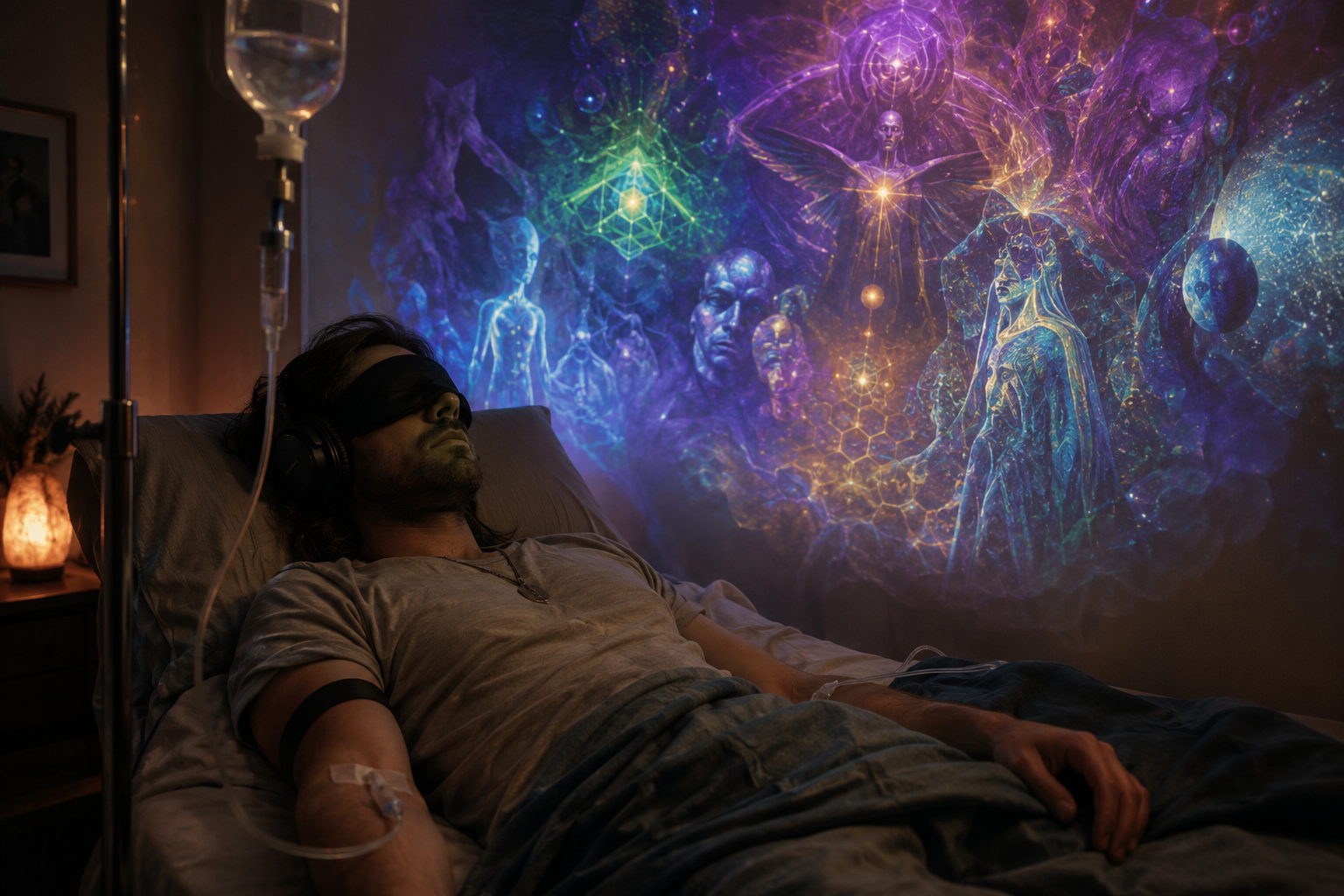
Ask enough people about their encounters with N,N-DMT and the cast of characters they experience starts to repeat. People on different continents, with different backgrounds and different expectations, and yet the same recurring figures show up on the other side.
This registry draws on the account given by independent researcher Danny Goler, founder of the nonprofit Code of Reality, in a recent long-form interview with Brian Krehbiel. Goler has spent years cataloguing entity reports across many DMT sessions, his own and others’, and has been trying to formalize that catalogue into a taxonomy.
Rather than filing this under “hallucination” and moving on, it’s worth treating it the way a field biologist would treat an unfamiliar ecosystem. That means cataloguing what’s being reported, look for behavioral patterns, and see what the structure implies. This isn’t a claim that any of it is literally true or not. It’s one researcher’s working model, and it’s worth taking seriously.
The Insectoids: architects of the substrate
The most structurally interesting entities in the registry are insectoids. They usually don’t interact with you directly so much as the they appear to be doing something else entirely when you show up. Goler describes insectoid beings as engaged in construction work, weaving or assembling the geometric lattices that seem to underlie the visual field itself. It often feels like you’ve wandered onto a job site.
What makes this entry stand out in Goler’s taxonomy is the added layer of apparent governance. He describes something like an administrative structure among them. A hierarchy, a chain of command, the felt sense of a bureaucracy running in the background of the visual scenery. If the entities are the ecosystem’s builders, his implied claim is that they’re also its civil service, the ones maintaining the infrastructure.
The Jokers: gatekeepers of ego
If the insectoids are the architects, the Jokers are the ecosystem’s wildcard. Goler describes them as occupying no fixed layer, roaming between registers of the experience in a way other entities don’t. His recurring description is of a being that holds both light and dark simultaneously rather than resolving into one or the other, which lines up with the unsettling, half-manic quality so many people report. Expect laughing, mocking, and hyper-dimensional court jesters that seem to know something the visitor doesn’t.
There’s a functional read on why this figure shows up so often. An entity that refuses to resolve into a moral category is, structurally, an ego-test. It won’t confirm your framing of the experience, won’t play straight man, won’t let you settle into “friendly guide” or “hostile force.” Whatever’s actually happening neurologically, the Joker archetype seems to be the ecosystem’s built-in check against a visitor grabbing onto easy certainty.
Reptilians and the light/dark axis: the regulators
Rather than a conspiratorial, sinister presence, he describes them as custodians, keepers of knowledge and accumulated wisdom rather than predators. Paired against various light and dark entities, the picture he paints is less good-versus-evil and more a set of specialized regulators, each one responsible for maintaining some kind of energetic or informational balance within the broader system.
This makes the DMT space look like an operating environment with distinct functional roles of builders, auditors, archivists, wildcards.
The consensus
None of this would be worth a field guide if it were just one person’s private iconography. What keeps drawing serious attention is the degree of overlap across accounts that have no business overlapping: strangers, different cultures, no shared vocabulary going in, describing the same rough cast. It’s the same phenomenon, in miniature, that led early researchers to nearly name harmine (the compound in ayahuasca) “telepathine,” after the shared visions reported by people who hadn’t spoken to each other during the experience.
That cross-report consistency is precisely what’s pushing some researchers toward actual experimental designs, including fixed visual stimuli under DMT, symbol-tagging protocols paired with brain-state recordings, and attempts to see whether independent subjects converge on the same reported content from the same input.
Filing it, not solving it
A field guide doesn’t have to prove its ecosystem exists to be useful. It has to describe what’s consistently observed clearly enough that someone else can check it against their own data. That’s the spirit here. Insectoid architects running something like infrastructure and governance, Joker figures policing certainty itself, reptilian custodians and light/dark regulators keeping some kind of balance.
Taken together, less a hallucination catalogue than a surprisingly specific map, drawn independently, again and again, by people who’ve never compared notes.
Source: interview with Danny Goler, founder of Code of Reality (youtube.com/watch?v=0lr-rAjLCmU).
Keep up with the research here.


Let’s see if the field guide is based on actual research.
It’s all too common to say that Insectoids, Jokers, Reptilians are the most common but the research doesn’ show that to be true. They might be some of the most provocative or intriguing from the outside but certainly not the most common.
Check out these research papers at the Journal of Psychedelic Studies:
1. Entity and environment relationships in psychedelic experiences resulting from inhalation of N,N-dimethyltryptamine
2. The content of complex psychedelic experiences resulting from inhalation of N,N-dimethyltryptamine