
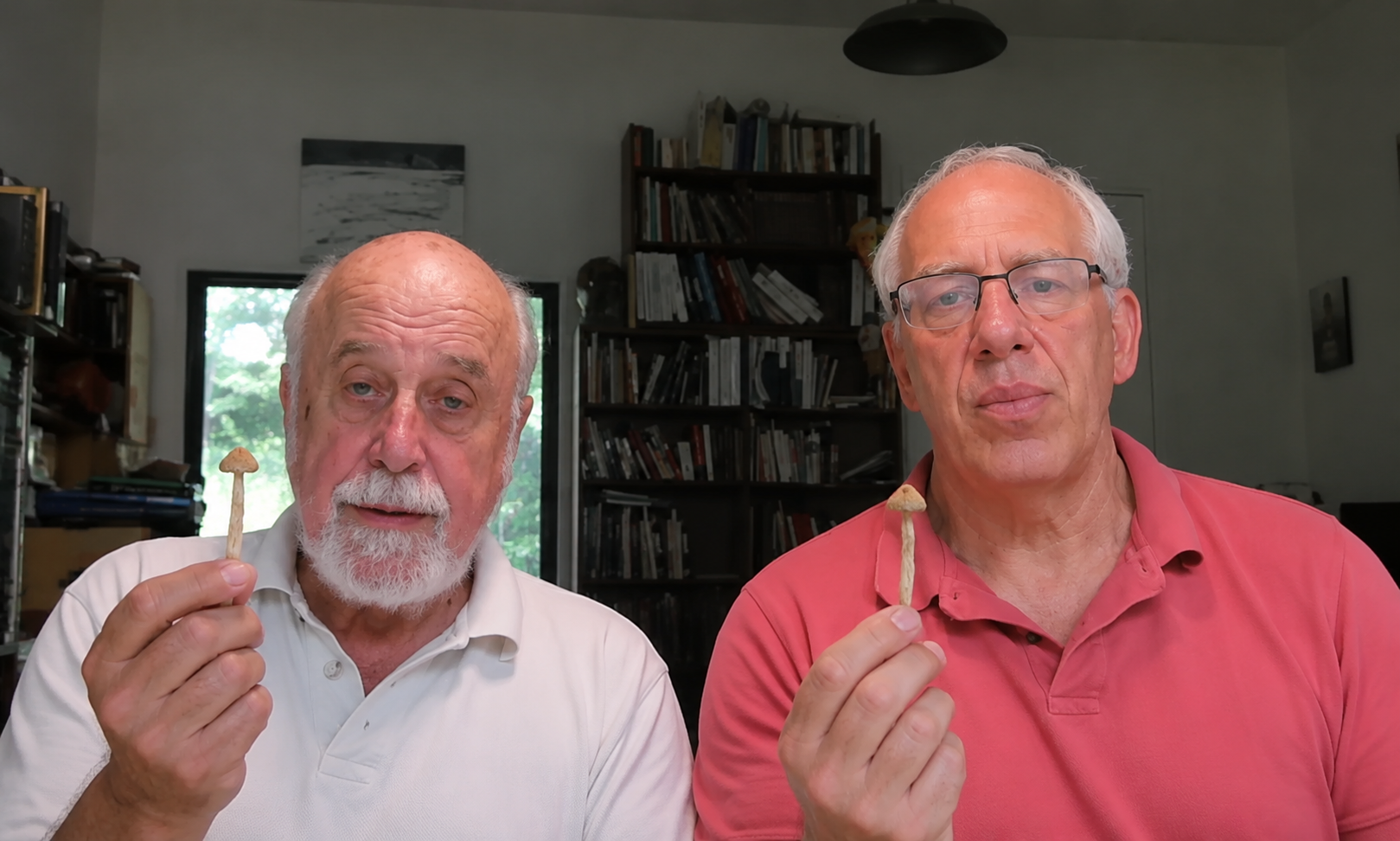
James Fadiman has spent close to fifty years working with psychedelics. Jordan Gruber has spent the last decade or so turning that work into something the rest of us can actually use. Together they wrote Microdosing for Health, Healing, and Enhanced Performance (2025), a paradigm-changing, and they recently sat down with the Therapeutic Astrology podcast to explain why.
Their argument is simple: microdosing isn’t a smaller version of a psychedelic trip. It’s a different thing entirely.
Two paradigms, not one
Fadiman draws a hard line between what he calls the psychedelic paradigm and the microdosing paradigm. High doses are, in his words, “a kind of overdose,” even when the person taking them is healthy and the experience is positive. They demand support, ritual, guides, and integration. They change how you see reality.
Microdosing does none of that. As Fadiman put it on the podcast, it “improve[s] the functioning of your normal healthy body in normal consciousness.” You don’t lose track of yourself. You do your work, often better than before.
That distinction explains why so much of the psychedelic world still doesn’t understand microdosing. Fadiman compared it to going to the opera expecting a full orchestra and being handed a single stringed instrument instead: “You have to let go of the big exciting to be able to focus on the small.”
The sweet spot is the whole model
If there’s one idea that runs through the entire conversation, it’s the sweet spot: a narrow dose range where benefits appear, bordered on both sides by nothing happening at all. Too little, no effect. Too much, and the benefits fall apart, not just plateau.
Fadiman used alcohol as the analogy everyone already understands. A little relaxes you. A lot, and every benefit reverses. “Microdosing is the same model,” he said.
Gruber described a 45-person ADHD study that used a dose twice the size of an effective microdose, on the assumption that more would be easier to measure. Participants dropped out, some got headaches, and the results were negative because the researchers weren’t studying microdosing at all.
Not a stimulant, not a suppressant
A lot of the conversation deals with what microdosing isn’t. It isn’t a stimulant like ADHD medication, which produces the familiar crash after a few good hours. It isn’t an SSRI, which Fadiman describes as forcing old serotonin molecules to stay in circulation longer than they should, “like throwing a monkey wrench in the system.” And it definitely isn’t alcohol, which he calls, flatly, a poison that never healed anything.
The pattern he keeps returning to is that pharmaceuticals are largely built to suppress symptoms, while microdosing appears to support a system that’s already capable of regulating itself. That’s a fundamentally different job description.
What people actually report
Gruber and Fadiman are unapologetic about relying on user-submitted reports rather than waiting for double-blind trials to catch up. They call it citizen science, and they’ve collected thousands of accounts through their site, microdosingbook.com.
Some of the reports are remarkable. A veteran who lost a leg and had lived with phantom limb pain for years found it disappeared after starting microdosing for unrelated reasons. A man with a spinal condition his doctor said should have left him unable to walk sent them a photo of himself on a mountaintop. People with chronic pain, Gruber said, don’t always report less pain exactly. They report a shift from “being in pain” to “having pain,” a change in how much of their attention the pain occupies rather than a change in the pain itself.
And on depression, the phrase that comes up again and again isn’t “I feel less depressed.” It’s more of an identity-based: “I’m back.” Fadiman explained what that means to him: “I feel the way I did before I became depressed.” That’s very different to managing symptoms while medicated. It’s a claim about returning to a baseline self.
Fadiman and Gruber argue that whole mushroom extracts outperform synthesized or isolated psilocybin, thanks to the additional compounds mushrooms produce alongside it. If that holds up, it means most published psilocybin research, which almost universally uses the isolated compound, may be underselling what the fungus itself can do.
Why this hasn’t gone mainstream yet
Neither of them thinks microdosing is under-recognised by accident. Fadiman is blunt about incentives: “You don’t find the limitations of a model from the people who make money from the model.” Alternatives to patentable, prescribable medications are structurally disadvantaged, regardless of how well they work, because there’s no one positioned to profit from promoting them.
That hasn’t stopped growth. By their estimate, the number of people microdosing psilocybin in the United States alone rose from roughly four million to ten million between 2023 and 2025.
The bottom line
Fadiman and Gruber aren’t claiming microdosing is a miracle or a replacement for medical care. What they are arguing is that a huge population of people is already running an uncontrolled, decentralised experiment on a substance class with a strong safety record, and the results keep pointing in the same direction – better sleep, better mood regulation, better pain tolerance, better focus, and without the side-effects that comes standard with the pharmaceutical alternative.
As Fadiman put it, “Do you want to feel better and function better? That’s all it does.”
Full conversation: James Fadiman and Jordan Gruber on the Therapeutic Astrology podcast, discussing their book Microdosing for Health, Healing, and Enhanced Performance (2025).

I have Mnd or als in the states. I strongly believe that this is the answer to my problems and I come from this by a credible source as I have set up a charity called challenging Mnd in the uk.
I believe that more needs to be done in this area. I welcome any trials.
Please can you help me in this area!
Thanks
20years in on various ssrni meds and still I’m at a loss of what am I to expect from them . Where and how can I try these mushrooms??
Richard go to mamadose.com. I was in the same boat as you with SSRI’s for 20 years and they did nothing but probably make things worse. Mushrooms quite literally saved my life and I don’t say that lightly. Go to the website above, you can pay with a card (they take it as a donation for legal reasons), feel free to do your research so you feel comfortable making the purchase but Richard…I don’t know you but I PRAY with everything I can that you purchase a microdose bottle. The mushrooms are in small capsules, accurately measured and you’ll take one a day, 100mg. IT WILL CHANGE YOUR LIFE. And you don’t experience any of the psychedelic effects, you’ll operate like on a normal day but just you watch how much better your life gets my friend. PLEASE PLEASE PLEASE just go check out mamadose.com. It’s legal and only hope that you pay it forward by telling other people like us who have searched for relief and haven’t found it. Let me know if you have any questions. Wish you all the best my friend.
Im on a very strict budget at this time in my depression & really can not afford this medicine at this time 😢🤷🏼♀️..I will keep you in my mind as hopefully my situation will change soon. Thank you for this information! Dawn
where do I find this?
Hi, I suffer chronic gastritis, iBS C, arthritis, does it help with the symptoms? 55 yro, living in Aus