For decades, people have described DMT as launching them into another reality. Reports of geometric landscapes, impossible architecture and encounters with seemingly autonomous beings have become almost synonymous with the psychedelic.
But what if those experiences aren’t random?
According to consciousness researcher Andrés Gómez Emilsson, director of the Qualia Research Institute (QRI), DMT experiences appear to follow a surprisingly consistent progression. Speaking on the Giant’s Shoulder podcast, he says after years of analyzing reports and comparing notes with mathematicians, neuroscientists and experienced psychonauts, he believes there are six distinct stages, each defined by characteristic changes in the geometry of conscious experience.
Level 1: Threshold
At the lowest doses, colours become brighter and more saturated. The world still looks recognisably normal, but perception feels enhanced and more vivid.
Level 2: The Symmetry Hotel
As the dose increases, surfaces begin filling with repeating geometric patterns. Walls, ceilings and everyday objects become tiled with increasingly intricate symmetrical designs.
According to Gómez Emilsson, the higher the dose, the more complex these symmetries become, progressing from relatively simple repeating motifs to extraordinarily dense mathematical patterns.
Level 3: The Magic Eye
The next transition introduces depth. Rather than simply seeing flat geometric patterns, they begin folding into three-dimensional structures, similar to the hidden images found in old Magic Eye books. Objects appear sculpted from living geometry, creating the sense that reality itself has gained another dimension.
Level 4: Crystal Worlds
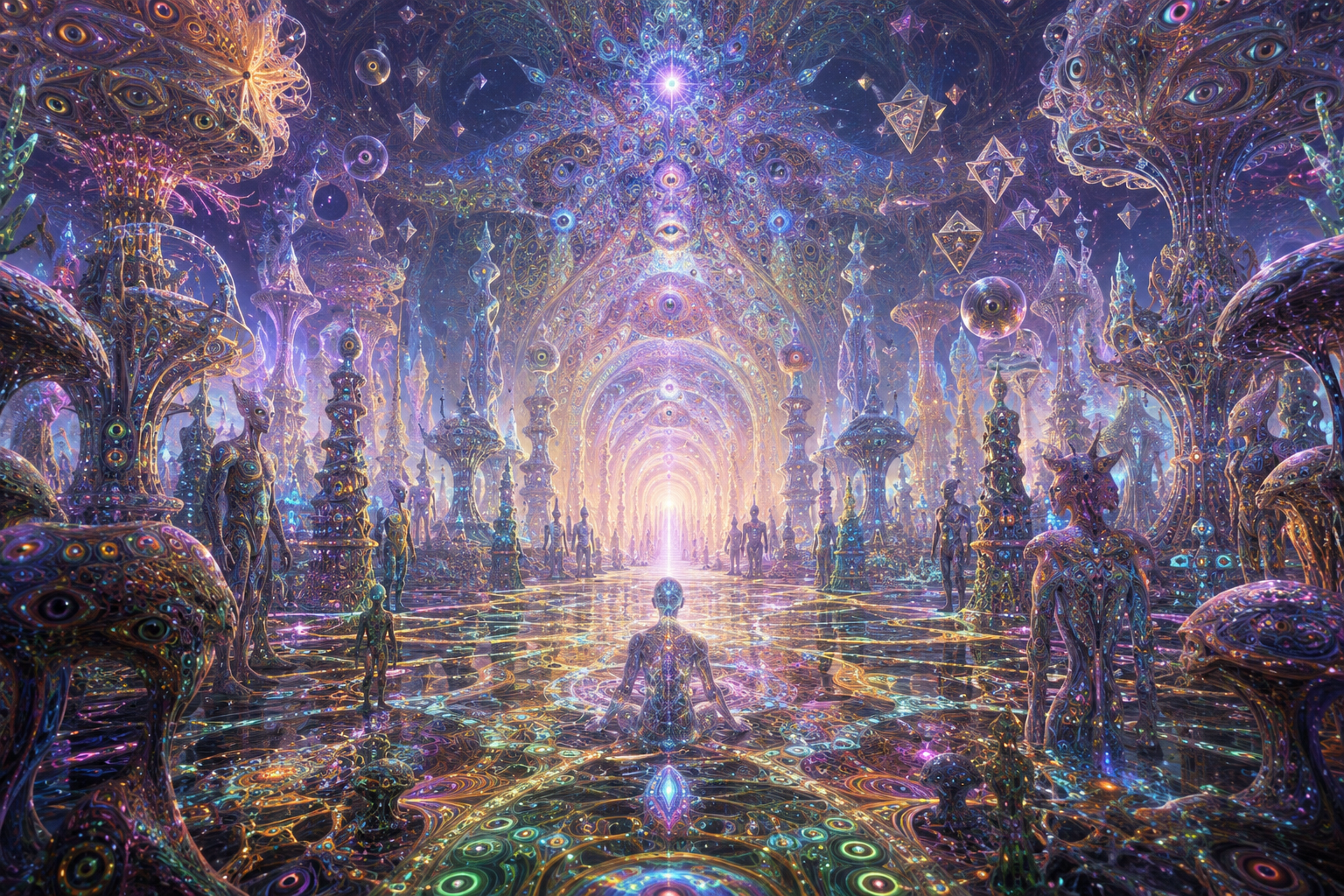
Eventually the geometry becomes so rich that it no longer feels like a pattern covering reality. Instead, reality itself appears to transform into crystalline architecture. Many users report vast structures made from shimmering, impossible forms that seem both physical and mathematical at the same time.
For many people, this represents the peak of the experience.
Level 5: The Waiting Room
Beyond the crystal worlds lies what many DMT users independently describe as “the waiting room.”
At this point, the experience becomes almost completely immersive. Users often report entering what feels like a real place populated by intricate architecture, strange objects or even entities. According to Gómez Emilsson, the different senses begin synchronising, with sights, sounds and bodily sensations becoming tightly integrated into a single coherent reality.
This may help explain why DMT often feels so astonishingly real.
Level 6: Breakthrough
At the highest doses comes the famous breakthrough. Here, Gómez Emilsson argues that the topology of experience itself changes. Space no longer behaves according to ordinary rules. Different parts of experience seem connected through impossible shortcuts, body boundaries dissolve and entirely new forms of conscious experience emerge.
Rather than simply seeing strange visuals, users often describe existing inside an entirely different world with its own internal logic.
One of the most intriguing ideas from the interview is that DMT may feel uniquely convincing because it synchronises multiple senses simultaneously.
On many psychedelics, visual distortions remain clearly separate from touch or sound. On DMT, however, people often report seeing, hearing and physically feeling the same environment all at once. That multisensory coherence could fool the brain’s normal reality-checking systems, making the experience feel as though it is genuinely happening rather than being imagined, Emilsson says.
A New Way To Think About Psychedelics
It’s important to stress that this framework remains a hypothesis rather than an established scientific model. The proposed stages are based on phenomenology (the systematic study of subjective experience) rather than direct measurements of brain activity.
Even so, it offers one of the most detailed attempts yet to organize the otherwise bewildering landscape of DMT experiences into something researchers can study and test.
Whether these six levels ultimately prove correct or not, they highlight an important shift in psychedelic science. Researchers are no longer asking only what psychedelics do to the brain. They’re beginning to ask whether the structure of conscious experience itself follows discoverable mathematical rules.
If they’re right, DMT may not simply produce hallucinations. It could provide one of the clearest windows we have into the hidden architecture of consciousness itself.