Anyone who has taken a full dose of DMT will tell you that one moment you’re here, and the next you’re somewhere else entirely, often in the company of other beings.
What almost nobody can tell you is how that transition actually happens. “Immersion” on DMT is a complete mystery. But a new paper published in Neuroscience of Consciousness attempts to improve our understanding of how the DMT world gets built.
The study
Researchers at Imperial College London, led by James W. Sanders and Christopher Timmermann, gave 23 healthy volunteers 20mg of intravenous DMT while recording fMRI and EEG. Straight after each session, while the memory was still fresh, participants sat down for a micro-phenomenological interview.
This included a structured technique designed to walk someone back through an experience in fine temporal detail, moment to moment, rather than asking them to summarize it after the fact. They were also asked to draw their experiences.
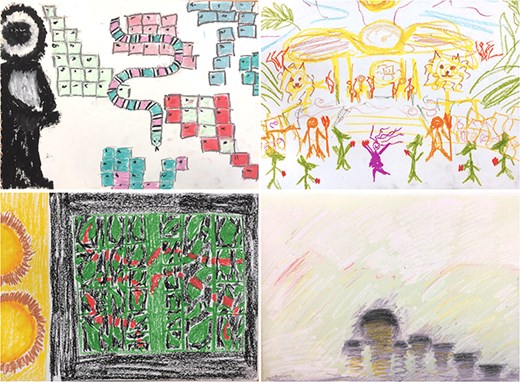
“It was a party… [All] around the room, my alien friends… We all had the same cups… someone came to me with this green liquid and they said that this will make you have a good time… I took the green liquid”
Most psychedelic research relies on questionnaires that average an entire trip into a single score for “mystical experience” or “ego dissolution.” This method asks participants what happened first, what happened next, and so on to produce a map of how the experience progresses.
From those 23 interviews, the team extracted 125 distinct phenomenological categories, everything from felt space to the semantic complexity of what appeared, then looked for common developmental sequences across participants.
“It felt like my senses had all conflated … [into an] amalgamation of everything that I’m sensing … from a sensory point of view, it’s all really merged into one.”
The world building order
The headline finding is that immersion is not immediate. It’s a a process with a reliable order of operations.
Bodily effects tend to come first. Things like pressure, vibration, warmth, the sense of the body dissolving or transforming. Visual effects tend to follow, and auditory effects tend to arrive last, when they arrive at all. Then, before any sense of three-dimensional space develops, the brain needs at least two channels running together, usually the bodily plus one other. Only once that multisensory foundation and a 3D spatial sense are both in place do perceived presences, the entities, show up.
In other words, you don’t just bump into an entity in the DMT space. The entity is often last to appear on top of a structure that has already been building for several seconds. Sensation comes first, space comes second, entities arrives third.
“That feeling of electrically vibrating, of being sawn [apart]. … it’s all part of the geometry … the fabric of what you’re feeling. As the picture rips, your body is ripping.”
Entities without eyes
One of the more fascinating sections of the paper deals with how these presences show up. Some were seen clearly, described in vivid physical detail, insectoid figures, alien celebrants at a party, a two-storey monkey with a fatherly presence. Others were heard, as chanting or abstract tones the participant interpreted as beings moving through space. Some were felt through touch or pressure on the body.
“One of the figures is presenting something to me… [something] opens up, like a drawer from the wall. In the drawer there’s this object… It’s blue and shaped like a corkscrew… there was a presentation of that object’”
But a notable subset were perceived through none of the above. Participants described a category the researchers call “felt presence”. So no visual, no sound, no touch, just an unmistakable sense that something else was there, sometimes carrying specific qualities like gender or intent. This lines up with something a lot of experienced psychonauts already intuit. The entity isn’t always a clear image you perceive. It’s closer to a something you simply know.
“I started thinking about kangaroos… and could kind of see, like, the edges of kangaroos in the blue stuff round the sides… if it would develop more it would have been kangaroos, but it was mainly just blue stuff.”
Why the order matters
The researchers argue this hierarchy places constraints on how we explain DMT neurobiologically. If presences reliably depend on multisensory integration and spatial construction being in place first, then any brain-based account of “why DMT produces entities” that focuses only on some dedicated social-cognition circuit is likely missing the actual mechanism. The entity experience looks like it rides on top of, and depends on, more basic processes of sensory and spatial construction, not the other way round.
How visually complex or simple the experiences were didn’t predict entity appearance. A participant seeing basic geometry was just as likely to encounter a presence as someone seeing elaborate scenes. So the gateway to entity contact wasn’t visual richness, it was the underlying scaffolding of multisensory and spatial integration.
“[The structure I was inside] was huge, like the dimensions of a cathedral… it was flipping over itself … I wasn’t moving … It’s as if the space itself was moving, a bit like slides, but with a rotating movement… As if the structure was a 3D hexagon, for example… Each side would be a room… A window into a virtual environment.”
Tthe bigger entity question
This mapping of how immersion unfolds connects to another thread we’ve been following on The Spore Report: whether DMT entities might be something more than the brain’s noise dressed up as sentience.
We covered a preprint earlier this year from Andrew Gallimore, Donald Hoffman, and Niffe Hermansson, “Traces of the Other,” which draws on Hoffman’s conscious realism framework, the idea that consciousness rather than matter is fundamental, and that perception evolved for usefulness over accuracy.
Their proposal is that DMT might perturb the human perceptual interface enough to let “traces” of otherwise imperceptible conscious agents come through as coherent experience. From that framework, they derive a testable prediction. If entities are traces of something genuinely external, they should appear embedded in a coherent, structured space, not as isolated intrusions.
The Sanders/Timmermann findings are worth reading alongside that, purely as a matter of timing. Presences only emerged in their data once multisensory integration and 3D spatial structure were already in place. Whether that sequencing says anything about the nature of the entities themselves, or simply reflects how any complex perceptual content gets assembled under DMT, isn’t something either paper settles.
But it’s a useful example of two very different methods, exhaustive phenomenological mapping on one side, formal testable predictions on the other, converging on the same open question from opposite directions.
“I feel the strange combination of novelty and familiarity… the space looks completely different, but I have this feeling that I’ve been in this place or in this frame of mind before.”
The bigger picture
What I find most useful about this paper is the demonstration that an experience this strange still has a shared, mappable architecture. The same interview method has already been used for mind-wandering, meditation, and dreamless sleep.
Extending it to DMT gives researchers, for the first time, a more precise account of how “another world” gets assembled in real time, and a template for asking the same questions of other short-acting psychedelics.
“I broke into tears and I saw these sounds, and the meaning of these sounds, expressed visually as a character face of myself, layering into this landscape. … [I saw] exactly the same content and material as my expressions. I was certainly shaping this world.”