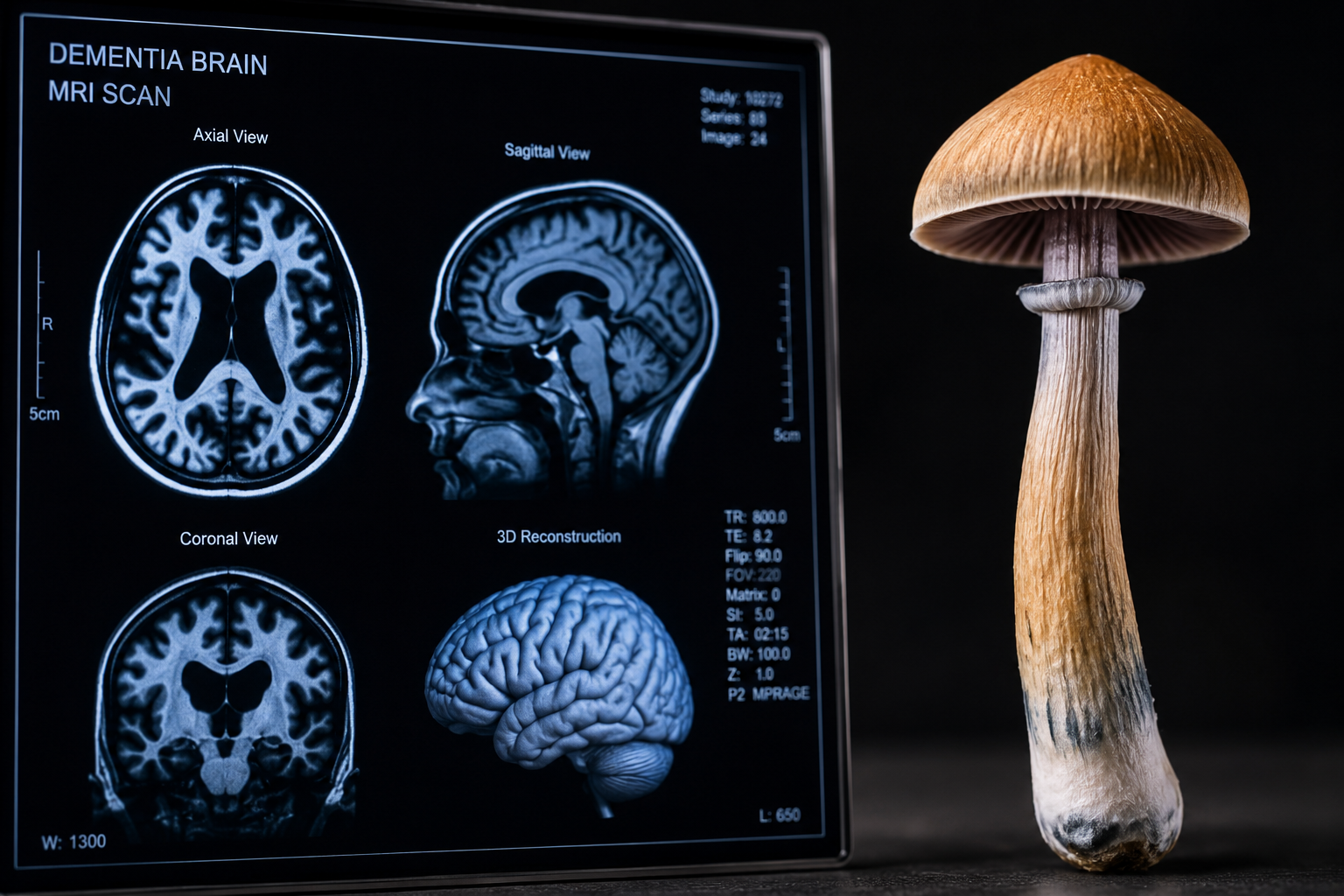
For five years, an 80 year old Japanese-American woman with advanced Alzheimer’s spoke almost entirely in single words. She couldn’t dress herself, couldn’t walk unaided, and had been incontinent for years. Her family had been grieving her in advance while she was still in the room.
Then she was given 5 grams of psilocybin mushrooms. Nineteen hours later she woke up and talked for nearly four hours. She spoke in full sentences, was able to recall autobiographical stories, and even cracked som jokes.
The case, published in Frontiers in Neuroscience in May 2026 by Marcos Lago, Mariana Cerveira, and Joe Xavier Simonet, is a single patient, no control group, no brain imaging, no standardized cognitive testing. On its own, it’s the weakest form of clinical evidence there is. But it does open up a question about how we understand neurodegenerative diseases like Alzheimer’s.
The old model
The standard story of Alzheimer’s says neurons die, memories disappear, and function is gone for good. Structural damage equals loss of cognitive function. It’s a tidy model, and it’s also the reason advanced dementia care is built almost entirely around management rather than recovery. If the hardware is destroyed, there’s nothing left to switch back on.
But clinicians have watched something inconvenient happen for decades. A person with severe, long-established dementia briefly becomes themselves again, recognizing family, telling a coherent story, and using names that were once lost. These episodes are documented even occurring in the days immediately before death. It’s called paradoxical lucidity.
Reviewing the phenomenon in 2024, researchers made the point that if cognition were genuinely erased, none of this should be possible, which suggests functional circuits remain in place and are only being intermittently, briefly reactivated. The fact that it happens at all, unpredictably and without intervention, is a standing clue that something in these brains survives in a state the standard model doesn’t account for.
The metabolic theory
This is where the woman in the case report comes in, because her recovery lines up with a competing account of what Alzheimer’s actually is. It’s been argued for years by researchers including Dale Bredesen, Suzanne Craft and Stephen Cunnane that it’s not primarily an amyloid disease, but an energy crisis.
Years before neurons start dying, FDG-PET scans show glucose uptake in the brain drops, and that hypometabolism reliably predicts the cognitive decline that follows, well ahead of major structural atrophy. Neurons develop something close to insulin resistance, mitochondria stop producing ATP efficiently, and oxidative stress climbs. And critically, synapses stop functioning well before the cells they belong to actually die.
Hirosawa and colleagues added a useful piece to this picture. The severity of everyday functional impairment in their patients tracked much more closely with regional glucose hypometabolism than with anything visible on structural MRI. In other words, it’s falling metabolism, not the amount of visible atrophy, that best predicts how impaired someone actually is. That’s a very different claim than “more shrinkage, less function.” It says function tracks energy, and energy can drop long before structure does.
That means the sequence isn’t “cells die, then function disappears.” It’s more like energy availability drops, synaptic communication fails, large-scale networks disconnect, memory becomes inaccessible, and only much later do the starved cells actually die. For a long stretch in the middle of that timeline, the structure is still there, it’s just running on fumes.
Power outage
There’s a precedent for this outside Alzheimer’s research. In stroke medicine, it’s called diaschisis. Brain regions well away from the actual site of damage often go quiet because they’ve lost input from a connected region that has died. Weeks later, once the disrupted circuit stabilizes, many of those “silent” regions come back online. The core lesson generalises well beyond stroke. Loss of function does not necessarily mean loss of tissue.
Some Alzheimer’s researchers now think something similar could be happening across large-scale cognitive networks, and it’s notable that one of the earliest sites of dysfunction in Alzheimer’s, the Default Mode Network (spanning the posterior cingulate, precuneus, medial prefrontal cortex and hippocampal regions), is also among the first to show glucose hypometabolism on FDG-PET. Network communication appears to fail before extensive cell loss, not after.
Picture a city after a major power outage. The buildings are standing, the roads are intact, and the computers still exist. But nothing works, because the power isn’t reaching it. From the outside, the city looks dead. Restore the electricity and activity floods back in. A phone at 5% battery behaves the same way. It freezes and crashes, but plug it in, and it starts working again.
This is the frame the case report fits into almost perfectly. The patient’s underlying pathology, the amyloid, the tau, wasn’t measured before or after and almost certainly didn’t change. What changed was access to energy. For a few weeks, dormant circuitry that the standard model would call gone got re-engaged.
Why psilocybin, specifically, might do this
Psilocin, what psilocybin becomes once metabolised, binds the 5-HT2A receptor and is capable of temporarily reorganizing large-scale brain network activity. In animal models it drives new dendritic spine growth through BDNF signaling, and it appears to calm overactive microglial cells, the immune cells that go into inflammatory overdrive around amyloid plaques and do real collateral damage to surrounding tissue.
None of that repairs the underlying energy deficit. But if a network is structurally intact and merely metabolically suppressed, a jolt toward greater plasticity and connectivity is the kind of thing that could help recruit whatever pathways are still viable, or briefly strengthen the ones running under capacity.
Now, let me be clear, there is no convincing evidence that psilocybin restores lost cognition in established Alzheimer’s disease, and this is one case, observed clinically rather than measured with imaging or standardized testing. Lago himself has said plainly that the finding isn’t proof psilocybin treats Alzheimer’s, and that families shouldn’t read it as a green light for unsupervised use in a population with cardiovascular and fall risk.
The woman in the report ran a suspected fever, was agitated, sweated heavily during the acute phase, before appearing unconscious for 19 hours. Who knows what she was going through.
The real shift
Paradoxical lucidity says the circuitry can sometimes come back on its own. The metabolic evidence says a meaningful stretch of the disease is about starved networks rather than dead ones. And this one case suggests that a compound capable of temporarily forcing greater plasticity and connectivity might be able to do, deliberately and for a few weeks, what paradoxical lucidity does spontaneously and for a few hours.
It’s a much narrower claim than “reversible,” and a much narrower role for psilocybin than “cure.” But what it points to instead is a treatment target nobody has taken seriously enough. Whether psilocybin or something aimed more directly at mitochondrial function turns out to be the way to do that reliably is genuinely unknown. But the fact that access, not just tissue, might be the thing failing is the real finding here, and it’s the one worth following.
Source: Lago M, Cerveira M, Simonet JX (2026). Transient multidomain functional improvement in advanced Alzheimer’s disease following high-dose psilocybin-containing mushroom administration: a case report. Front. Neurosci. 20:1813281.