
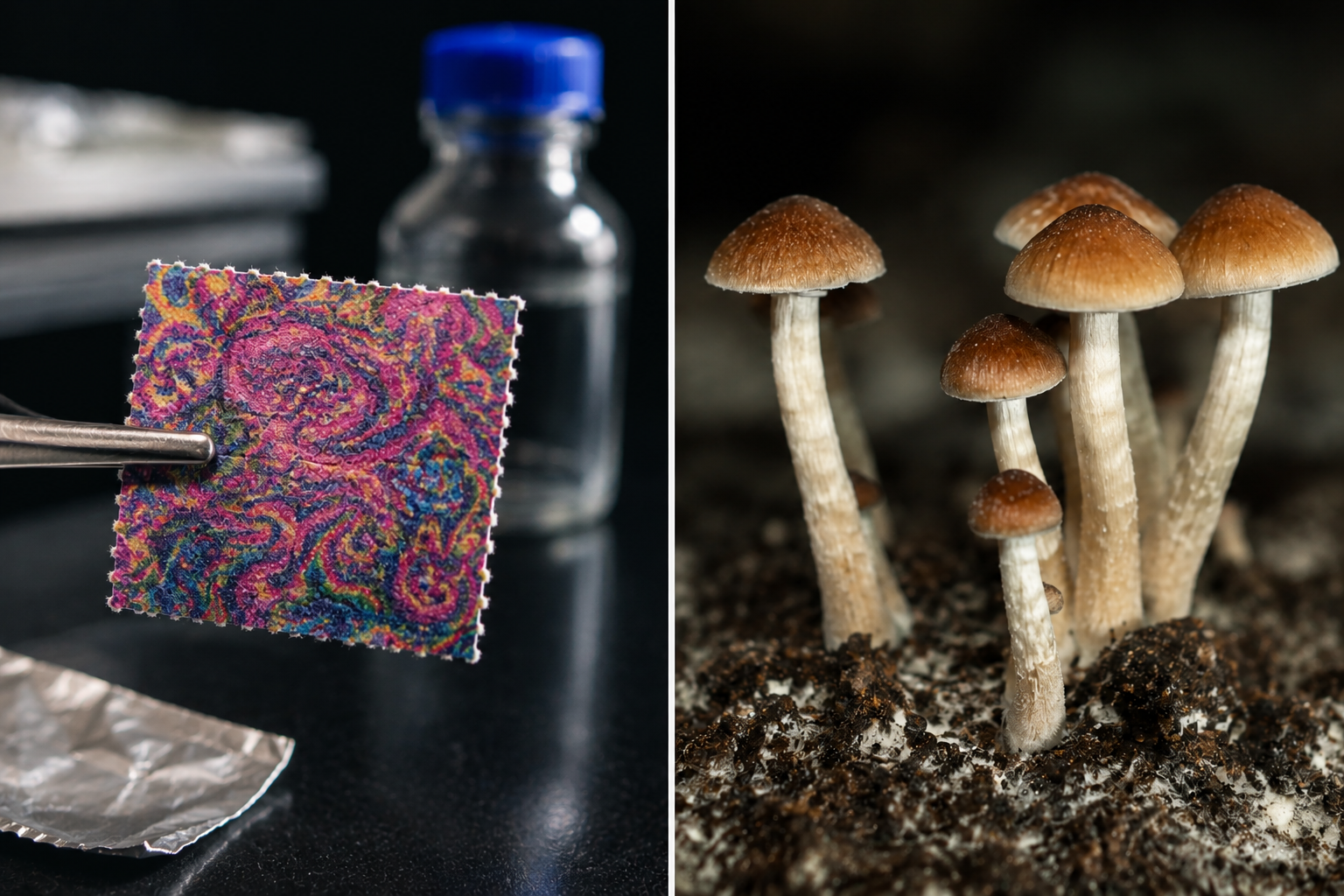
On Monday, Definium Therapeutics’ (formerly MindMed) shares jumped more than 50% after the company reported that DT120, its lysergide (LSD) based depression treatment, hit every primary and key secondary endpoint in its 149 patient Emerge trial. Definium’s CEO told Fierce Biotech the data was “the best ever seen in a pivotal study of depression.” Needham’s analyst called it “unprecedented.”
That’s a lot of superlatives for a Monday morning. So let’s take a deeper look at what this trial actually measured, what can it tell us about LSD for depression, and whether it is even better than psilocybin for treating the condition.
The Emerge trial
Patients with major depressive disorder were given either a single 100 microgram dose of LSD or a placebo, then monitored for roughly eight hours by a trained attendant. Six weeks later, the LSD group showed an 8.1 point greater reduction in MADRS scores (the standard clinician rated depression scale) compared to placebo. That’s the primary endpoint, and it’s a large effect size for a single dose intervention. At twelve weeks the gap had narrowed slightly to 7.1 points, still a big win.
It was also safe, with no increase in suicidal ideation, and per Reuters’ reporting, 99% of adverse events were mild to moderate and clustered on dosing day itself. An open label extension is now testing how non-responders fare with repeat dosing.
LSD vs psilocybin
Both Definium’s own materials and the press coverage line up DT120 against the competition, including Spravato’s (an isomer of ketamine) 6.8 point reduction, Compass Pathways’ psilocybin candidate COMP360. On paper, DT120 comes out on top.
But there’s a big asterisk attached to that ranking. Definium’s own presentation admits, in its own small print, that you can’t really compare these trials directly, because each one was run differently, on a different group of patients. For example, the analyst comparison to Compass and Spravato measured those drugs’ results four weeks after dosing, but measured DT120’s results at six weeks.
There are other hidden differences too. Each trial enrolled a slightly different type of patient, trained its depression-scoring clinicians differently, and saw a different placebo effect (how much patients improve even on a sugar pill, which varies a surprising amount between trials). None of these differences show up on a bar chart that just lines the numbers up side by side, but they are the kind of thing that can make one trial’s number look bigger than another’s for reasons that have nothing to do with the drug.
None of this means the DT120 result isn’t real or isn’t impressive on its own terms. It means “DT120 beat psilocybin” is a claim that hasn’t actually been tested. Nobody has run LSD and psilocybin against each other, in the same patients, under the same rules, scored by the same clinicians. Until someone does, what we have is two separate piles of evidence growing side by side, not a verified winner.
LSD and psilocybin are very different
It’s tempting to lump LSD and psilocybin together under “classic psychedelics” and treat them as basically interchangeable. But they’re chemically different drugs, and those differences could plausibly matter for how well each one works as a depression treatment, even though we don’t yet know which differences actually make the difference.
Both drugs act on the same core target, a serotonin receptor called 5-HT2A that’s thought to be central to the psychedelic experience itself (this is true of psilocybin, LSD, mescaline, and DMT alike, it’s what makes them all “classic psychedelics” in the first place). The difference is in how each one behaves once it’s there. Structural biology research has found that LSD gets physically trapped inside the 5-HT2A receptor by a flexible part of the receptor that folds down like a lid, which causes LSD to linger far longer than psilocybin’s active form typically does.
LSD also binds more broadly across other receptor types, including other serotonin subtypes, dopamine receptors, and adrenergic receptors, while psilocybin’s active form stays more narrowly focused on serotonin receptors. That lingering, broader grip may help explain why LSD sessions tend to run long. Definium kept patients monitored for eight hours, compared to the roughly six hours typical of a psilocybin session.
Definium’s chief medical officer, Daniel Karlin, called LSD “remarkably potent” and “uniquely gentle” in its effects. That’s a company talking point, so it deserves a raised eyebrow until there’s actual head-to-head data behind it, but the broader idea, that different psychedelics produce noticeably different qualities of altered state, does line up with decades of clinical and personal accounts.
There’s also a difference in philosophy here that has nothing to do with the drug itself. Karlin was explicit that Definium’s session attendants are there to support the patient, not to function as part of the treatment: “it’s not meant to be any sort of an intervention that contributes to the outcome for the patient.” Compass takes a similar approach, trying to isolate the drug’s effect on its own, separate from any added therapy.
Both companies are deliberately keeping the therapy-style support around the dosing session to a minimum. That sets them apart from integration-focused models, which treat that surrounding support, the conversations and reflection that happen around the dose, as part of what produces the outcome, not just a nice extra.
So, is LSD better than psilocybin for depression?
Based on what’s actually in front of us, we don’t know. What we do know is that one well-designed, late-stage clinical trial of an LSD-based capsule produced a large reduction in depression symptoms, one unlikely to be down to chance, with no worrying safety signals.
That’s a great outcome for the patients in that trial, and a meaningful early proof that LSD can work as a pharmaceutical, which is no small thing given that LSD spent eighty years mostly outside the clinic after Albert Hofmann first identified its effects in 1943.
We also have mounting evidence for the efficacy of psilocybin’s antidepressant effects. What we don’t know is how DT120 would perform against psilocybin in a true head-to-head trial, because that trial hasn’t happened. Comparisons across separate trials, even ones built by serious researchers, are simply how an early-stage drug company tells its best story with the numbers it has on hand.
The more interesting long-term question isn’t which molecule wins a number on a slide. It’s whether the field ends up confirming that the experience around the dose, the support, the integration work, the reframing that happens in the weeks after, matters as much as which brain receptor gets switched on for eight hours. Definium and Compass are both, in their own way, betting that it doesn’t matter much. The growing body of research on integration and support suggests that might be the riskier bet of the two.
DT120’s results in anxiety and a lower-dose depression trial are expected later this year. They’re worth watching for the same reason this one was: not to see who wins, but to see what the comparison can, and can’t, actually tell us.


I’ve had Recurrent Major Depressive Disorder most of my life, I was officially diagnosed recently. I tried a gentle dose of fresh magic mushrooms one time a few years ago and had a wonderful experience, I didn’t see much visuals, but I remember my friend’s dog being like a guardian. For about three to four months after I felt like my depression was gone completed. I thought I was cured, sadly it’s back and still hard to manage, I love seeing the results of these studies, it’s so good to see the science proving what I felt. I really want to try them again.
I was a recreational user of psychedelics since before LSD was made illegal 60 years ago. I’ve used, LSD, STP, DMT, Peyote, Datura, and psilocybin. I was a poor student, rebelling about my forced participation, with low self esteem. I graduating magna sum lousy in the bottom 5% of my high school class before before discovering psychedelics.
They got me interested in studying everything and I ended up with a PhD in Mathematics, teaching math in college for 46 years, and have never had a problem with depression. I’m not saying they were the cause, but they did inspire insight into the existence of a much more refined and interesting universe than the average person was experiencing and a constant drive to learn more.