I’ve stumbled onto the best pre-workout I’ve ever used. It isn’t caffeine or one of those overpriced electrolyte sachets dressed up like a wellness product. It definitely isn’t a chemical-laden powder blend with eleven ingredients.
It’s the OG preworkout your hunter gatherer ancestors used to tune into the patterns of the forest and drop in to the mind of their prey. It helped them go faster for longer, with the added benefit of psychic communication with their fellow hunters (possibly).
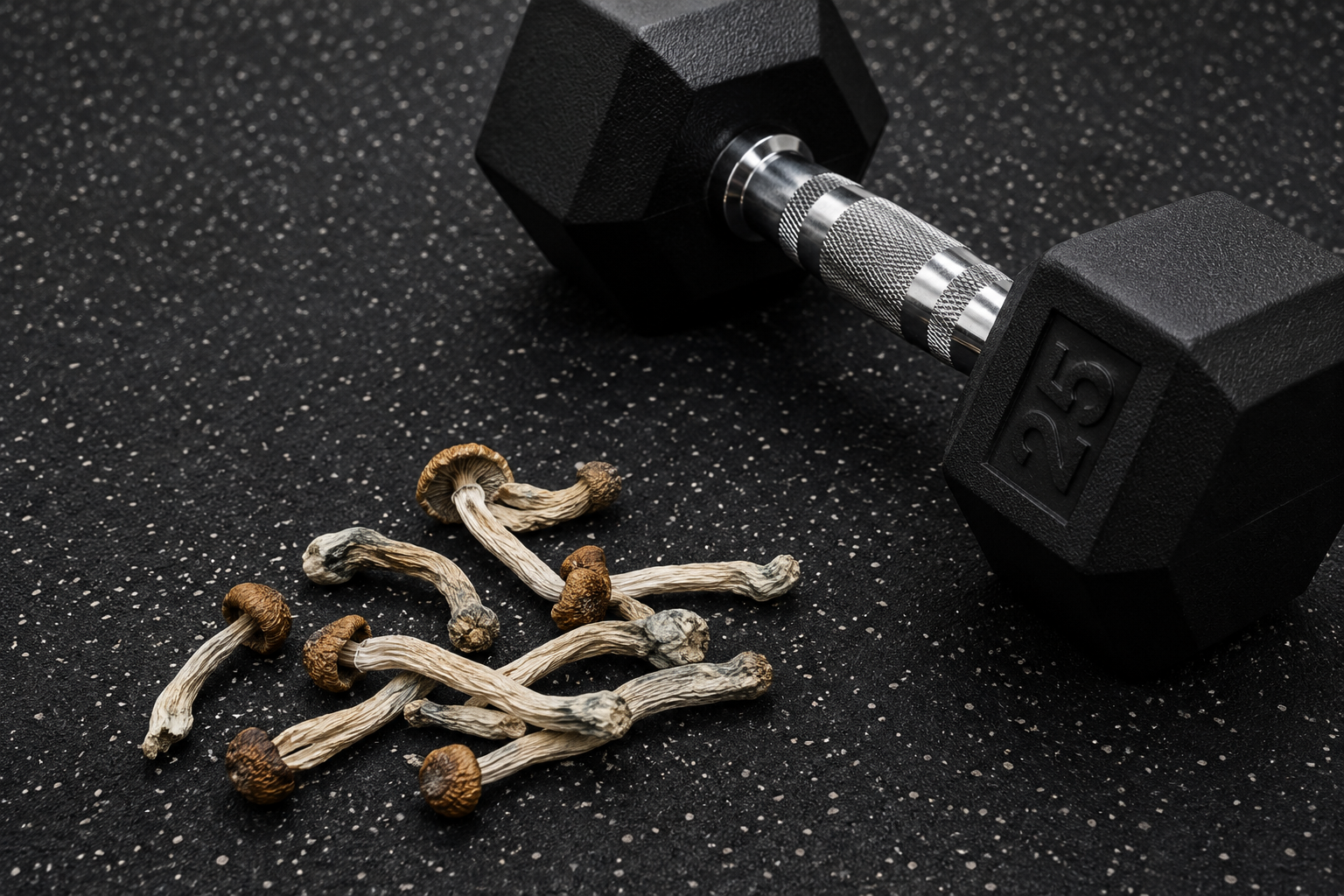
Now we can use to it block out gym tv screens, connect deeply with our biceps, and become one with the treadmill. Psilocybin mushroom microdoses are the ultimate pre workout and a game-changer for elite focus, profound mind muscle connection, and dangerous pumps.
And I’m not just saying this, there is fascinating cutting edge science backing this up.
Flow state
The case for psilocybin as a focus tool rests on its well-documented relationship to flow and immersive states. Subjectively, people report a shift in perception toward detail, texture, and pattern, exactly the kind of narrowed, absorbed attention that defines flow.
A preregistered study out of the University of Amsterdam found that psilocybin microdosing increased feelings of awe and aesthetic immersion, tracking with the same drop in default mode network activity seen in full psychedelic doses, the part of the brain associated with self-referential thinking switching off so the senses can take over.
That said, the most rigorous study on the topic (a double-blind, placebo-controlled trial) found that when researchers controlled for expectation, most of the reported cognitive and creative benefits of microdosing didn’t hold up, with people’s belief that they’d taken the active dose responsible for most of the effects.
The honest read is that there’s a real neurological mechanism for increased immersion and altered perception, but a lot of the “flow state” reporting in the wild is probably some mix of pharmacology and a powerful expectation effect. Worth knowing, even if it doesn’t kill the argument.
Metabolic state
Psilocybin’s effects on plasticity and learning are well established. What’s newer, and frankly more compelling, is the metabolic data.
A 2025 study out of Emory University and Baylor College of Medicine (Kato et al., published in npj Aging) found that psilocin, the active metabolite of psilocybin, extended the lifespan of human skin and lung cells in culture by over 50%, with no brain or nervous system present in the dish at all.
The same study gave aged mice monthly doses of psilocybin and found a 30% increase in survival, alongside healthier fur and reduced markers of cellular aging. The researchers’ explain how psilocybin is acting on the cell itself, or on the system as a whole, not just on the brain.
A 2026 study from a European research consortium (Colognesi, Gabbia, et al., Pharmacological Research) gave mice on a high-fat, high-sugar diet a very low, non-psychedelic dose of psilocybin for twelve weeks. The results showed reduced weight gain, improved insulin sensitivity, normalized blood glucose, and a measurable regression of fatty liver disease, all without any detectable effect on the central nervous system.
The mechanism wasn’t even the classic psychedelic receptor (5-HT2A). It ran through a serotonin receptor in the liver itself (5-HT2B), suggesting psilocybin has a metabolic action that’s almost entirely separate from the trip.
Then there’s Bryan Johnson’s recent experiments with psilocybin. Yes, it’s one person, one session, tracked on a continuous glucose monitor, so treat it as an anecdote and not a study. But it’s a noteworthy one. He reported his glucose control jumping from the top 2% to the top 0.2% of the population in the days following a psilocybin session, with an 8% drop in mean blood glucose and an estimated drop in HbA1c.
His hsCRP (a key inflammation marker) dropped from 0.23 mg/dL to below the test’s detection limit of 0.15 mg/dL, a decrease of over 35%, which tracks with clinical research showing reduced CRP, TNF-alpha, and IL-6 after high-dose psilocybin. Five days post-trip, his cortisol and DHEA-S had fallen 42% and 45% respectively. Cortisol spikes during the trip itself, but afterward his body settled into a sustained parasympathetic, deeply relaxed state, the same “afterglow” effect documented in clinical literature.
His estradiol tripled, from 11.3 to 36 pg/mL, likely from psilocybin’s activation of 5-HT2A receptors stimulating aromatase (the enzyme that converts testosterone to estradiol). His testosterone didn’t budge, so his body simply compensated, and estradiol at that level isn’t a problem here. It’s neuroprotective and anti-inflammatory.
Johnson used a 5g dose, not a microdose, and it’ a single data point, but stacked next to the Emory and liver findings, it’s pointing in the same direction, suggesting that psilocyib can have profound effects on the physical system as well as the mind.
So, is it a pre-workout?
Using it to lift weights might be the least interesting application of psilocybin we’ve found, and that’s the point. If a compound can plausibly extend cellular lifespan, reverse early metabolic dysfunction, and sharpen the attention to make a workout feel like a flow state, then “pre-workout” is in my account one of the most fun entry point into something much bigger – one of the most potent geroprotective, metabolism-enhancing, neuroplasticity-boosting compounds we’ve found yet.
And it grows out of the ground, all over the world. Genuinely incredible.
Sources: Kato et al., “Psilocybin treatment extends cellular lifespan and improves survival of aged mice,” npj Aging (2025); Colognesi, Gabbia, et al., “Low, non-psychedelic doses of psilocybin as a novel treatment for MASLD, obesity and type 2 diabetes via 5-HT2B receptor-dependent mechanisms,” Pharmacological Research (2026); van Elk et al., “Effects of psilocybin microdosing on awe and aesthetic experiences,” Psychopharmacology (2021); Marschall et al., “Microdosing with psilocybin mushrooms: a double-blind placebo-controlled study,” Translational Psychiatry (2022); Bryan Johnson, self-reported CGM data via X/Twitter (2025).