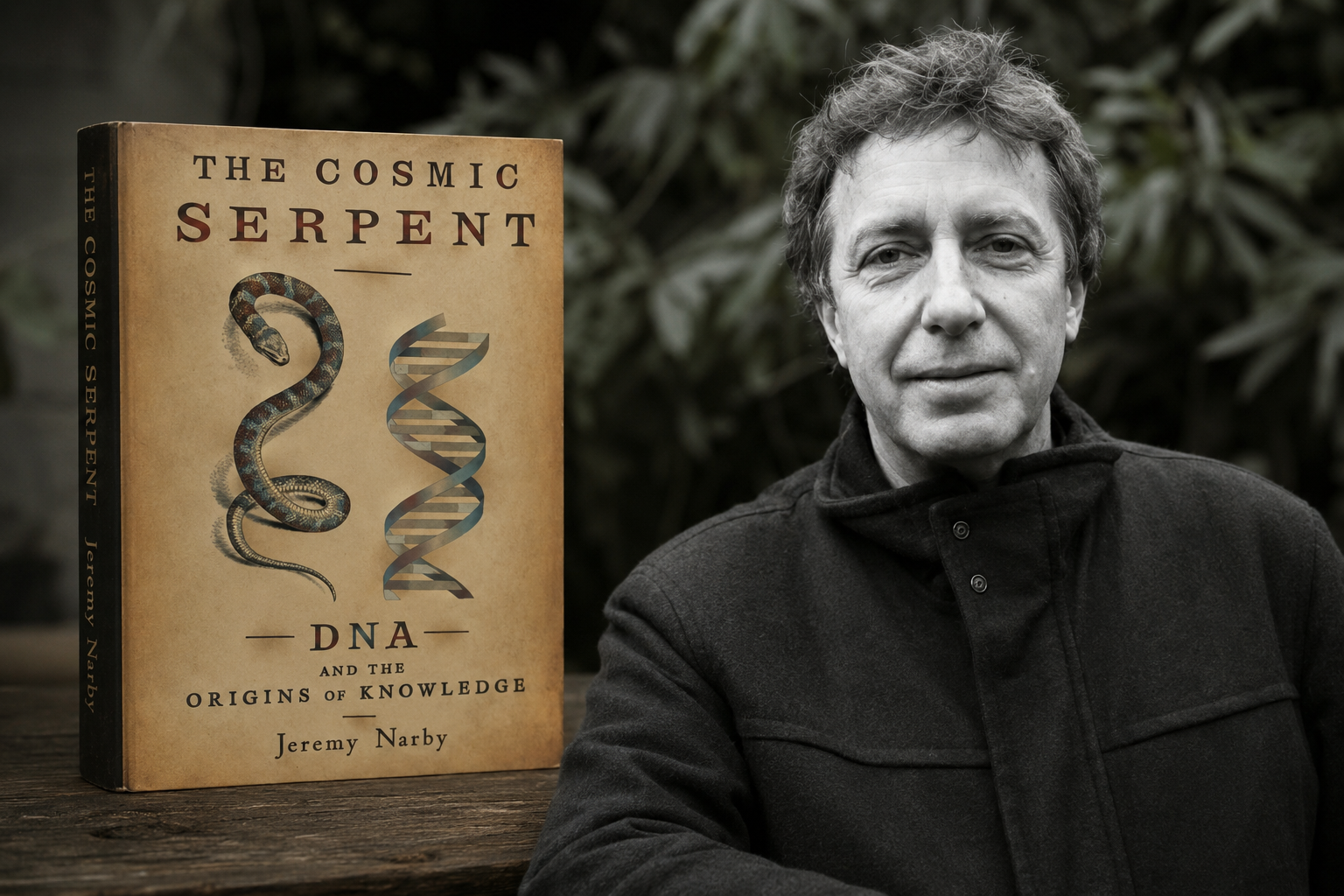
Some books settle a question. Jeremy Narby’s The Cosmic Serpent: DNA and the Origins of Knowledge does the opposite. Three decades after its publication, it’s still unsettling people, and that’s exactly why it belongs in any serious conversation about plant medicine, consciousness, and the limits of what science currently claims to explain.
Narby is an anthropologist who spent years living with the Asháninka people in the Peruvian Amazon. While there, he kept running into the same question. How did indigenous shamans identify precise, effective combinations of medicinal plants from a rainforest containing tens of thousands of species, seemingly without the centuries of systematic trial and error you’d expect it to take?
The shamans themselves had an answer. They said the plants told them.
The hypothesis
Narby, trained in the rationalist tradition, initially dismissed this as metaphor or myth. But after participating in ayahuasca ceremonies himself, he became convinced the claim deserved to be taken literally, or at least taken seriously enough to investigate.
His hypothesis runs like this. Consciousness accessed during psychedelic states might obtain information unavailable to ordinary waking awareness. A striking number of cultures, separated by geography and history, share a visual motif of two intertwined serpents (think the caduceus, twin dragons, sacred vines, ladders to the sky). Narby noticed this pattern resembles nothing so much as the double helix of DNA, and he began to wonder whether these recurring serpent visions were somehow direct encounters with the molecular basis of life itself.
It’s a wild idea. It’s also, in its own way, a fungal one. Information moving through a network via a channel we don’t fully understand yet, using an intelligence that doesn’t look like ours.
The case he builds
Narby never claims to have run a controlled experiment. His argument is cumulative, built from three threads:
Indigenous knowledge too specific to be accidental. Ethnobotanists generally believe that generations of careful observation and cultural transmission can account for most Amazonian plant knowledge (this isn’t magic, it’s methodology, just not one written down in journals). But Narby pushes back, saying the combinations are so precise and so consistently arrived at across unconnected groups that “trial and error” can’t explain it.
The recurring serpent motif. Twin snakes, intertwined vines, ladders, and dragons. Narby lays these images side by side across civilizations that had no contact with one another and asks whether the resemblance to DNA’s structure is coincidence, or something else.
His own ayahuasca visions. Narby reports encountering enormous luminous serpents during ceremony, imagery he found striking because Amazonian shamans across different cultural contexts describe remarkably similar visions.
Mainstream push back
There is no accepted scientific evidence that psychedelics let people access information encoded in DNA, or that DNA communicates in anything resembling the way Narby proposes. Mainstream biology just doesn’t support this.
What modern psychedelic neuroscience does show is that these substances increase brain entropy and disrupt predictive processing, which could help explain why intensely vivid, symbolically loaded experiences (serpents included) show up so reliably across cultures and individuals.
Mind bending
Split the book in two and it holds up well. The first half, the respect for indigenous epistemology, the vivid ethnography of Amazonian shamanism, the refusal to dismiss traditional knowledge just because its origin story is spiritual rather than clinical, is genuinely valuable and still underappreciated in Western science. The second half, the literal DNA-communication hypothesis, is of curse speculation.
But if you’ve been following our coverage of Donald Hoffman’s interface theory or the Gallimore/Hoffman/Hermansson entity research, you’ll notice the overlap immediately. Narby is asking, decades early, whether ordinary perception is showing us the whole picture, and whether psychedelics can perturb the brain and allow us to see see outside of our usual perception range.
Jung would read the serpent as archetype, transformation, instinct, renewal, rather than literal biology. Both readings can be true at once.
Read it that way, as an invitation to question your assumptions about where knowledge comes from, not as proof of its central thesis, and The Cosmic Serpent earns its reputation. It won’t settle anything. It’ll just make you a little less certain about where the boundary between metaphor and mechanism actually is.
Source: Jeremy Narby’s The Cosmic Serpent: DNA and the Origins of Knowledge