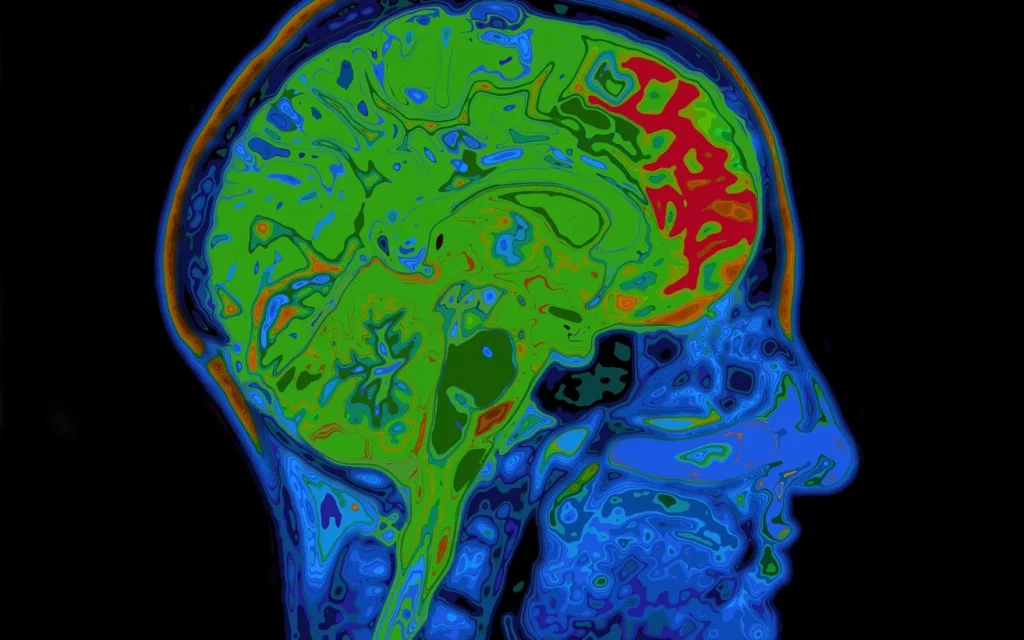
A new study out of Beijing University of Posts and Telecommunications, published in PLOS Computational Biology, offers one of the clearest pictures yet of how LSD reorganizes the brain at the level of individual circuits, and the answer looks a lot like what The Spore Report covered just last week in a separate review of psychedelic electrophysiology.
Once again, the story is not that LSD simply revs the brain up. It is that LSD changes which parts of the brain get to speak, and how loudly.
The study
Lingyu Zhang and colleagues worked from an existing dataset of 15 healthy adults, each scanned twice on separate days, once after a placebo injection and once after intravenous LSD.
Directly measuring the balance between excitatory and inhibitory activity inside a living human brain is not something current scanning technology can do on its own, so the team paired the functional MRI data with a computational model, using known structural connections across the cortex to estimate that excitatory-to-inhibitory (E/I) ratio in fine detail, region by region.
Under placebo, the brain behaved the way decades of resting-state research would predict. It moved fluidly between distinct, specialized states, sensory processing networks handling one set of tasks, the default mode network (the seat of mind-wandering, memory, and self-referential thought) handling another, each largely staying in its own lane.
Under LSD, that separation broke down. The researchers measured a marked increase in global brain synchrony, meaning that instead of different networks running semi-independently, much larger portions of the cortex began firing in unified rhythm together. Once the brain entered this highly synchronized state, it became considerably less likely to drop back into its usual specialized, compartmentalized patterns. The unified state behaved almost like a basin the brain kept sliding back into.
Senses down, abstraction up
The computational model gives a mechanistic reason why. LSD did not shift the E/I ratio uniformly across the cortex, it moved it in opposite directions depending on the region. In areas handling basic sensory and motor processing, inhibition strengthened substantially, meaning these regions became less excitable and less tightly anchored to raw sensory input.
In associative regions, the parts of the cortex responsible for abstract thought, self-reflection, and introspection, the pattern reversed. The excitatory-to-inhibitory ratio rose, making those areas more active and less constrained.
The effect is a kind of leveling. Sensory regions get quieter and less locked to what is actually arriving through the eyes and ears. Associative regions get louder and less disciplined by their usual top-down control. The functional gap that ordinarily separates concrete perception from abstract cognition narrows, and in some cases seems to collapse almost entirely.
That maps unusually well onto the subjective territory psychedelic users have described for decades. A dissolving sense of self, sensory input that feels charged with meaning rather than merely received, and thought that behaves more like perception and vice versa.
Disruption
Notably, the researchers found that this cascade appears to start in the sensory and motor cortices rather than the association areas. The suppression of these early sensory processing regions seems to propagate upward through the cortical hierarchy, disturbing the higher-order networks that normally impose top-down structure on cognition.
In other words, the disorientation of the psychedelic state may begin with the brain’s basic contact with the outside world getting turned down, with everything else unraveling from there.
The chemistry lines up too. LSD’s primary mechanism runs through the 5-HT2A serotonin receptor, which triggers changes in glutamate release, the brain’s dominant excitatory neurotransmitter. The team found that their modeled map of E/I disruption closely tracked known anatomical distributions of serotonin and glutamate receptors across the cortex, offering a plausible biological throughline from receptor binding to the wholesale reorganization of brain-wide synchrony.
The authors are appropriately cautious about the scope of these findings. The sample size was small, at just 15 participants, and larger studies will be needed before the results can be generalized with confidence. The model also excluded subcortical structures entirely, most notably the thalamus, which prior research has repeatedly implicated as central to how hallucinogens alter perception, and which will need to be incorporated for a fuller picture.
The study also did not correlate these measured brain changes against participants’ own subjective reports of what they were experiencing in the moment, a gap the researchers flag as the natural next step.
The Bigger Picture
Still, this is a meaningful addition to a rapidly consolidating picture of how classic psychedelics work. Alongside recent electrophysiological findings on layer 5 pyramidal neurons, timing, and network reorganization, this study reinforces that the psychedelic brain is not a louder brain.
It is a brain where the usual walls between systems, sensory and abstract, self and world, come down, at least for a few hours, revealing just how much of ordinary consciousness depends on those walls staying up.
Keep up with the research here.