
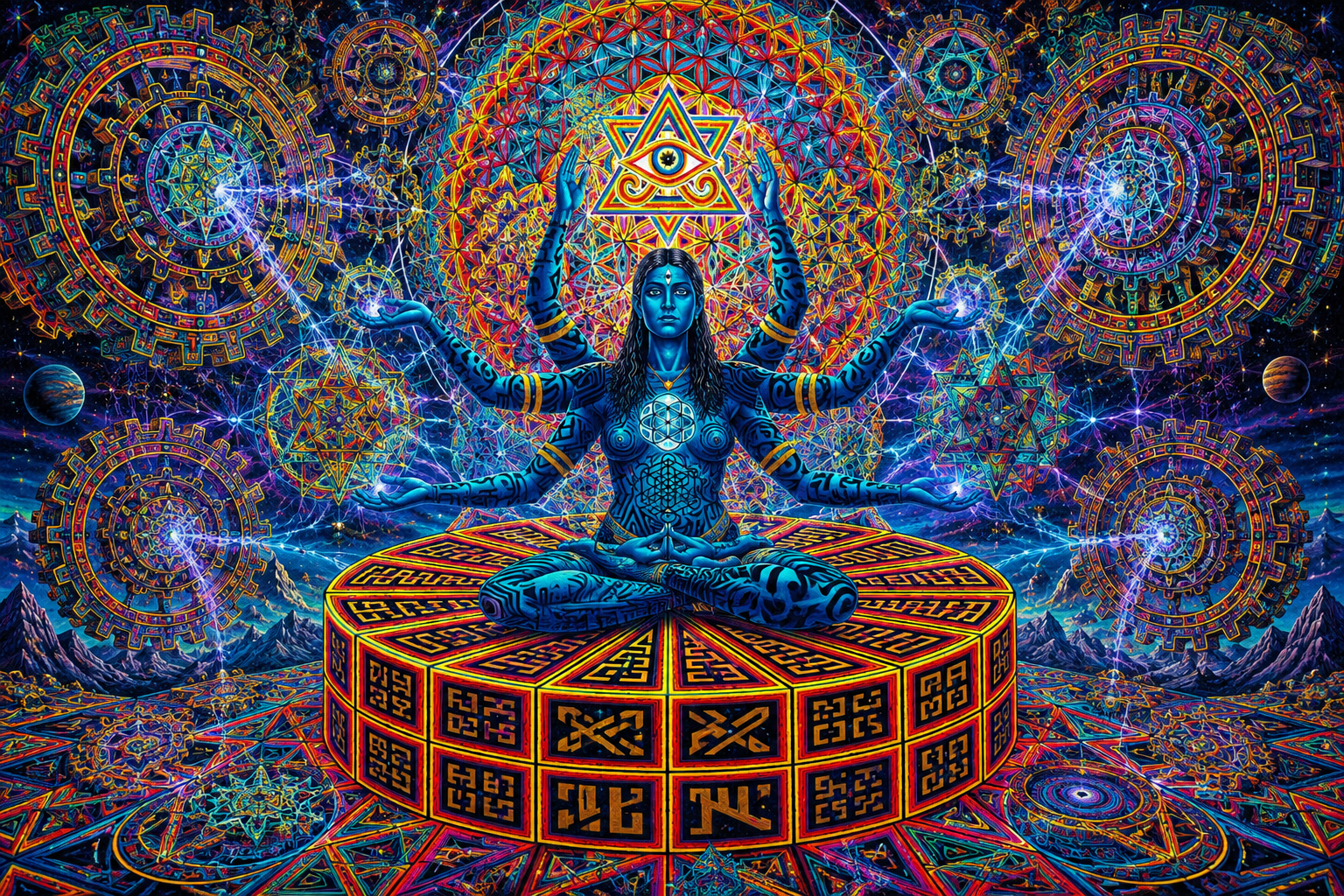
10 years ago, I sat overlooking a calm lake and took three big hits of DMT. As the experience intensified, the entire sky transformed into a vast kaleidoscope. Reality fractured into endlessly repeating patterns, and everything appeared to be moving together like some impossibly complicated cosmic machine. And at the centre of it all was a presence.
It appeared as a kind of blue energy with many arms, stretching outward into the surrounding geometry. These arms seemed connected to enormous cog-like fractals, as though this thing was controlling everything.
The entire universe was one gigantic interconnected mechanism, and this strange blue, many-armed presence sat at the centre of it, turning the gears.
When I came back, one of my first thoughts was obvious. That looked incredibly Hindu. If someone painted what I saw and stuck it on the wall of a Hindu temple, it wouldn’t have looked out of place.
I wouldn’t claim that I met Shiva, Vishnu, Krishna or any other Hindu deity. I have no idea what I experienced. DMT does strange things to perception, and the human brain is very good at finding meaning in ambiguous information.
But my friend who I was with, who took a couple of hits after me, said he saw something similar. I soon discovered that experiences like this are pretty common.
People taking psychedelics have been reporting encounters with gods, goddesses, spirits and entities for decades. And common among them are Hindu god-looking beings. People have described encounters with Shiva, Kali, Ganesh and other recognizable figures, sometimes claiming they had little interest in Hinduism beforehand.
So what’s going on? Are people simply hallucinating imagery they’ve unconsciously absorbed from the culture around them? Do psychedelics naturally produce visual experiences that happen to resemble Hindu religious art? Did ancient Hindu mystics explore similar states of consciousness through psychedelics, meditation and other practices? Or, as some psychedelic users inevitably wonder, are we actually encountering something “real”?
People Really Do Report Hindu Gods On DMT
In 2022, researchers including Robin Carhart-Harris, Roland Griffiths and Christopher Timmermann published a fascinating study in Scientific Reports analysing 3,778 descriptions of DMT experiences posted to the r/DMT Reddit community between 2009 and 2018.
Entity encounters appeared in 45.5% of the experiences. Among those encounters, 17% involved entities described as deities. The researchers identified an enormous range of beings, including aliens, mythological creatures, jesters, demons, elves and religious figures. Among them were Hindu deities.
The researchers specifically identified reports mentioning Ganesh, Shiva, Kali, Indra, Naga and Shakti. Hindu deities represented only a small proportion of all the encounters, so it’s clear that not everyone who smokes DMT meets Shiva. But they appeared often enough for researchers to identify them as a distinct category.
Even more interestingly, the most common visual phenomena across all 3,778 reports were fractals, shapes and patterns, appearing in around a third of experiences.
And that combination immediately raises an interesting possibility, because if you’ve ever spent much time looking at Hindu religious art, some of it can look remarkably similar to descriptions of powerful psychedelic experiences.
Why Does Hindu Art Look So Psychedelic?
Hindu gods are routinely depicted with features that would be completely bizarre in ordinary waking reality. They can have multiple arms and heads, unusual colours, third eyes and bodies surrounded by elaborate patterns and radiant energy. Gods transform into enormous cosmic forms, appear at impossible scales and sometimes contain entire worlds within themselves.
One of the most dramatic examples comes from the Bhagavad Gita. Krishna reveals his universal form, the Vishvarupa, to Arjuna, who suddenly perceives something far beyond the familiar human-like Krishna. He sees countless faces, eyes, mouths and arms, with the entire universe seemingly contained within this single overwhelming form.
It would be silly to read that and conclude that somebody in ancient India must have taken DMT. Humans have been reaching altered states through meditation, fasting, ritual, chanting and countless other practices for thousands of years. But the similarities are fascinating because psychedelic visuals aren’t entirely random either.
Scientists have been trying to understand recurring geometric hallucinations for decades. A fascinating 2001 paper published by the Royal Society explored why people experiencing hallucinations repeatedly see similar geometric structures and argued that some of these patterns could arise from the functional architecture of the visual cortex itself.
This gives us one possible explanation for the overlap. Perhaps psychedelic users and ancient mystics weren’t necessarily seeing the same gods, but were experiencing some of the same underlying features of human perception.
Imagine trying to communicate an experience in which a being seemed infinitely powerful, existed in multiple places simultaneously and appeared connected to everything around it. Drawing an ordinary bloke with two arms probably isn’t going to capture it. Giving the figure ten arms, several faces, radiant colours and an enormous cosmic body makes more sense.
Perhaps some religious imagery is essentially an attempt to represent experiences that ordinary realistic art isn’t capable of representing.
Culture Almost Certainly Plays A Role
A much simpler explanation for seeing Shiva while tripping is that you’ve seen Shiva before.
We don’t enter psychedelic experiences with empty brains. By adulthood we’ve accumulated an enormous library of faces, symbols, stories and cultural imagery, much of which we probably don’t consciously remember encountering.
You don’t need to have read the Vedas to know what Hindu gods look like. Images of Shiva, Ganesh and Kali appear in films, tattoos, yoga studios, album artwork, festivals, books and social media. Even somebody who says they knew nothing about Hinduism could have encountered those images dozens of times without paying much attention to them.
Under psychedelics, when perception becomes ambiguous and extraordinarily unusual, the brain may use that existing information to make sense of whatever is happening.
If a strange blue being with multiple arms emerges from a mass of geometry, your brain needs some way of interpreting it. If the closest concept stored somewhere in memory is a Hindu deity, that could influence what you think you’ve encountered.
This could also help explain why psychedelic entity reports contain such a ridiculous variety of beings. The same 2022 analysis of DMT experiences found references to Christian figures, Buddhist figures, Hindu gods, Egyptian gods, aliens, jesters, demons and all sorts of other creatures.
Rather than everybody accessing completely different supernatural dimensions, culture may provide some of the imagery through which a deeper but more ambiguous experience gets interpreted.
There is an important distinction here, though. Culture influencing an experience doesn’t necessarily mean culture completely creates it.
What If The Image Changes But The Experience Doesn’t?
This is where Carl Jung’s idea of archetypes becomes interesting. Jung believed that certain patterns repeatedly emerge within human psychology and mythology. Different cultures might give them different names and appearances, but underneath those differences are recurring themes: the mother, the trickster, the hero, the destroyer, death, rebirth and transformation.
Hindu gods are particularly rich representations of these sorts of forces. Kali can simultaneously represent destruction, death, time, liberation and maternal power. Shiva encompasses destruction and creation, meditation and sexuality, stillness and ecstatic movement.
Perhaps psychedelics don’t simply cause somebody to retrieve a picture of Kali from their memory. They may produce experiences involving death, terror, femininity, transformation and rebirth, which the mind then represents through something resembling Kali.
In that interpretation, two people from completely different cultures could have psychologically similar experiences while describing entirely different beings afterwards. One person encounters Kali, another encounters a terrifying mother goddess, while another encounters some enormous feminine intelligence without giving it a name at all.
The costume changes, but perhaps something underneath it remains surprisingly consistent.
Then There Is The Philosophy
The visual similarities were what originally interested me, but the rabbit hole gets considerably deeper when you look at what people actually report feeling during profound psychedelic experiences.
The 2022 DMT study found recurring reports of mystical experiences, ego dissolution, death and rebirth, interconnectedness and profound changes in the sense of self. These aren’t obscure features reported by a handful of psychonauts; they’re now well-recognised parts of psychedelic phenomenology.
One of the classic experiences is ego dissolution, where the ordinary boundary between “me” and everything else temporarily disappears. People describe becoming the universe, experiencing everything as one interconnected system or suddenly feeling that their individual identity was merely a small part of something much larger.
This starts sounding remarkably familiar to ideas found in Indian philosophy, particularly Advaita Vedanta. Advaita is a non-dual tradition. Put very simply, it argues that the separation we ordinarily experience between ourselves and ultimate reality isn’t quite what it appears to be. Atman, the deepest self, and Brahman, ultimate reality, are ultimately not separate.
Anyone who has read enough psychedelic trip reports will recognise the similarity. “I realised I was everything” might be one of the most stereotypical psychedelic revelations imaginable.
That doesn’t mean someone taking five grams of mushrooms has scientifically confirmed Hindu philosophy. Similar mystical experiences appear in Christianity, Buddhism, Sufism and many other traditions.
In fact, a large Johns Hopkins study of psychedelic and naturally occurring “God encounter” experiences makes this point particularly interesting. Researchers compared reports from more than 4,000 people who had experienced what they interpreted as an encounter with God or an “Ultimate Reality”, either spontaneously or after taking psilocybin, LSD, ayahuasca or DMT.
There were differences between the groups, but the researchers were struck by the similarities. Psychedelic and non-drug experiences could both produce powerful encounters with something perceived as conscious, sacred or ultimately real, followed by lasting changes in attitudes towards life, meaning and spirituality.
Perhaps humans have been entering unusual states of consciousness and returning with surprisingly similar ideas for a very long time. Psychedelics may simply be one unusually reliable way of getting there.
Were Ancient Hindus Using Psychedelics?
You can’t go very far down this rabbit hole without eventually encountering Soma. Soma appears throughout the Rigveda, one of the world’s oldest religious texts. It was both a sacred substance and something personified as divine, and consuming it played an important role in early Vedic ritual. But what Soma actually was remains one of the great mysteries of ancient religion.
Researchers have proposed all sorts of candidates over the years, including Ephedra, cannabis and Amanita muscaria. The ethnomycologist R. Gordon Wasson famously argued that Soma was the fly agaric mushroom, although the theory remains controversial.
The debate is much older and broader than psychedelic culture sometimes makes it sound. An academic discussion published by Cambridge University Press, Soma and Amanita muscaria, notes that scholars have proposed numerous botanical candidates and that identifying the original Soma plant has long been a problem within Vedic studies. So claims that “Soma was definitely a psychedelic mushroom” go much further than the evidence allows.
More importantly, Hindu traditions developed numerous ways of altering consciousness that don’t require drugs at all. Meditation, breath control, fasting, chanting, sensory withdrawal and intense concentration can all dramatically alter subjective experience. So it’s entirely possible that ancient mystics became extraordinarily skilled at exploring unusual states of consciousness using techniques that modern Western culture largely forgot.
So What Did I Actually See?
I still have absolutely no idea what that blue multi-armed thing in the sky was.
The most straightforward explanation is that DMT disrupted my normal visual processing, generated complex geometric imagery and caused my brain to perceive agency within it. Somewhere within my memory was the visual language of Hinduism, and my mind used that language to interpret what I was seeing.
That’s completely plausible. But it doesn’t make the experience any less interesting.
In 2020, researchers from Johns Hopkins published one of the largest studies specifically investigating DMT entity encounters. Their survey included 2,561 people who described their single most memorable encounter with an entity after taking DMT.
People commonly described what they encountered as a “being”, “guide”, “spirit”, “alien” or “helper”. Most respondents attributed consciousness and intelligence to the entity, and many believed it existed in some real but different dimension and continued to exist after their DMT experience ended.
Perhaps most remarkably, more than half of the participants who identified as atheists before their encounter no longer identified as atheists afterwards.
Still, none of that means the entities actually exist. They might. And I think dismissing the whole phenomenon with the word “hallucination” can sometimes close the conversation too quickly. Calling something a hallucination tells us something about its relationship with external sensory reality. It doesn’t necessarily explain why the hallucination took that particular form, why certain themes recur, or why humans have apparently been describing comparable mystical states for thousands of years.
Maybe Hindu imagery has simply become part of our cultural vocabulary, and psychedelic brains draw upon it when trying to make sense of otherwise incomprehensible experiences. Maybe ancient Hindu mystics discovered aspects of human consciousness that psychedelics can also expose. Maybe recurring gods and entities are archetypal constructions produced by the architecture of the human mind.
Or maybe consciousness is considerably stranger than we currently understand.
I certainly don’t think my DMT trip proves that Hindu gods are real. But seeing that blue, many-armed presence turning the fractal machinery of reality gave me a new appreciation for why humans might have created images of beings like this in the first place.
The interesting question isn’t really whether people are literally meeting Hindu gods on psychedelics. It’s why, when ordinary reality falls apart, the worlds people encounter can sometimes look so much like the worlds mystics have been describing for thousands of years.
Keep up with the research here.

I’ve often wondered if some of the visuals are related to Jungian archetypes.
“The most straightforward explanation is that DMT disrupted my normal visual processing, generated complex geometric imagery and caused my brain to perceive agency within.”
Thats not really a straightforward explanation- its a materialistic reduction.
Back to the ‘comfort’ of a deterministic mechanical chemical universe. Very new model of the world.
There is mileage to be gained from these experiences- culturally – personally. When we say .. oh its really just reflections of so?3 bioprocess. Well thats one way to see the world
Prob won’t move culture. No one gonna make a pyramid for that.
Id be mindful of how you feel when entertaining your various explanations.
This article was fascinating it definitely leaves you with more questions than it answers. But it did make me think about when I get migraines and how I see these fractals. I’m wondering if part of this experience is like you said how our brain is perceiving things but also perhaps maybe we’re just connecting with the rest of the universe. I mean we really are physically all connected as in atomically or whatever smaller than that. Thank you
Or simply we’re entering dimensions where these beings that actually exist.
It’s pretty hard for me to imaging a Native American seeing Hindu anything on an any kind of psychedelics. That makes me pretty sure this is a cultural thing somehow.
And by the way, you should proofread this article. Especially the first half.
Honestly with shrooms i have the strong feeling that i connect to an ancient wery wide extra-senzorial wisdom and the plant transfeeres some of its knowledge to me when it reaches my blood. The largest living organism on earth is afterall a fungi the looks like a huge brain. Maybe the figures ar part of the unseen knowlegde and hindus through the use of pschihedelics managed to understand some of it and translated it into their religion. Let’s keep an open mind… after all we perceive merely a speck of dust from the universe and internet is the best proof that unseen things are real:) we should’t be so naive to think that we are the most intelligent been on earth… our history is rather short and we are truly very invasive… not wise…