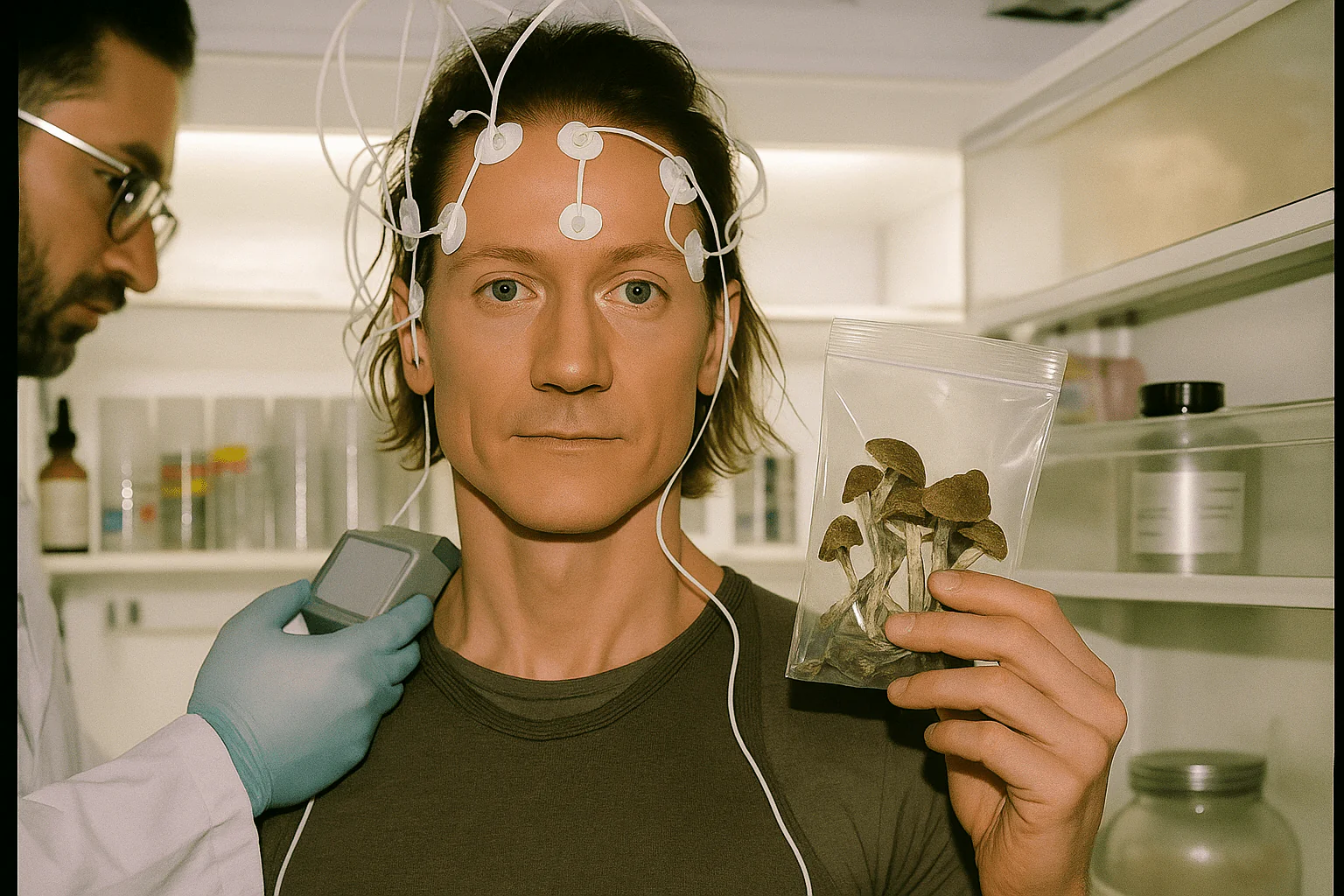
Blinding in clinical trials exists to control for expectancy bias. Expectancy bias is the simple, well documented fact that if you expect to get better, you often do, at least partially. That’s true for placebo, it’s true for conventional antidepressants, and it’s especially true for microdosing, where the drug effect is subtle enough that belief can do a lot of the heavy lifting.
But at large, full doses of a classic psychedelic, blinding usually fails. People know what they’ve taken. Researchers call this functional unblinding, and it’s become one of the biggest methodological problems in the field.
It’s the reason the FDA’s advisory committee voted so heavily against recommending approval for Lykos Therapeutics’ MDMA therapy for PTSD, and the reason the FDA has now issued formal 2026 guidance requiring active placebos and expectancy controls in future trials.
Given all that, you’d expect expectancy to run wild in psychedelic studies since people can so easily tell which arm they’re in. But that’s not the case.
Where it gets strange
In the Imperial College head to head trial comparing psilocybin therapy with escitalopram for depression, Szigeti, Carhart-Harris, and colleagues found something odd. Patients expected far more from psilocybin than from escitalopram going in, no surprise there. But when they actually checked whether that expectation predicted outcome, it didn’t. Higher hopes for escitalopram tracked with better results on the escitalopram arm, exactly what standard placebo theory predicts. On the psilocybin arm, expectancy and outcome were essentially unrelated.
If anything, the relationship ran slightly the wrong way, with higher pre-trial hopes nudging toward worse results, though not to a level the study could confirm with confidence.
Similar observations have emerged in a handful of other small studies, including work in fibromyalgia, early anorexia research, and scattered findings around bipolar disorder and mindfulness based psychotherapy paired with psychedelic treatment for depression.
Now, this isn’t yet a robust literature. The studies are small, heterogeneous, and mostly not designed to test this question directly. But it’s notable that the same trend keeps turning up.
The recent anorexia nervosa trial is a good example of how this tends to look in practice. Across three separate expectancy measures, checked against eating disorder symptom scores and readiness to change at six weeks and six months, the researchers found essentially nothing. The null held in 14 of 15 comparisons.
The one exception, a moderate negative correlation between confidence in psilocybin’s effects and later readiness to change, was flagged by the authors themselves as likely spurious once you account for the number of comparisons run. That’s a trial actively looking for an expectancy effect and mostly failing to find one, which is a different kind of evidence than a trial that simply didn’t check.
Robin Carhart-Harris, who has now seen this pattern across several of his own trials, put it bluntly when this particular result did the rounds. He’s hoping people stop repeating the idea that psychedelic therapy’s effect is just a placebo-flavoured self-fulfilling prophecy, since the evidence keeps failing to back that up.
An explanation
One possible interpretation, inspired by the REBUS framework (Carhart-Harris and Friston’s model of how psychedelics affect belief updating in the brain), is that psychedelics may temporarily weaken the precision of deeply held beliefs, making even long standing self models more open to revision. In depression, the mind can settle into stories that feel like facts rather than interpretations. Nothing will work for me. Psychedelics won’t work either. These beliefs stop functioning as predictions about the world and start becoming identity.
It’s almost as though the experience ignores whether the belief going in was optimistic or pessimistic, and instead destabilizes whichever beliefs have become most rigid, regardless of whether someone walked in hopeful or resigned. It’s a plausible explanation that fits the data so far.
Interestingly, the same Imperial trial found that trait suggestibility, not expectancy, predicted who responded well to psilocybin. Importantly, suggestibility isn’t the same thing as simply believing the treatment will work. It reflects a broader openness to adopting new perspectives or revising existing mental models. It suggests the people who benefit most aren’t necessarily the ones who believed hardest going in, but the ones whose minds are more permeable to being restructured once the drug takes hold.
Final thoughts
Normally we think expectation shapes experience, what you expect colors what you go on to feel. REBUS suggests something closer to the reverse. That the experience reshapes the expectation that follows it, rather than the expectation dictating the experience. That’s quite profound.
None of this proves psychedelics are somehow immune to belief, but it does complicate the tidy story that psychedelic trial results are just an elaborate placebo effect. If the pattern holds up in larger trials, it could mean psychedelics work on beliefs directly, rather than simply amplifying whatever beliefs you already have.
This has implications well beyond trial design. It would suggest psychedelic therapies may be capable of helping people who arrive deeply skeptical, or convinced that nothing can help them, a group for whom conventional expectancy driven treatments often struggle the most.
Psychedelics appear to be paradigm-shifting compounds in more ways than one. They may not simply change how we treat mental illness, but how we think lasting psychological change happens in the first place.
Keep up with the research here.