There’s a moment, somewhere in the ascent of a psilocybin experience, where you can almost feel your brain changing gears. The mental chatter quiets. Something else takes over. It’s not like alcohol, not like cannabis. It’s more like deep meditation.
For decades, people have been describing this shift. What’s been missing is the mechanics. What exactly is happening in the electrical activity of the brain when psilocybin does its thing? And why does the same dose feel profoundly meaningful to one person and merely disorienting to another?
A new study, published in Progress in Neuro-Psychopharmacology and Biological Psychiatry by Cheng-Teng Ip and Sebastian Olbrich from the University of Macau and the University of Zurich, has gone further than most in answering these questions.
The Setup
Twenty-five healthy volunteers were part of the double-blind crossover experiment. Each had one session with psilocybin (10-20mg adjusted for body weight), and one with a placebo, with fourteen days between them. Before and during each session, participants wore EEG caps – small sensors measuring the brain’s real-time electrical activity.
They also completed the Altered States of Consciousness Questionnaire, a well-validated instrument for mapping the texture of psychedelic experience: feelings of unity, visual and auditory changes, anxiety, what researchers call “oceanic boundlessness” (the sense of dissolving into something larger than yourself).
The question was straightforward: do the measurable changes in brain electrical activity actually track what people are experiencing? And can you predict, before someone takes the drug, how intense their experience is going to be?
Two Waves
When participants were on psilocybin, the researchers saw a clear and consistent pattern. Slow brain waves (theta and alpha) decreased. These are the rhythms typically associated with relaxed, unfocused, idling states. Your brain produces them when you’re daydreaming, drifting, or settling into a quiet evening. They’re the neural signature of low engagement.
At the same time, fast brain waves (beta and gamma) increased significantly. These are the rhythms of active processing. Focused attention. Complex information handling. High arousal.
In other words, psilocybin doesn’t sedate the brain. It does the opposite. It shifts the brain from rest to something like high-resolution engagement. Except the processing isn’t outward, it’s inward. The brain is running hard, but the content it’s working on is experiential, emotional, associative. Ip and Olbrich describe it as “a more dynamically engaged brain state, possibly reflecting the vivid internally generated experiences that occur during the psychedelic state.”
This fits what we know about neuroplasticity. The brain forms new connections most readily under conditions of active engagement, when it’s being pushed to process novel, complex, emotionally significant material. Psilocybin appears to create exactly that neurological environment, which likely explains a lot of its therapeutic promise.
Default Mode Network
The researchers also looked at how different brain regions were communicating with each other. Specifically the default mode network, or DMN.
The DMN is the brain’s internal narrator. It’s most active when you’re not focused on anything external. When you’re ruminating, self-reflecting, imagining yourself in the future, or spinning a story about who you are. In depression, it tends to become overactive and rigid, running the same loops, reinforcing the same negative self-perceptions. Most effective antidepressants, one way or another, seem to quiet or disrupt it.
Under psilocybin, Ip and Olbrich found that connectivity within the DMN increased significantly. Regions that normally communicate with each other became even more tightly linked. They also found similar increases in the parietal lobe, which is an area involved in integrating sensory information and, interestingly, in the sense of bodily self.
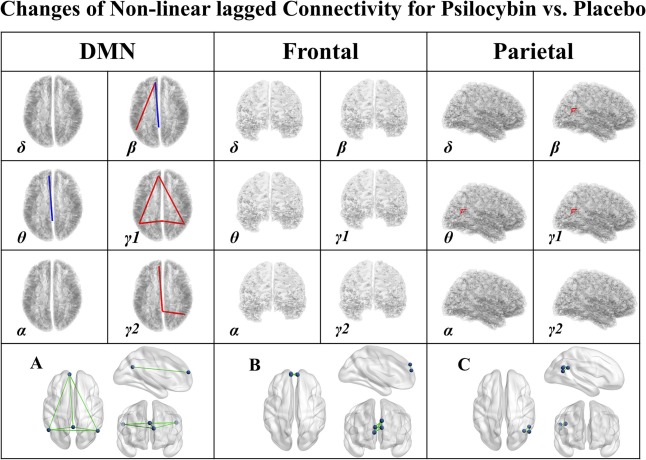
What that might mean experientially is the dissolution of rigid self-narrative. When the DMN becomes both more active and more integrated, the internal sense of “I” doesn’t disappear, it becomes more fluid, less defended, more open to reinterpretation. This is a plausible mechanistic account of why people report “mystical” insights about themselves during psychedelic experiences that seem to stick.
Correlation
The researchers also found that changes in brain activity correlated directly with the intensity of the subjective experience. Participants who showed the strongest shifts in their brainwave patterns also reported the most intense psychological effects. The correlation ran across multiple dimensions, meaning the more gamma activity spiked, the more people reported oceanic boundlessness, that sense of deep unity and meaning.
That’s significant. It’s one thing to say psilocybin changes the brain. It’s another to show that those changes are the experience. That what’s happening electrically and what’s happening phenomenologically are the same story told in two languages.
But especially interesting is that baseline brain activity before taking the drug predicted how strongly people would respond to it.
Individuals with higher resting-state fast-wave activity in the frontal and emotional centres of the brain tended to report more profound psychological alterations after taking psilocybin. So the brain’s starting position – its default electrical personality before psilocybin had entered the system – shaped the journey.
This is an important finding for making psychedelic-assisted therapy more effective. Not everyone needs the same dose. Not everyone will respond the same way. And if we can measure, before treatment, which patients are most likely to have the kind of experience that drives therapeutic change, we can stop treating this like a blanket intervention and start treating it like a calibrated, targeted, and personalised tool.
Convergence
A large scoping review published around the same time found that when people spend time in natural environments, their brains shift into a measurably different state. Slower rhythms dominate, alpha and theta waves increase, and the amygdala quiets. The prefrontal regions associated with rumination go offline and the default mode network becomes more internally coherent.
It’s almost a mirror image of what Ip and Olbrich observed under psilocybin, just in the opposite direction. Psilocybin suppresses alpha and theta, elevating the brain into high-arousal engagement. Nature does something complementary: it suppresses the stress rhythms of beta and brings the brain into calm, integrated coherence.
On the surface that looks like a contradiction. But the more interesting interpretation is that they’re two different on-ramps to the same destination. Which is a brain that is less defended, less rigid, and more open to change.
You see, both states share the same DMN signature. Under psilocybin, default mode network connectivity increases and becomes more coherent. In nature, it does too. Whatever else differs between the two states, the brain’s internal narrative network becomes more integrated in both. That coherence appears to be the common currency of restoration.
Both also attenuate the threat-detection machinery. Psilocybin quiets amygdala reactivity. So does nature. The subgenual prefrontal cortex (the region most implicated in ruminative, self-critical thinking) steps back in both cases. The brain’s defensive, vigilance-oriented circuitry disengages, and something more open takes its place.
The researchers behind the nature review explicitly note this overlap with psychedelic and meditative states, describing them as part of the same broader family of restorative brain configurations. They introduce an elegant term for what natural environments do: “spontaneous regulators” of the nervous system. You don’t have to do anything. You just have to be there, and the system self-corrects. The environment does the work.
What this suggests is that psilocybin and nature may be complementary rather than interchangeable. Psilocybin looks like an active, high-intensity reconfiguration. Nature looks like passive restoration. One is something like a controlled burn. The other is the conditions that allow regrowth afterward.
Which brings us back to the baseline finding from the Ip and Olbrich study. If your pre-dose brain state shapes the intensity and character of a psilocybin experience, then the chronic conditions of modern life may be quietly degrading the very conditions that make psychedelic healing possible. A brain that is chronically beta-dominant and amygdala-activated arrives at the session in a fundamentally different starting position than one that has been regularly exposed to the restorative complexity of the natural world.
Beyond the Clinic
There’s a tendency to frame psilocybin research entirely in terms of what it can fix. And those applications are real and important. But there’s an implication in studies like this that deserves equal attention.
We are starting to map, in real time, the electrical signature of profound human experience.
The sensation of unity now has a corresponding pattern in brain wave activity. The feeling of meaning and emotional reconnection that participants describe after psilocybin sessions isn’t some ineffable mystery. It’s correlated with measurable changes in gamma coherence and default mode connectivity. It can be tracked, potentially predicted, and, perhaps, cultivated.
That’s not reductive. If anything, it’s the opposite. It’s taking seriously the claim that these experiences of what the researchers call “oceanic boundlessness” are real, neurobiologically substantive events. Not side effects. Not noise. But signal.
If you’re genuinely curious about the science, culture, and evolving story of fungi, The Spore Report is worth your time — a newsletter that covers the research and ideas without the hype.
Read The Spore Report →