
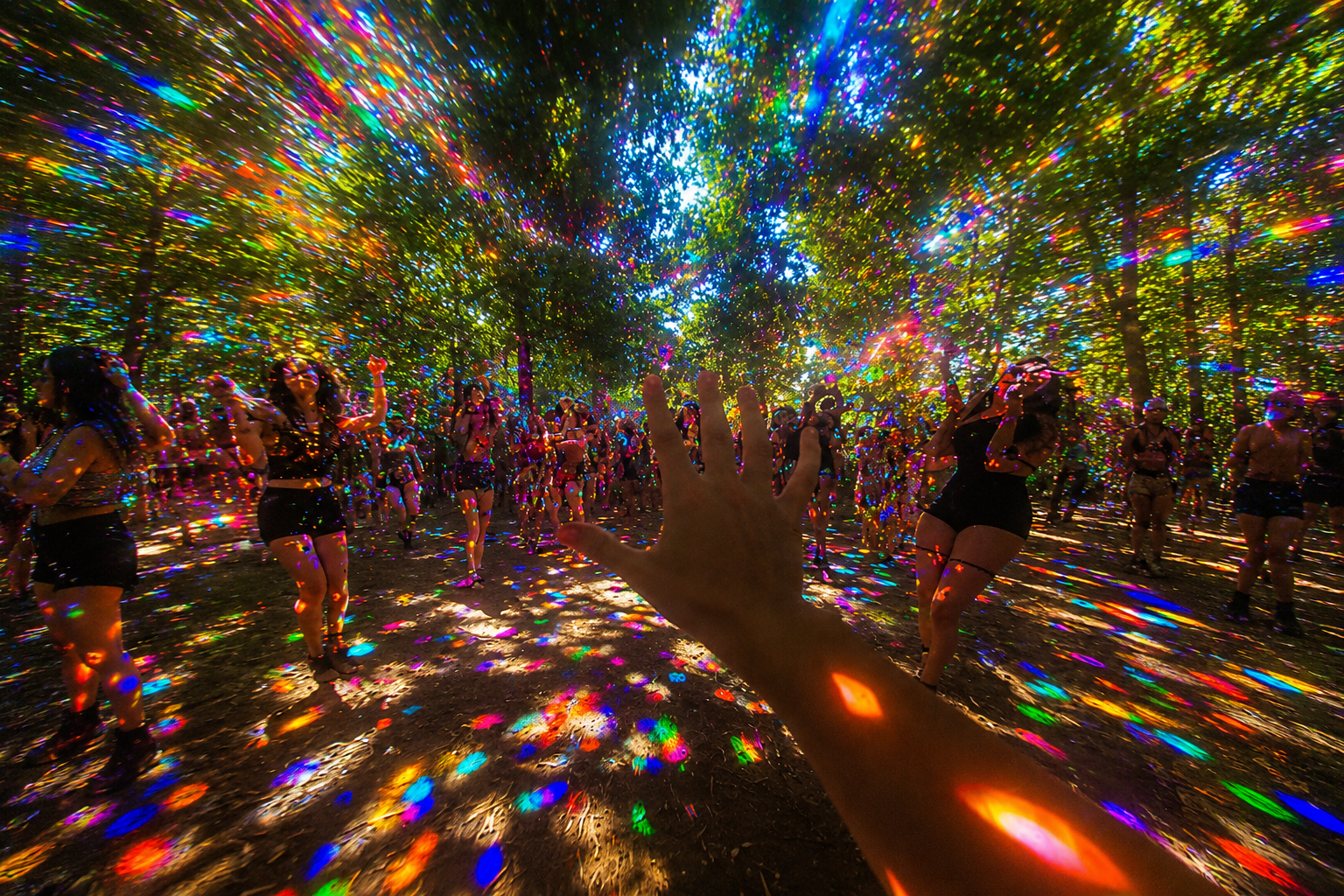
Most people picture psychedelic therapy as something that happens in a beige room with a therapist nearby and mood lighting calibrated to within an inch of its life.
A new study suggests the real world is already running its own version, and it’s working.
Published in Progress in Neuro-Psychopharmacology and Biological Psychiatry, the research followed 85 adults with histories of childhood maltreatment who took psychedelics at group events (organised ceremonies and raves/EDM festivals) with an explicit therapeutic intention. Two months later, they showed large reductions in PTSD and complex PTSD symptoms, significant drops in internalised shame, and marked increases in feelings of connection to self, others, and the world.
All three outcome areas fell into what researchers call the “large effect size” range.
Why group settings might matter for this kind of trauma
Complex trauma, particularly trauma rooted in childhood neglect or abuse, is categorically different from single-incident PTSD. It tends to fragment the sense of self, disrupt emotional regulation, and leave people with a persistent, bone-deep feeling of being fundamentally flawed. The clinical term is internalised shame. It’s less “I did something bad” and more “I am something bad.”
This is vital because both ceremonies and raves are environments built around radical acceptance, communal vulnerability, and shared altered states. The researchers weren’t comparing these settings arbitrarily. They noted that despite looking very different on the surface, both environments share meaningful structural features: overnight duration, rhythmic trance-inducing music, prosocial norms that encourage emotional openness, and a kind of collective ritual container.
Lead author CJ Healy described this as a “socially mediated therapeutic experience.” The social architecture of the setting isn’t incidental, it’s potentially load-bearing.
And crucially, it didn’t matter whether participants attended a ceremony or a rave. Outcomes were equivalent across both.
What predicted the strongest improvements
Dose predicted the intensity of the acute experience. But dose alone did not predict long-term improvements. What did predict lasting change was the quality and depth of the subjective experience itself: ego dissolution, oceanic boundlessness, emotional breakthrough, psychological insight, and (notably) communitas, which researchers define as a sense of profound shared humanity and group togetherness.
The people who felt most genuinely connected to the group around them during the experience tended to be the ones who showed the greatest reductions in shame and trauma symptoms two months later. For a condition rooted in relational wounding, healing seems to come through relational experience.
What this doesn’t prove
The study has limitations. There’s no control group, so we can’t isolate the psychedelic from the setting. The improvements could partly reflect placebo effect, or simply the benefit of attending a supportive communal event full stop. Self-reported data on symptoms and dosage carries obvious constraints, especially in naturalistic settings without drug testing.
Longer follow-up would also help. Two months is encouraging, but it doesn’t tell us whether these gains hold at six months or a year.
What the study does offer is a methodologically serious attempt to map the mechanism. The cascade it describes, dose → subjective intensity → psychological transformation → lasting symptom reduction, is consistent with what controlled trials are finding.
The bigger picture
Clinical psychedelic research is essential. But it captures a narrow slice of how these substances actually get used, and it tends to treat the social dimension as noise to be controlled rather than signal to be studied.
This research treats the social dimension as central. The setting is part of the medicine.
For the millions of people with complex trauma histories who will never access a clinical trial or a $3,500 ketamine infusion, the question of what naturalistic psychedelic use can offer, under what conditions, and with what safeguards, is not an academic one.
The study, “Acute subjective effects of psychedelics in naturalistic group settings prospectively predict longitudinal improvements in trauma symptoms, trait shame, and connectedness among adults with childhood maltreatment histories,” was authored by C.J. Healy, Aaron Frazier, Stephen Kirsch, Anna Sanford, Albert Garcia-Romeu, McWelling Todman, Jeremy Varon, and Wendy D’Andrea.

Interesting 🤔
I want to be part of the testing .. I have PTSD , depression